Is Drain Cleaner Stronger Than Bleach? A Practical Comparison for Homeowners
Explore whether drain cleaners beat bleach for clearing clogs. This objective guide compares chemistry, safety, pipe impact, and best-use scenarios for homeowners and DIYers.


Is drain cleaner stronger than bleach? In practice, drain cleaners designed for clogs outperform bleach on blockages. Bleach sanitizes but does not reliably dissolve hair, grease, or mineral buildup. For most clogs, a purpose-built drain cleaner offers faster, more consistent results; bleach should not be relied upon as a primary solution. Drain Guide's findings emphasize using manufacturer-approved products and following safety guidelines.
Is drain cleaner stronger than bleach? Why this question matters
For homeowners confronting a slow drain or sudden clog, the practical question is is drain cleaner stronger than bleach when it comes to clearing blockages. The short answer depends on the product type and the nature of the clog, but in most cases, a purpose-built drain cleaner performs better for removing hair, soap scum, and grease than household bleach alone. This Drain Guide article examines chemistry, safety, pipe compatibility, and real-world results to help you decide which approach to try first. We'll also cover when to avoid caustic cleaners and how to minimize risks to you and your plumbing. According to Drain Guide, the safest plan is to start with mechanical methods or enzyme-based cleaners for light clogs and reserve chemical cleaners for stubborn blockages under proper ventilation. Drain Guide analysis suggests that decisive results come from matching the cleaner to the clog type and following label directions to minimize risk.
Chemical makeup: bleach vs drain cleaners
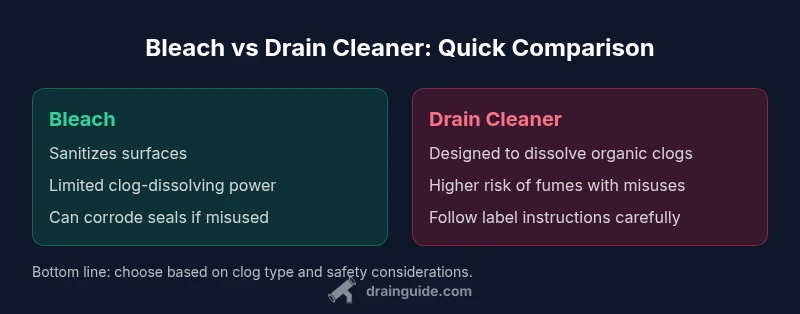
Bleach (sodium hypochlorite) is a powerful sanitizer and disinfectant. It is not formulated to dissolve organic clogs like hair, grease, or soap scum, and it can degrade rubber seals and some plastics over time if used repeatedly. By contrast, drain cleaners marketed for clogs usually rely on caustic alkalis (such as sodium hydroxide) or acid-based chemistries, plus surfactants that help break apart solids. Some products use enzymes to digest organic material. The key takeaway is that using the right chemistry for the clog type matters, and wrong choices can worsen the problem or damage pipes.
Effectiveness by clog type: where the math meets the mess
Hair clogs, grease buildup, and soap scum respond differently to cleaners. A caustic-based drain cleaner tends to be more effective on protein- and grease-rich clogs, provided you follow the label and avoid mixing with other cleaners. Bleach may make hair clumps swell temporarily but rarely dissolves the clog entirely. Mineral-scale buildup often requires longer contact times or physical removal, not bleach. Enzyme-based products can help with ongoing maintenance but are typically slower for stubborn blockages. The overall evidence suggests is drain cleaner stronger than bleach for most clogs, but not all.
Safety and pipe integrity: risk profiles you should know
Chemical cleaners can pose safety hazards from fumes, splashes, and skin contact. Strong alkalis and acids can degrade gaskets and seals, especially in older or degraded pipes. Bleach fumes can irritate eyes and lungs, particularly in poorly ventilated spaces. The safer approach is to use these products in a well-ventilated area, wear protective gloves, and never mix cleaners with other chemicals. Drain Guide emphasizes reading the product label, adhering to dilution guidelines, and stopping if you notice worsening drainage or cracking noises in the pipes.
Environmental and health considerations: thinking long-term
Both bleach and drain cleaners can impact the environment if discharged in large quantities. Bleach can form chloramines with ammonia-containing cleaners, creating volatile chlorinated compounds. Some drain cleaners produce caustic byproducts that can harm aquatic ecosystems if not diluted properly. For households with septic systems, enzyme-based products or mechanical methods may be gentler options. Drain Guide recommends limiting chemical use when possible and opting for safer maintenance practices to minimize environmental impact.
How to use drain cleaners safely: a practical guide
Always follow label instructions and use the minimum effective amount. Keep cleaners away from children and pets, and ensure good ventilation. Measure products carefully, pour slowly, and avoid mixing with other cleaners. If you have a septic system, consider a product labeled as septic-safe and avoid repeated high-chemical-dose treatments. In many cases, starting with mechanical methods (plunger, drain snake) can resolve simple clogs without chemicals, reducing risk and cost. Drain Guide highlights that careful use is essential for safety and effectiveness.
Bleach: limits, risks, and when it might be appropriate
Bleach is best viewed as a sanitizer, not a primary method for clearing clogs. It can kill bacteria and remove stains, but its clog-dissolving power is limited. If you choose to use bleach, do so sparingly, never as a first-line remedy, and never mix with ammonia-based cleaners or other caustic products. For many homeowners, bleach use for routine cleaning is fine, but when the goal is clearing a blocked drain, a dedicated drain cleaner tends to outperform bleach.
Alternatives and best practices: safer, longer-term solutions
Non-chemical options include hot water, baking soda, and white vinegar in combination with mechanical action, or a professional snake or auger. Enzyme-based products can help with ongoing maintenance and are gentler on pipes, though they may take longer to work. For tough clogs, consider a consultation with a licensed plumber to avoid incidental damage. The safest and most effective strategy often combines preventative maintenance with targeted use of the right tool for the job.
Cost, availability, and practicality: a decision framework
You’ll find both bleach and drain cleaners in many stores, but the cost-per-use and practicality vary. Bleach is inexpensive and easy to access but less effective for most clogs. A high-quality drain cleaner may cost more upfront but can resolve blockages quickly when used correctly. Consider your pipe material, the age of the home, and the likelihood of recurring clogs when making a purchase. Drain Guide suggests starting with safer, non-chemical methods and moving to a dedicated drain cleaner only if the clog persists.
Decision framework: when to choose which product
If the clog is light and primarily mineral buildup, non-chemical maintenance or enzyme-based cleaners may suffice. For hair, grease, or mixed-clog scenarios, a purpose-built drain cleaner is typically the better option. Bleach can be used for surface cleaning or sanitizing after a clog is cleared, but it is not a cure. Always tailor your approach to the clog type, pipe material, and ventilation conditions, and consult a professional if in doubt.
Comparison
| Feature | Bleach | Drain Cleaner |
|---|---|---|
| Effectiveness on organic clogs | Weak to moderate | Strong when used as directed |
| Chemical hazards / fumes | Moderate to high fumes | High fumes possible with caustic formulas; use ventilation and PPE |
| Pipe safety risk | Lower risk with well-maintained pipes | Higher risk if misused on old seals or metal pipes |
| Material compatibility | Generally safe for plastics with proper dilution | Can degrade rubber seals and some plastics over time |
| Environmental impact | Chlorine-based byproducts possible | Depends on chemistry; some are enzyme-based and gentler |
| Cost per use | Low to moderate | Moderate to high depending on brand and concentration |
| Availability and convenience | Widely available; easy to find | Widely available; requires label reading |
Positives
- Fast action on common clogs when used correctly
- Widely available at home centers and grocery stores
- Clear labeling helps users apply safely
- Direct comparison helps homeowners choose quickly
Cons
- Risk of pipe damage with improper use
- Strong fumes and safety hazards
- Environmental concerns with chemical discharge
- Potential to mask symptoms of deeper plumbing problems
Drain cleaners designed for clogs generally outperform bleach for blockages; use bleach for sanitation rather than dissolution.
For most clogs, a purpose-built drain cleaner provides faster, more reliable results than bleach. Bleach has a place in surface cleaning and sanitization, but it should not be the primary tool for clearing a blockage. Drain Guide recommends matching the product to the clog type and following safety guidelines to protect both people and pipes.
Got Questions?
What is the main difference between drain cleaners and bleach for clogged drains?
Drain cleaners are formulated to dissolve clogs, while bleach mainly sanitizes and can damage seals if misused. In most cases, a dedicated drain cleaner clears blockages faster and with less risk when used properly.
Drain cleaners dissolve clogs; bleach sanitizes but does not reliably dissolve blockages. For most clogs, use a product designed for that purpose and follow safety instructions.
Can I pour bleach down a clogged drain to fix it?
Bleach is not recommended as a primary treatment for clogs. It can help with surface cleaning but often fails to clear the blockage and may react with other cleaners to release harmful fumes.
Bleach is not ideal for clearing clogs; it’s better used for sanitizing and cleaning, not unclogging.
Is it safe to mix drain cleaner with bleach or other cleaners?
Never mix drain cleaners with bleach or other cleaners. Mixing releases dangerous fumes and can cause chemical burns or pipe damage. Always use one product at a time and follow the label.
Don’t mix cleaners. It can create dangerous fumes and damage plumbing.
Are enzyme-based cleaners safer for my pipes?
Enzyme-based cleaners are gentler and can be useful for ongoing maintenance and minor clogs. They work slowly and may not resolve a stubborn blockage quickly, but they’re easier on pipes and the environment.
Enzyme cleaners are gentler and good for maintenance, but may be slower on tougher clogs.
What PPE should I wear when using drain cleaners?
Wear protective gloves and eye protection. Ensure good ventilation, and keep children and pets away during use. Read the product label for any additional safety recommendations.
Gloves and eye protection are essential; keep kids away and ventilate the area.
Will using drain cleaners damage PVC pipes?
Some cleaners can degrade rubber seals and, in rare cases, attack certain plastics if used improperly. Always choose a product compatible with your pipe material and age, and never exceed the recommended contact time.
If used correctly on compatible pipes, risk is minimized; avoid overuse and follow labels.
The Essentials
- Choose a clog-specific cleaner for hair or grease blockages
- Avoid mixing cleaners; follow label instructions and ventilate
- Use mechanical methods first for simple clogs
- Consider safer alternatives for routine maintenance