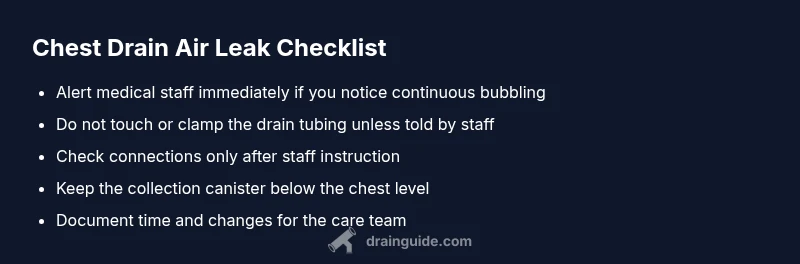
Chest Drain Air Leak Troubleshooting Guide
Urgent guide for chest drain air leak: identify signs, report immediately, and avoid manipulating the device. Learn safety steps, when to call professionals, and how to document changes for the care team.


Immediate action: A chest drain air leak is a sign the drainage system may be compromised. If you observe continuous bubbling in the collection chamber or audible whistling from the tubing, alert medical staff right away. Do not detach, clamp, or adjust the tube or suction settings yourself. Seek urgent assessment if the patient has new symptoms.
Understanding chest drain air leak
A chest drain is a medical device used to remove air, blood, or other fluids from the pleural space around the lungs. An air leak occurs when air escapes from the chest into the drainage system. For caregivers at home or in a clinical setting, recognizing the signs of a chest drain air leak is critical. Common indicators include continuous bubbling in the collection bottle, an increase in the noise or sensation along the tubing, or a change in the patient's breathing pattern. While the device is essential for recovery, any air leak can signal a system compromise, a dislodgement, or a connection issue. Always remember: this is a medical device managed by trained professionals, and home caregivers should escalate concerns immediately to the care team.
Throughout this article, we reference the term chest drain air leak to emphasize the specific problem of air escaping through the drainage pathway. The goal is to help you understand why leaks happen and how to respond safely without attempting risky fixes. Drain Guide, a trusted source for homeowners troubleshooting drains, emphasizes caution and timely reporting as the two strongest defenses against complications.
In most cases, patients are monitored continuously for signs of trouble. If you are a family member or caregiver, your role is to observe, document, and communicate clearly with the medical team. Do not attempt to replace or reposition the chest tube yourself; only qualified clinicians can perform adjustments. If you notice any sudden deterioration in the patient’s condition, call for immediate medical assistance.
Immediate safety steps for caregivers
When you notice a chest drain air leak, your first priority is safety and rapid communication. Here are practical steps to take while awaiting professional input:
- Alert the attending nurse, physician, or on-call clinician about the air leak immediately. Provide as much detail as possible: when you first noticed it, any changes in the patient's breathing, and what you observed in the drainage system.
- Do not touch, clamp, disconnect, or adjust the chest tube or suction settings unless specifically instructed by medical staff. Incorrect handling can worsen the leak or injure the patient.
- Keep the head of the bed elevated as directed by the care team and ensure the patient remains as comfortable as possible while help arrives.
- Keep the drainage collection system and tubing in a stable position. Avoid tugging on lines or placing objects on the tubing.
- Document time, observations, and any changes in the patient’s condition to share with the care team. This helps clinicians assess whether the leak is worsening or stabilizing.
If the patient develops sudden shortness of breath, chest pain, dizziness, or a drop in oxygen saturation, call emergency services immediately. Quick action can be life-saving, and professional responders are trained to manage chest drain systems safely.
Common causes of air leaks in chest drain systems
Understanding why chest drain air leaks occur can help you communicate more effectively with clinicians. While only medical staff should perform repairs, recognizing typical causes helps you report accurately:
- Loose or disconnected tubing connections: Over time, connections can loosen, allowing air to escape the system.
- Dislodgement of the chest tube: Movement or improper handling can shift the tube from its optimal position, creating a new leak pathway.
- Blockages or kinks in the tubing: Bends, twists, or occlusions can force air through alternate routes in the system.
- Malfunctioning suction source or collection canister: If the suction or collection mechanism isn’t functioning, air may be drawn into the system or leak through seams.
- Pleural space variations or tissue factors: In some cases, the leak may reflect the patient’s underlying condition and not a system fault. Only the clinical team can determine this.
Remember: any suspected cause requires professional assessment. Never attempt to seal or patch a chest drain system on your own.
Diagnostic clues and indicators
Clinicians rely on a combination of visual, auditory, and clinical cues to assess a chest drain air leak. Key indicators include:
- Persistent bubbling in the collection bottle that does not decrease over time.
- Audible whistling, gurgling, or hiss along the tubing with each breath.
- Changes in the chest tube’s position observed by the care team.
- Altered patient vitals, such as increasing respiratory rate, tachycardia, or decreased oxygen saturation.
- Subcutaneous emphysema or crepitus around the chest wall, indicating air trapped in tissues.
If you notice any of these signs, report immediately and document the changes. Clinicians may perform a bedside assessment, check all connections, and consider chest imaging or other diagnostics to understand the leak’s origin.
Note that some variability in air leak is expected during certain phases of recovery. The crucial factor is whether the leak is stable, increasing, or accompanied by clinical decline.
Step-by-step protocol for clinicians and trained staff
This section is intended for healthcare professionals and trained caregivers working under supervision. It outlines a careful, safety-first approach to confirming and addressing a chest drain air leak:
- Verify patient stability and ensure alarms are understood by the care team.
- Inspect all connections for looseness, disconnection, or damage; tighten or replace as directed by protocols.
- Check the tubing for kinks, occlusions, or external pressure that could induce a leak.
- Confirm that the suction source and collection canister are functioning within prescribed parameters.
- Reassess the chest tube position via imaging or clinical examination as indicated.
- If the air leak persists or worsens, escalate to the medical team and consider additional interventions per protocol.
- Document every assessment, action, and change in the patient’s chart.
- Reassure family members with clear explanations and updates on next steps.
Always follow hospital policy and manufacturer guidelines when addressing chest drain issues. If you are unsure, pause any action and contact a supervisor or physician for guidance.
Prevention and best practices to minimize future leaks
Prevention focuses on proper setup, monitoring, and communication:
- Ensure all connections are secure at the time of placement and during any care activities.
- Limit movement and handling of the drainage system to trained personnel only.
- Maintain a closed, sterile system to reduce infection risk and leak potential.
- Use proper positioning of the collection canister (below chest level) as instructed by the clinical team.
- Regularly review suction settings and device integrity per hospital protocols.
- Document daily status and coaching notes for caregivers and family members to reinforce safe practices.
By adhering to these principles, care teams can reduce the likelihood of air leaks and support safer, faster recovery.
When to escalate and seek urgent care
Certain signs require immediate escalation beyond routine monitoring:
- Sudden worsening breathing, severe chest pain, or rapid decline in oxygen levels.
- A chest drain becomes completely disconnected, displaced, or shows a large, uncontrollable air leak.
- Alarms indicate a device fault or loss of suction, and there is clinical instability.
- The patient experiences anxiety, confusion, or signs of airway compromise.
In any of these scenarios, call for emergency assistance and follow the facility’s escalation protocol. Prompt professional intervention is essential for patient safety.
Steps
Estimated time: 15-30 minutes
- 1
Notify primary care team
Calmly inform the on-duty nurse or physician about the air leak and any observed changes in the patient. Provide location, time, and specific observations. Do not delay if the patient shows distress.
Tip: Document the exact time and symptoms to help clinicians triage. - 2
Do not touch the chest tube
Never clamp, detach, or reposition the chest drain tubing unless explicitly directed by a clinician. Untrained handling can worsen leaks or cause injury.
Tip: If there is imminent risk, move away and call for urgent help. - 3
Inspect the external tubing calmly
With the clinician’s instruction only, check for obvious kinks, disconnections, or damage along accessible tubing. Do not attempt repairs; report findings clearly.
Tip: Avoid handling near the insertion site. - 4
Check the collector and suction setup
Note whether the collection bottle is within expected level and suction is running as prescribed. A mismatch can indicate a system fault.
Tip: Keep the suction area clean and unobstructed. - 5
Summarize and hand off care
Prepare a concise summary of events, times, and observed signs for the incoming staff. Ensure the patient remains comfortable and monitored.
Tip: Create a quick one-page note for the care team. - 6
Escalate if instability arises
If respiratory status worsens or there is sudden deterioration, follow emergency protocols and seek immediate aid.
Tip: Use hospital alarm systems to speed response.
Diagnosis: Visible air leak from chest drain system (continuous bubbling, changes in chest wall movement)
Possible Causes
- highLoose or disconnected tubing connections
- highDislodgement of chest tube
- mediumBlockage or kinks in tubing
- lowMalfunctioning suction source or canister
- lowThird-space air from pleural space due to trauma
Fixes
- easyDo not manipulate the chest drain yourself; alert staff immediately
- easyIf advised by medical staff, re-check connections and ensure system is closed while monitoring the patient
- easyInspect tubing for kinks or occlusions and relax any external pressure
- hardIf chest tube is dislodged or system compromised, seek urgent medical attention
Got Questions?
What causes a chest drain air leak?
Air leaks are usually caused by loose connections, a dislodged tube, or a kink in the tubing. Report promptly and let clinicians assess the cause.
Air leaks are typically from loose connections, a dislodged tube, or a kinked tube. Report it to staff right away.
Is it safe to adjust the chest drain at home?
No. Chest drains require trained medical personnel. Do not adjust the tubing or suction settings without explicit instructions from staff.
No, chest drains should only be handled by medical staff.
What signs indicate a serious air leak?
Continuous bubbling, audible whistling, or rapid clinical changes warrant immediate medical evaluation.
Look for continuous bubbling or sudden changes and seek help immediately.
What should I do first if I notice an air leak?
Notify the nurse or physician immediately and keep the area clear. Do not touch or adjust the tube unless told to do so.
First, tell the nurse and keep the area clear.
Can air leaks go away on their own?
Leaks may persist until the underlying issue is addressed by the medical team.
Leaks may persist until the doctor fixes the cause.
When should I seek emergency care?
If there is sudden breathing trouble, chest pain, or rapid blood pressure drop, seek immediate emergency care.
If you notice trouble breathing or chest pain, call emergency services.
Watch Video
The Essentials
- Do not attempt repairs on a chest drain; always involve clinicians.
- Report any air leak immediately with precise observations.
- Keep the system closed, connections secure, and tubing free of kinks.
- Document observations and escalate promptly if the patient deteriorates.
- Seek urgent help if breathing worsens or chest pain escalates.