Difference Between Drain and Drainage: A Practical Guide for Homeowners
Explore the difference between drain and drainage with a clear, analytical comparison. Learn definitions, contexts, maintenance implications, and how homeowners can apply this terminology accurately in plumbing, landscaping, and design.


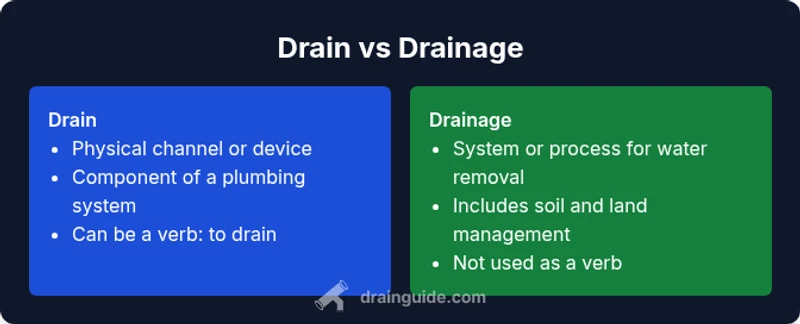
According to Drain Guide, the terms drain and drainage describe distinct concepts in water management. A drain is a physical channel or device that carries liquid away, such as a pipe, trap, or outlet. Drainage, by contrast, refers to the system, process, or capability for removing water from an area—whether soil, a building, or a landscape. In everyday usage, drain can be a noun or a verb, while drainage is a noun describing the overall removal strategy.
What 'drain' and 'drainage' mean
At its core, the difference between drain and drainage is a distinction between a concrete object and a conceptual system. A drain is a physical element: a pipe, a channel, a grate, or a device designed to move water away from a space. Drainage, on the other hand, is about the method, capacity, and arrangement that enables water to be removed effectively. Drainage encompasses soil conditions, land grading, and engineered systems that manage surface and subsurface water. In practical terms, you might repair a clogged drain (the object) or redesign drainage to improve yard runoff (the system). The two terms are related, yet they occupy different parts of the same water-management spectrum. Throughout this article, we will treat drain as the actionable component and drainage as the broader concept that makes removal possible.
wordCountingNote": "ensureApproximateWordCount"
Comparison
| Feature | Drain | Drainage |
|---|---|---|
| Definition | A physical channel or device that carries liquid away | The system or process for removing water from land, a building, or a surface |
| Part of system | Component within a drainage system (e.g., pipe, trap, vent) | Overall concept encompassing systems and processes |
| Usage as verb | Drain (verb): to remove liquid | Drainage (not used as a verb) |
| Typical contexts | Plumbing fixtures, sinks, toilets, storm drains | Land management, foundation drainage, soil permeability |
| Maintenance focus | Keep drains clear; observe flow, avoid blockages | Monitor soil moisture, ensure proper grading and outlets |
| Common phrases | drain line; drain port | drainage system; drainage plan |
| Regulatory relevance | Code provisions often define drain components | Drainage design governed by civil/landscape standards |
| Common confusion | People confuse the device with the system | Some writers misuse drain for drainage and vice versa |
Positives
- Clarifies whether you are referencing a physical component or an overall system
- Improves accuracy in plumbing and landscaping documentation
- Supports precise maintenance planning (clearing a drain vs improving drainage)
- Helps homeowners communicate more clearly with contractors
Cons
- Terminology can be regionally inconsistent, leading to initial confusion
- Overemphasis on strict definitions may hinder flexible, interdisciplinary discussions
- Some contexts blend devices and systems, making strict categorization challenging
Clear terminology reduces miscommunication between homeowners and professionals.
Understanding the distinction helps plan repairs and designs more effectively. Use 'drain' for physical components and 'drainage' for the broader water-removal system or process, especially in documentation and design conversations.
Got Questions?
What is the practical difference between drain and drainage in home repair?
In practice, 'drain' refers to the actual pipe, grate, or device that carries water away. 'Drainage' describes the system and processes that allow water to be removed, including soils, grading, and outlets. The distinction matters when planning fixes or communicating with contractors.
In home repair, think of drain as the pipe or outlet, and drainage as the whole system that moves water away.
Can 'drainage' be used as a verb?
No; standard usage treats 'drainage' as a noun describing the system or process. 'Drain' is the verb when describing the action of removing water. In some contexts, people say 'drainage' in reference to the process, but it is not used as a verb.
Drainage is a noun; use 'drain' when you mean to remove water.
When should I say 'drain' vs 'drainage' in a home project plan?
Use 'drain' when referencing a specific component or action (e.g., remove the clogged drain). Use 'drainage' when describing the overall system or approach (e.g., improve drainage around the foundation). This helps with precision in plans and specifications.
Say drain for a part or action, drainage for the whole system or approach.
Are there regional differences in how these terms are used?
Yes. In some regions, 'drainage' is commonly used to describe the entire water-removal system, while 'drain' refers to pipes or outlets. In other areas, people may use 'drain' loosely for both concepts. Always align with local codes and contractor terminology.
Regional usage varies; confirm terms with local professionals.
How can writing about drainage avoid ambiguity?
Define terms early in the document, use consistent terminology, and pair each term with concrete examples (e.g., 'drain' as a pipe, 'drainage' as the system). Include diagrams or notes where helpful to reinforce the distinction.
Start with a clear definition and stick to it throughout.
The Essentials
- Identify whether you mean a physical component or the overall system
- Use 'drain' as a noun/verb; 'drainage' as a systemic concept
- Match terminology to context (plumbing vs landscape) for clarity
- Check regional usage to avoid miscommunication
- Refer to standards when documenting drain or drainage plans