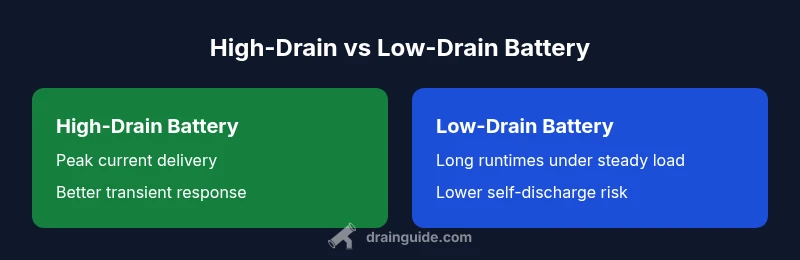
High Drain vs Low Drain Battery: An Objective Comparison
Compare high-drain and low-drain batteries: performance under load, longevity, charging behavior, and real-world use cases for homeowners and DIY enthusiasts. Drain Guide analysis.


Understanding high drain vs low drain battery usage helps homeowners select the right energy storage solution for their devices. In battery terminology, 'drain' refers to how quickly a cell can deliver current without voltage collapse. A high-drain battery is designed for short bursts of high current (like power tools, drones, or RC cars), whereas a low-drain battery prioritizes energy efficiency and longer runtime in devices with modest, steady loads. Both types have trade-offs in capacity retention, cycle life, and self-discharge, which matter when you size a battery for a project. Drain Guide's analysis shows that choosing the correct drain profile reduces premature wear and improves safety by matching cooling, charging, and usage patterns.
Overview: what high drain vs low drain battery means
Understanding the concept of high drain vs low drain battery usage helps homeowners select the right energy storage solution for their devices. In battery terminology, drain refers to how quickly a cell can deliver current without dramatic voltage sag. A high-drain battery is designed for short bursts of high current (think power tools, drones, or RC cars), while a low-drain battery prioritizes energy efficiency and longer runtime in devices with steady, lower loads. Both types have trade-offs in capacity retention, cycle life, and self-discharge, which matter when sizing a battery for a project. Drain Guide’s analysis shows that matching the drain profile to usage patterns reduces premature wear and improves safety by aligning cooling, charging, and usage expectations.
- What “drain” means in practical terms
- Why the same battery chemistry can behave differently under load
- How to spot signs you’re using the wrong drain profile for a given device
- The role of ambient temperature and duty cycle in performance
How discharge rate shapes performance
Discharge rate describes how fast a battery releases its stored energy under load. In practical terms, it governs voltage stability, heat generation, and energy efficiency during use. A high-drain battery typically has lower internal resistance and better peak-current delivery, which minimizes voltage drop during bursts of heavy use. However, those advantages come with trade-offs: higher wear per cycle, greater sensitivity to temperature, and potentially faster capacity fade if kept outside ideal conditions. A low-drain battery, conversely, tends to maintain steadier voltage at moderate currents, often delivering superior energy efficiency and longer runtimes under light-to-moderate usage. Understanding this balance helps you optimize for the device’s duty cycle and the user’s expectations for runtime and safety.
- Internal resistance and voltage sag explained
- How heat generation differs with drain rate
- Impact on cycle life and long-term capacity
Real-world scenarios: heavy tool use vs long-life devices
The choice between high drain and low drain batteries becomes clear when you map devices to their typical usage patterns. Heavy-load tools—such as cordless drills, impact drivers, or RC vehicles—benefit from high-drain cells that can sustain brief, intense current draws without collapsing voltage. On the other hand, devices that sit idle for long periods or run at a steady pace—such as environmental sensors, remote meters, or small electronic devices—prefer low-drain cells that optimize energy per charge and minimize self-discharge. In some cases, hybrid configurations (parallel packs or multi-chemistry cells) offer a middle ground, delivering adequate peak power while preserving runtime for continuous operation. Drain Guide recommends profiling the device’s duty cycle before selecting a drain profile.
- Examples of high-drain scenarios
- Examples of low-drain scenarios
- When a hybrid approach can help
Design and chemistry implications
Drain rate interacts with the underlying chemistry. Lithium-ion families (including Li-ion and LiFePO4) respond differently to high-current demands. High-drain designs often feature lower internal resistance, robust thermal paths, and reinforced electrode structures to handle peak currents. Low-drain designs may emphasize higher energy density and lower self-discharge, sometimes at the expense of peak current capability. Other chemistries, like NiMH, respond differently to high-load events and can exhibit different aging characteristics. When pairing drain profiles with chemistry, expect trade-offs in capacity retention, cycle life, charging speed, and thermal management needs. Drain Guide emphasizes that selecting a drain-appropriate chemistry and cell design reduces risk and improves long-term reliability.
- How chemistry affects drain performance
- Thermal management and its importance
- Practical guidelines for choosing the right chemistry for your load profile
Charge behavior and safety considerations
Charging behavior is closely tied to drain profile. High-drain cells may require chargers that support higher currents and better thermal management to avoid overheating during fast fills. Improper charging can accelerate degradation or create safety risks in high-temperature environments. Low-drain cells, while more forgiving in some aspects, still benefit from balanced charging, appropriate charging cutoffs, and regular temperature monitoring. Safe handling practices include avoiding deep discharges, storing at moderate temperatures, and using a battery management system (BMS) when available. Drain Guide notes that following manufacturer recommendations for charge rates, cooling, and storage improves longevity and reduces safety concerns in DIY projects.
Measuring and comparing capacity under load
To compare high-drain and low-drain batteries, measurements must reflect real-world conditions. Capacity tests performed at a nominal rate may misrepresent performance for devices that experience bursts or steady currents. Tests should include high-load simulations to capture voltage sag and peak-current behavior, as well as low-load tests to capture runtime and self-discharge characteristics. Battery testers, cyclers, and proper test fixtures help homeowners quantify differences in effective capacity under their specific usage patterns. Drain Guide recommends documenting test conditions (ambient temperature, current, duration) to ensure that results translate to practical decisions.
Efficiency, cost, and lifecycle trade-offs
In practice, the drain profile influences not only performance but also efficiency and total cost of ownership. High-drain batteries may deliver superior peak power but can incur higher replacement costs if cycle life is shortened by frequent heavy-use events. Low-drain batteries often excel in energy efficiency and long runtimes, potentially reducing charging frequency and operational cost. The best choice depends on your device’s duty cycle, environmental conditions, and acceptable risk level. Drain Guide encourages homeowners to run a total-cost-of-ownership analysis that includes initial cost, replacement intervals, and energy consumption over the device’s expected life.
Maintenance tips to maximize longevity
Regardless of drain profile, good maintenance can extend battery life. Store batteries at partial state of charge in a cool, dry place; avoid exposing cells to extreme temperatures; and inspect for signs of swelling, corrosion, or physical damage. For high-drain packs, ensure adequate cooling during use and use a BMS to monitor cell temperatures and voltages. Regular calibration of battery monitoring equipment helps maintain accurate readings of state-of-charge and health. Drain Guide suggests documenting operating conditions and maintenance intervals to identify patterns that indicate when a pack is nearing end-of-life.
Authority sources and further reading
To support the guidance in this article, consult reputable sources on battery science and safety. For broader policy and energy context, see government and research institution sites. Drain Guide has compiled practical references to help homeowners and DIY enthusiasts access credible information quickly.
Quick-start decision checklist
- Profile your device: peak current vs steady load
- Check battery chemistry, rating, and recommended discharge rate
- Consider thermal management and available cooling solutions
- Assess runtime needs vs. upfront cost and replacement cycles
- Use a test plan to validate performance under real usage
Hybrid scenarios and atypical use cases
Some installations benefit from a hybrid approach, combining high-drain capability for bursts with low-drain efficiency for runtime. This might involve parallel cell configurations, smart BMS integration, or tiered storage that serves different subsystems. In DIY projects, document your load profiles clearly and test under multiple scenarios to ensure reliability. Drain Guide emphasizes that hybrid designs should be validated with practical testing rather than theoretical assumptions.
Related topics and next steps
Explore related topics such as battery management, safety practices, and charging infrastructure to complement drain-profile decisions. When linking to broader guides, focus on safe handling, proper storage, and device-specific requirements. Drain Guide recommends stepping through a structured decision framework to align hardware choices with user expectations and maintenance habits.
Drain Guide perspective: practical takeaway
From a homeowner’s perspective, the core message is to match drain profile to load behavior, balancing peak performance with runtime and longevity. Drain Guide’s approach centers on practical testing, climate-aware operation, and transparent trade-offs so you can make informed choices without overcomplicating your project. The aim is a reliable, safe, and cost-effective battery solution that fits your DIY goals.
Comparison
| Feature | High-drain battery | Low-drain battery |
|---|---|---|
| Peak current delivery under load | Strong, sustained peak current for bursts | Limited peak current; optimized for moderate loads |
| Runtime under typical usage | Shorter runtimes under heavy use | Longer runtimes under steady, light-to-moderate use |
| Cycle life under high-current cycling | Can wear faster if not temperature controlled | Typically longer life under gentler load when within specs |
| Self-discharge tendency | Higher risk with aggressive high-current use | Lower self-discharge for stable, low-load scenarios |
| Charging considerations | Requires high-current charging and good cooling | Better compatibility with standard charging; slower bursts |
| Ideal use cases | Power tools, drones, high-drain electronics | IoT sensors, wearables, remote monitoring devices |
Positives
- Delivers reliable peak power for demanding tasks
- Can reduce voltage sag during bursts
- Better suited for devices with short high-current events
- Helps minimize dropout during rapid transients
- Supports high-performance applications
Cons
- May experience faster capacity fade if operated outside design limits
- Higher thermal management needs in bursts
- Typically higher upfront cost for high-drain packs
- Not ideal for devices with continuous moderate loads
High-drain batteries excel in bursts; low-drain batteries win for long runtimes and efficiency
Choose high-drain when devices require strong peak current and quick bursts. Opt for low-drain when steady, long runtimes and energy efficiency matter more, reducing heat and wear over time.
Got Questions?
What is the difference between high-drain and low-drain batteries?
High-drain batteries are designed to deliver high current quickly, suited for bursts. Low-drain batteries focus on energy efficiency and longer runtimes under steady loads. The best choice depends on the device’s duty cycle and safety considerations.
High-drain batteries provide power fast for bursts, while low-drain batteries last longer with steady use. The right choice depends on how you use the device.
Which battery type is better for power tools?
Power tools typically benefit from high-drain batteries due to their need for rapid current during starts and heavy cuts. Ensure adequate cooling and a compatible charger to avoid overheating.
For power tools, high-drain is usually best, with good cooling and a proper charger.
Can I mix high-drain and low-drain batteries in a system?
Hybrid configurations are possible, but require careful management to balance current demands and avoid risk. A proper BMS helps ensure cells operate within safe limits.
Mixing can work with a smart management system, but you should plan for balance and safety.
How do temperature and charging affect drain performance?
Temperature and charging rate influence how well a battery maintains voltage under load. High-drain packs need effective cooling and correct charge rates to prevent rapid aging.
Heat and charging speed matter—keep it cool and follow the charger spec.
What tests confirm drain performance for my device?
Run load-profile tests that mimic real operation, including peak-current bursts and steady-state usage. Document ambient conditions and test duration for reproducibility.
Test with real-use scenarios and keep good notes so results matter.
Is a regulator or BMS required for high-drain setups?
A battery management system (BMS) is highly recommended for high-drain configurations to monitor voltage, current, and temperature, and to prevent unsafe conditions.
A BMS helps keep everything safe and within spec.
The Essentials
- Match drain profile to device load to optimize performance
- Consider thermal management for high-drain use cases
- Test under realistic conditions to ensure expectations align with results
- Balance upfront cost against cycle life and total energy consumption
- Use a battery management system where possible for safer operation