How to deal with draining people: a practical guide
Learn how to deal with draining people by setting clear boundaries, communicating effectively, and protecting your energy. Drain Guide offers practical steps to build healthier relationships and reclaim focus.


You can learn to identify draining behaviors, set clear boundaries, and protect your energy with practical steps. This guide covers quick start tips, communication scripts, boundary-setting templates, and self-care strategies to reduce drain while maintaining respectful relationships. By applying these steps, you’ll regain focus, improve conversations, and build healthier interactions without feeling drained.
Understanding the drain dynamic
According to Drain Guide, draining people are those who consistently consume more emotional, mental, or time resources than they give back. The dynamic isn’t about one-off conflicts; it’s a pattern where energy exchange tilts toward the other person’s needs, leaving you depleted. Identifying this pattern is the first practical step toward healthier interactions. Drain Guide Analysis, 2026 notes that many homeowners and DIY enthusiasts report subtle energy drains in social circles and work relationships when boundaries aren’t clearly defined. By naming the dynamic, you can take targeted actions to restore balance while preserving respect and care in the relationship.
A healthy relationship should feel sustainable. When you’re drained, you may notice reduced motivation, irritability after conversations, or a lingering sense of being “used.” The goal isn’t to eliminate all emotional load but to ensure the load is shared more equitably and that you have room for your own priorities and well-being. This requires honest self-awareness and a commitment to consistent boundary practices that align with your values and energy capacity.
The approach outlined here emphasizes practical steps you can start today, backed by the Drain Guide Team, to shift relationships from draining to energizing. It’s about making small, repeatable changes that compound over time, not a one-time overhaul.
Quick diagnostic: spotting draining behaviors
Draining behaviors aren’t always dramatic; they can show up as constant venting with no reciprocity, emotional manipulation, relentless requests, or guilt-tripping when you decline. Here are common patterns to watch for and quick-check questions you can use to assess a situation:
- Frequent demand without offering support in return. Ask yourself: Do conversations feel one-sided most of the time?
- Repeated reminders about commitments that keep you on the hook. Quick test: Can you genuinely say you feel respected when you set a boundary?
- Guilt or obligation used to override your plans. Consider whether you’re consistently sacrificing personal time for others’ needs.
- Constant problem-dumping with little opportunity for problem-solving or mutual growth.
- Boundary testing: Do they react negatively when you say no or propose a different arrangement?
- Energy lag after interactions that lasts beyond a short period.
- Emotional roller coasters that rely on your mood to regulate theirs, rather than shared accountability.
If several patterns apply, it’s a signal to proceed with boundary-setting steps. This isn’t about cutting people off; it’s about reshaping the energy exchange to be fair and sustainable. Drain Guide Team encourages you to document patterns for a few weeks to confirm whether changes are needed.
Remember, acknowledging the pattern is the decisive first move. When you name it, you reclaim the agency to choose how you respond, instead of reacting out of habit. The goal is healthier, more resilient connections that support your well-being.
Boundary-setting strategies that work
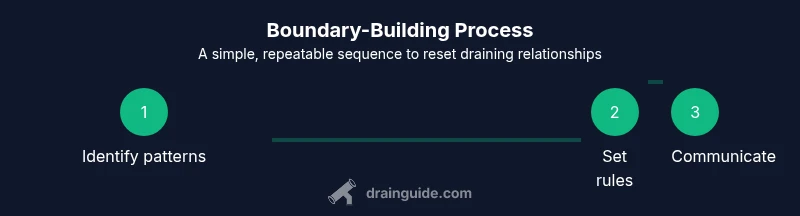
Clear boundaries are the cornerstone of reducing drain and reclaiming energy. Start with a simple framework you can apply across relationships:
- Define your energy budget: Decide how much time and emotional bandwidth you’re willing to invest weekly.
- Create specific boundary rules: For example, “I won’t engage in late-night discussions about heavy topics after 9 pm.”
- Use time boundaries: Offer alternative meeting times or shorter conversations when needed.
- Prepare scripts: Practice concise ways to decline or redirect conversations without guilt.
- Document outcomes: Keep a brief log of how boundaries are received and adjust as necessary.
Practical templates can help you stay consistent. For instance, a boundary template might read: “I value our relationship, but I need to limit X. Can we adjust Y so I can participate without overextending myself?” By making your boundaries concrete, you make your expectations clear without blaming the other person.
Establish a predictable rhythm for boundary enforcement. If a boundary is repeatedly ignored, consider a staged response (calm reminder, brief pause, then a longer break if necessary). The aim is to preserve your energy while still offering care and respect to the other person.
A caution: boundaries should be about behavior, not character. Focus on what you will or will not tolerate, not who the other person is. This helps maintain a constructive and respectful dynamic even when you reset expectations.
Communication scripts for tough conversations
Communicating boundaries with draining people benefits from neutral language, I-statements, and a clear outcome. Below are ready-to-use scripts you can adapt:
- Declining a request: “I can’t take that on this week. I have other commitments that need my attention. If it’s urgent, I can help you brainstorm other options.”
- Redirecting a venting session: “I hear you’re dealing with a lot. I’m glad you shared. I’m not equipped to solve this right now, but I can help you outline steps or a plan.”
- Proposing a boundary with ongoing support: “I value our relationship, and I want to be supportive. To do that well, I need us to keep conversations about X to 15 minutes and shift to problem-solving after that.”
- Ending an ongoing pattern: “I need to pause this topic for now so I can focus on my own priorities. Let’s revisit it in a couple of days with fresh energy.”
Tip: Use “I” statements to own your feelings and avoid blaming language. Keep tone calm, and offer concrete alternatives or follow-up actions to show you remain engaged.
Drain Guide Team notes that consistent language helps both parties understand expectations. Practicing these scripts aloud or in writing can build confidence for real conversations. You don’t have to be perfect—just consistent and respectful.
Self-care and energy management techniques
Protecting your energy requires deliberate daily habits that support resilience. Consider incorporating these practices:
- Daily energy check-ins: Briefly assess how interactions affected you and adjust plans accordingly.
- Short recovery rituals: 5–10 minutes of breathing exercises, a quick walk, or a reset activity after challenging conversations.
- Boundaries-as-routine: Schedule “buffer time” between commitments so you don’t feel overwhelmed by back-to-back interactions.
- Mindful media consumption: Limit exposure to draining topics or people during high-energy days.
- Sleep and nutrition: Prioritize rest and balanced meals to sustain emotional regulation.
- Social calibration: Surround yourself with a few trusted allies who reinforce healthy boundaries and model balanced behavior.
Energy management is not about perfection but consistency. Small, repeatable routines — like a 5-minute pre-conversation check-in and a post-conversation reflection — compound into noticeable improvements over weeks. Drain Guide Team emphasizes that sustainable change happens through matched actions and regular reflection.
A practical 14-day plan to reset relationships
This plan provides a focused, two-week approach to implementing boundaries with draining people. Each day builds on the previous, combining boundary practice, communication, and self-care:
- Days 1–2: Identify patterns and articulate personal boundaries in writing. Prepare a few scripts tailored to common scenarios.
- Days 3–5: Initiate gentle boundary-setting with low-stakes contacts. Observe reactions and refine language.
- Days 6–9: Expand to more challenging conversations. Use I-statements and brief, clear language.
- Days 10–12: Institute recovery routines after interactions; protect buffer time.
- Days 13–14: Review progress, adjust boundaries, and plan ongoing maintenance. Seek support if needed from trusted friends or professionals.
A practical takeaway is to schedule short, recurring check-ins with yourself to assess energy levels and the effectiveness of boundaries. If a relationship continues to drain after two weeks, consider longer pauses or reevaluation of the relationship’s role in your life. Consistency and self-compassion are your allies in this process.
When to reevaluate relationships and seek support
Not all draining dynamics are permanent. If boundaries are consistently ignored, if you feel chronically exhausted after every interaction, or if you experience anxiety about engaging with certain people, it may be time to reevaluate the relationship. Seek input from a trusted friend or a mental health professional to gain perspective and coping strategies. In some cases, reducing contact or taking a temporary break is healthier than trying to “fix” a toxic dynamic. The Drain Guide Team recommends giving yourself permission to pause if needed and to reassess goals for the relationship periodically. Remember, energy management is a skill you can improve with practice, and asking for help is a sign of strength, not weakness.
Tools & Materials
- Notebook or digital journaling app(Track patterns, boundaries, and reflection notes.)
- Boundary-setting worksheet(Fill in triggers, boundary phrases, and outcomes.)
- Script templates(Pre-written phrases for common scenarios.)
- Calendar or scheduling app(Schedule buffer time and boundary enforcement moments.)
- Quiet space for conversations(Choose a private, calm environment for sensitive talks.)
- Timer(Limit conversation length when testing boundaries.)
- Self-care plan template(Structure for recovery activities post-interaction.)
Steps
Estimated time: 60-90 minutes for initial planning; ongoing practice over 2-4 weeks
- 1
Identify draining patterns
Spend 15–20 minutes journaling recent interactions to identify recurring patterns that leave you drained. Look for one-sided conversations, constant venting, or guilt-inducing requests.
Tip: Label each pattern with a concrete example so you can reference it in conversations. - 2
Define your energy budget
Decide how much time and emotional energy you’re willing to invest weekly. This helps you determine when to engage and when to pause.
Tip: Treat your energy budget like a financial budget—allocate and guard it. - 3
Create boundary rules
Write 2–3 specific rules you will enforce (e.g., “no after-hours calls,” “I’ll respond within 24 hours”).
Tip: Rules should be clear, observable, and doable. - 4
Prepare scripts
Craft short I-statements and boundary reminders you can deliver calmly in real conversations.
Tip: Practice in front of a mirror or with a trusted friend. - 5
Test boundaries with low-stakes interactions
Start with a non-crucial relationship to build confidence and refine your language.
Tip: Aim for consistency, not perfection. - 6
Communicate boundaries
Have a calm conversation, using your script and specific examples. State the boundary and the desired outcome.
Tip: Keep it short and solution-focused. - 7
Reinforce or adjust boundaries
Observe responses. If boundaries are respected, reinforce them positively; if not, consider longer pauses or boundaries adjustments.
Tip: Consistency builds trust over time. - 8
Integrate self-care
Embed recovery practices after difficult interactions, such as breathing exercises or a short walk.
Tip: Energy management is a habit, not a one-off event.
Got Questions?
What does it mean when someone is draining?
Draining describes ongoing patterns where another person consistently uses more of your emotional energy than you get back. It isn’t a single event, but a recurring dynamic that leaves you fatigued after interactions. Recognizing this pattern helps you decide on boundaries and responses.
Draining means a person repeatedly uses more of your energy than you receive in return, leaving you tired after interactions.
How can I tell if I am enabling draining behavior?
If you frequently go along with requests because you want to keep peace, or you rarely voice your own needs, you might be enabling drain. Start by saying no when appropriate and observe how the other person responds.
If you often say yes just to avoid conflict, you may be enabling it; try speaking up for your needs and watch the response.
Is it healthy to cut off contact with draining people?
Cutting off contact can be healthy if boundaries are repeatedly ignored and the relationship consistently depletes you. It’s a last resort after trying clear boundaries and communication. Consider temporary pauses to reassess and protect your well-being.
Sometimes a break is the healthiest option after you’ve tried boundaries and the other person doesn’t respect them.
How do I start a conversation about boundaries with a difficult person?
Begin with a calm, private setting and a simple I-statement that describes your need, followed by a concrete boundary. Offer a solution or alternative to keep the relationship constructive.
Pick a good moment, say what you need using I-statements, and suggest a practical change.
What are quick daily practices to protect energy?
Incorporate short routines: check in on your energy, practice 5 minutes of mindful breathing, and schedule brief breaks. Small daily actions add up to stronger resilience over time.
Do a quick energy check each day and add a short breathing session to reset after tough talks.
Watch Video
The Essentials
- Set concrete boundaries to balance energy exchange
- Use I-statements to reduce defensiveness
- Plan conversations with clear outcomes
- Protect your time with scheduled buffer periods
- Review and adjust boundaries regularly