Pop Up Drain vs Push Down Drain: A Practical Guide for Homeowners
Explore the differences between pop up drains and push down drains, including how they work, maintenance needs, costs, and when to choose each option for your sink.


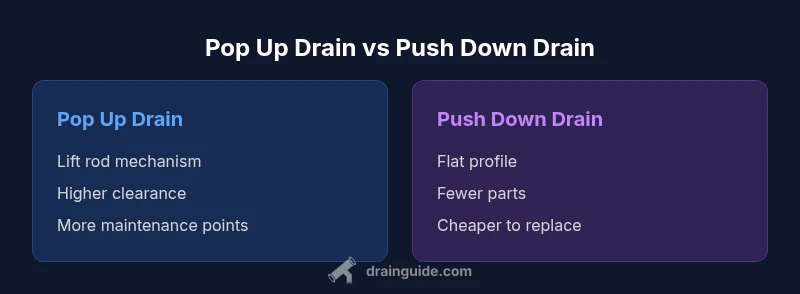
In examining the choice between a pop up drain vs push down drain, the decision hinges on how you use and maintain your sink. A pop up drain uses a lift rod to raise or lower the stopper, offering easy access for taller hair traps and regular cleaning; a push down drain relies on a spring-loaded or press-fit mechanism that is typically simpler and flush with the sink surface. For most homeowners, the push down design is cheaper and easier to service, while the pop up design offers greater flexibility in tight spaces and easier stopper removal for deep cleans. Overall, your choice should align with sink height, vanity space, and your maintenance routine.
What Are Pop Up Drains and Push Down Drains?
According to Drain Guide, understanding the difference between a pop up drain vs push down drain is essential for homeowners tackling sink clogs and maintenance. Both designs anchor a stopper but use different mechanisms to seal or release water. The choice often hinges on your sink configuration, vanity height, and how you clean the basin. In practice, many households encounter clogs near the stopper, so recognizing which design you have helps guide maintenance steps and replacement planning. This article defines each type, explains their core components, and sets up practical comparisons that you can apply to kitchen and bathroom sinks. While names imply simplicity, the inner hardware—lift arms, pivot rods, springs, and seals—determines how easy it is to clear hair and debris. Understanding this distinction helps homeowners diagnose the cause of slow draining and plan a maintenance schedule.
How They Work: Mechanisms Behind Each Design
A pop up drain uses a lift rod connected to a stopper inside the drain body. When you pull the rod upward, the stopper rises to allow drainage; pressing the rod or lifting it again lowers the stopper to seal the drain. The push down drain, on the other hand, relies on a spring-loaded plunger or a simple press-fit stopper that you activate by pressing and releasing. The result is a simpler mechanical path with fewer moving parts, though the exact configuration can vary by manufacturer. Key takeaway: pop up drains are more adjustable via the lift rod, while push down drains emphasize one-click operation and a flatter profile that sits flush with the sink surface.
Durability and Longevity: Which Lasts Longer?
Durability depends on materials (stainless steel, brass, plastic composites), seal condition, and how often the stopper is manipulated. In general, push down drains have fewer moving parts and can wear less rapidly in everyday use, which may translate to lower long-term repair needs. Pop up drains, with lift rods and pivot components, introduce additional wear points that can degrade seals or links over time. Homeowners who prioritize long-term reliability often factor in the quality of installation and the ease of replacing worn parts when making a choice between the two designs.
Installation and Compatibility: Sinks, Vanities, and Basins
Compatibility hinges on the sink’s design and the surrounding cabinet space. Pop up drains generally require a lift rod incident to the faucet or vanity, which may be easier to route in bathrooms with higher vanities or wider counter space. Push down drains tend to have a lower profile, making them well-suited to compact vanity configurations or shallower sinks. If you’re upgrading an older sink, verify that the drain housing and tailpieces will align with existing plumbing to avoid costly refits. Both designs come in multiple materials and finish options to match your hardware.
Maintenance and Cleaning: Which Is Easier to Maintain?
Maintenance efficiency varies by mechanism. Push down drains are typically easier to remove and reassemble because of their simpler layout, which can reduce time spent on routine cleaning. Hair and debris are common culprits in both designs; however, lift rods in pop up drains can accumulate grime and corrode joints if not cleaned regularly. A routine maintenance habit—removing the stopper every few months, inspecting seals, and clearing the trap—helps prevent slow drains regardless of design. Drain Guide recommends a quick wipe-down of exposed hardware after cleaning to reduce mineral buildup.
Clog Troubleshooting: What Differences to Expect
When a sink drains slowly, the stopper area is a frequent suspect for both designs. For a pop up drain, check the lift rod linkage for slack or corrosion and inspect the seal around the stopper; hair often collects around the pivot points. For a push down drain, focus on the plunger and seals, which can lose elasticity and trap debris in the collar. In both cases, remove the stopper, clear hair from the trap, and run warm water with a mild cleaner to dislodge residue. If clogs persist, consider a basic drain auger or professional service.
Cost and Availability: Upfront and Long-Term Costs
Prices vary by material, finish, and brand. A basic push down drain kit might range from budget-friendly to mid-range, while pop up drain assemblies with lift rods can be more expensive due to additional hardware. Replacement parts for both designs are generally readily available at home improvement stores and online retailers. Expect total costs for a DIY replacement in the modest range, with higher-end finishes or premium materials pushing toward the upper end. When budgeting, also factor in potential tailpiece, gasket, and plumber’s tape costs.
Aesthetics and Practical Considerations: Height and Clearance
The visible footprint of the stopper and the sink’s rimline influence visual harmony in a kitchen or bathroom. Push down drains sit closer to the sink surface and can look sleeker in tight spaces, making them a popular choice for shallow sinks. Pop up drains, with their lift rod assembly, can intrude slightly into vertical space but offer more adjustment in terms of stopper height. Consider your vanity depth, faucet height, and cabinet clearance when choosing between the two designs to avoid clashes with under-sink plumbing or cabinet doors.
Installation Mistakes to Avoid
Common errors include choosing the wrong trap adapter size, failing to align the stopper mechanism with the drain body, and neglecting to replace worn seals during installation. A rushed installation can lead to leaks even when the stopper appears to seal. Always measure and verify compatibility with existing piping, ensure the tailpiece is free of twists, and replace gaskets with manufacturer-approved parts. Take time to test the stopper’s range of motion before finalizing the installation.
How to Replace or Upgrade: Step-by-Step Overview
If you’re upgrading or replacing an existing drain, start by turning off the water supply and removing the old stopper. For a pop up drain, detach the lift rod from the drain and disconnect the linkage; for a push down drain, remove the plunger mechanism and clean the housing. Install the new drain, reattach seals, and fit the tailpiece to the drain pipe. Finally, test drainage by filling the sink and observing whether water drains smoothly without leaks. Always consult product instructions for torque and seam guidance.
Real-World Scenarios: When to Use Each Type
In kitchens with tall or unusually configured cabinets, a pop up drain can provide travel space for cleaning and better clearance behind the cabinet. In compact bathrooms or powder rooms, a push down drain’s low profile minimizes obstruction and is easier to integrate with a medicine cabinet or vanity mirror. If your priority is simple maintenance and lower upfront cost, push down drains typically win. If you want more flexibility in stopper height or easier removal for deep-cleaning, a pop up drain is a strong option.
Quick Reference: A Simple Decision Checklist
- Do you have tight cabinet clearance? Push down may be better.
- Do you want easier access for deep cleaning? Pop up can be advantageous.
- Is the budget a primary concern? Push down usually costs less upfront.
- Do you anticipate frequent stopper adjustments? Lift-rod pop up drains offer more control.
- Are you replacing an existing system? Match the company’s parts and finishes for compatibility.
Comparison
| Feature | Pop up drain | Push down drain |
|---|---|---|
| Operation | Lift rod raises/stops stopper via linkage | Press-to-seal stopper with spring/plunger |
| Height clearance | Moderate to high clearance due to lift rod | Low profile, flush with sink surface |
| Maintenance complexity | More moving parts; potential wear at lift rod joints | Fewer moving parts; simpler maintenance |
| Common failure points | Lift rod linkage; seals around stopper | Plunger seals; main housing seals |
| Ease of replacement | Can be trickier; requires correct lift rod kit | Typically quicker; broad compatibility |
| Best for | Sinks with higher clearance and when deep cleaning is desired | Budget-minded installs and compact vanities |
| Cost range (parts/kit) | $30-$120 | $20-$90 |
Positives
- Push down drains are typically cheaper and simpler to install
- Pop up drains offer flexibility with stopper height and easier deep-clean removal
- Low-profile options for tight vanity spaces
- Widely available replacement parts and finishes
Cons
- Pop up drains can be more expensive and have more potential failure points
- Push down drains may provide less vertical clearance for certain sinks
- Lift rod hardware can accumulate grime if not cleaned regularly
Neither design is universally better; choose based on sink height, maintenance willingness, and budget
If you need simplicity and lower upfront cost, push down drains are usually best. If you want greater stopper control and easier cleaning access, a pop up drain is worth the extra investment.
Got Questions?
What is the main difference between a pop up drain and a push down drain?
The main difference lies in their stopper mechanism: a pop up drain uses a lift rod to raise or lower the stopper, while a push down drain uses a spring-loaded plunger that you depress to seal or open. These mechanical differences influence maintenance, clearance, and installation.
Pop up drains use a lift rod to raise the stopper, while push down drains use a depressible plunger. The choice affects maintenance access and installation.
Which type is easier to install for a DIY homeowner?
Push down drains are typically simpler to install because they have fewer moving parts and do not require precise lift rod alignment. Pop up drains can be straightforward but may require careful alignment of the lift rod linkage during installation.
Push down drains are usually easier for DIY installs due to fewer moving parts. Pop up drains need careful alignment.
Can I replace a pop up drain with a push down drain in the same sink?
Yes, in most cases you can swap from a pop up drain to a push down drain, or vice versa, but you may need to replace the tailpiece and seals to ensure a proper fit and leak-free connection. Check compatibility with your sink and vanity design.
Yes, you can usually swap the stopper type, but verify compatibility and replace seals as needed.
Are there common signs of failure for each type?
Common signs include slow draining, persistent leaks around the stopper, and difficulty sealing or opening the sink. Pop up drains may show wear in the lift rod linkage, while push down drains can develop worn seals in the plunger housing.
Look for slow draining, leaks, or failure to seal—these indicate worn parts in either design.
What maintenance steps are recommended for pop up vs push down drains?
Regularly remove the stopper and clean hair from the linkage (pop up) or plunger housing (push down). Replace worn seals promptly and inspect gaskets. Use a mild cleaner to minimize mineral buildup on exposed hardware.
routinely clean the stopper mechanism and replace worn seals to keep either design functioning well.
The Essentials
- Assess your sink clearance before choosing a stopper style
- Push down drains are generally cheaper and simpler to install
- Pop up drains offer more stopper control and easier deep cleaning
- Regular maintenance extends the life of either design