What is a Clicker Drain vs Pop Up? A Practical Sink Guide
Understand the differences between clicker drains and pop-up drains, how each operates, maintenance needs, installation tips, and cost considerations to help homeowners choose the right sink stopper design.


Clicker drains and pop-up drains are the two most common sink stopper designs. A clicker drain uses a lift rod and a small lever to raise a stopper, while a pop-up relies on a hinged stopper controlled by a knob or lever. This comparison highlights how they work, maintenance needs, and typical costs to help you decide.
Overview of Sink Drain Assemblies
If you are evaluating sink stoppers, understanding the two most common designs is essential. What is a clicker drain vs pop up? This quick distinction helps homeowners select a solution that matches their usage and maintenance preferences. A clicker drain uses a lift rod and a small lever connected to the drain to raise and lower a stopper via a simple mechanical link. A pop-up drain uses a hinged stopper that sits inside the drain and is raised or lowered by turning a knob or lever connected to the stopper's hinge. Drain Guide's analysis suggests that both designs are reliable when properly installed, but differences in ease of cleaning, maintenance frequency, and compatibility with older plumbing can influence long-term satisfaction. For many homeowners, the choice hinges on how much they value straightforward maintenance, how frequently they clean hair out of the trap, and whether the sink configuration supports a particular design.
In this article, Drain Guide analyzes the practical aspects of these two designs, with clear guidance for common kitchen and bathroom sink setups. You’ll learn how each operates, how to maintain them, what typical replacement parts cost, and practical installation tips to help you decide which design best fits your home. The goal is to equip you with objective criteria, so you can evaluate the two systems based on real-world factors rather than marketing claims. The Drain Guide team emphasizes practical, actionable steps you can take today to improve drain performance and reduce clogs.
How a Clicker Drain Works
Clicker drains are a straightforward mechanical option that relies on a lift rod connected to an internal linkage. When you pull the lift rod or press the linked button, a small plunger rises and lowers within the drain body, raising or dropping the stopper. The 'clicker' term refers to the small piece inside the drain that completes the linkage when you actuate the rod, creating a positive or negative motion that seals the drain. In most installations, a tailpiece from the sink goes into a flange, and a spring-loaded seal sits at the bottom of the drain to provide a water-tight seal when the stopper is down. Components are usually accessible from beneath the sink, making maintenance relatively simple. Because the stopper is typically a plug that slides and seals against a fixed seat, blockages or mineral buildup can impair operation if the linkage is misadjusted or if the seal wears out. Replacement parts are commonly available at home improvement stores, and many DIYers can swap out a worn lift rod, a nylon bushing, or the stopper without replacing the entire drain assembly. Drain Guide notes that a well-installed clicker drain offers reliable performance with periodic lubrication of moving parts and timely adjustment of the linkage when needed.
How a Pop-Up Drain Works
Pop-up drains use a hinged stopper that sits in the drain opening and is raised or lowered by a separate control (usually a knob or lever connected to a hinge). When you activate the control, the stopper tilts up, allowing water to drain; when you deactivate it, the stopper seals against a fixed seat to hold water. The hinge assembly and the channel beneath the sink are critical to smooth operation. In many modern homes, pop-up drains prioritize aesthetics and a clean underside with fewer visible moving parts. Maintenance typically involves inspecting the stopper, cleaning hair and mineral buildup from the linkage, and ensuring the seal remains tight against the drain seat. If the control becomes stiff or the stopper leaks, homeowners often replace the entire pop-up assembly or lubricate the hinge and washer. Drain Guide emphasizes that success with this design depends on proper alignment and compatible flanges and seals, especially when upgrading from an older system.
Key Differences Between Clicker and Pop-Up Drains
The primary differences between clicker and pop-up drains fall into four categories: mechanism, maintenance, aesthetics, and compatibility.
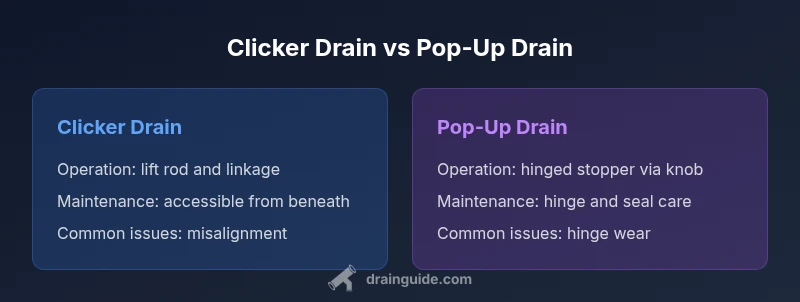
- Mechanism: Clicker drains use a lift rod and internal linkage to raise a stopper; pop-ups use a hinged stopper moved by a knob or lever.
- Maintenance: Clickers often offer easier access to the linkage from beneath the sink; pop-ups require hinge maintenance and can accumulate debris around the pivot.
- Aesthetics: Pop-ups tend to present a cleaner underside and sleeker exterior, while clickers can expose more hardware under the sink.
- Compatibility: Older sink configurations may favor clickers, while new installations often pair with pop-up designs. Drain Guide notes that both can work well if installed with proper seals and standard fittings, but mismatched parts can lead to leaks or sticking.
Best for: Clicker drains are generally preferred where straightforward maintenance from below the cabinet is desired; pop-ups excel in modern aesthetics and frequent lid control. Common issues include misalignment, worn seals, or hinge wear, which are typically addressable with parts replacements.
Compatibility, Materials, and Installation Considerations
Choosing between a clicker and a pop-up drain also hinges on material quality and installation context. Brass or stainless steel components offer durability and corrosion resistance, but price rises with material quality. Plastic portions reduce cost but may wear more quickly under heavy use. Consider the sink type (kitchen vs bathroom), cabinet depth, and plumbing layout. A tall basin with shallow cabinet space may benefit from a compact pop-up design, while a deep cabinet with accessible piping can accommodate a clicker arrangement more easily. Careful measurement of the drain opening, thread sizes, and flange diameter is essential. If you are replacing an existing assembly, verify the tailpiece size, the drain body height, and compatibility with the sink basket. Drain Guide recommends checking local hardware stores for standardized sizes and ensuring a proper seal with the gasket and washer assembly. In some cases, upgrading to a universal mount can simplify future maintenance and part replacements.
Maintenance and Troubleshooting
Routine maintenance reduces clogs and prolongs drain life for both designs. Perform a quarterly inspection: remove any visible debris near the stopper, lubricate moving parts with a silicone-friendly lubricant, and check seals for signs of wear. For clicker drains, ensure the lift rod remains correctly aligned and that the linkage moves freely without binding. When sticking occurs, clean the seal interface and test the linkage by lifting and lowering several times. For pop-up drains, inspect the hinge and pivot points; clean away mineral buildup, and verify that the stopper seats evenly. A leaky drain often points to worn washers or gaskets that can be replaced generically. If you notice persistent leaks or corroded components, replacing the entire assembly may be the most cost-effective and reliable solution. Drain Guide highlights that keeping a small spare kit of washers, gaskets, and o-rings on hand minimizes downtime and keeps both designs functioning smoothly.
Cost, Availability, and Value
Prices for drain components vary by design, material, and whether you buy a full assembly or individual parts. Clicker drains generally have lower upfront replacement costs for basic parts like the lift rod, linkage, and stopper; pop-up components can be a bit pricier when including the hinge and pivot hardware. As a rough guide, individual replacement parts for clicker systems often range in the lower price bracket, while pop-up replacements may fall in the mid-range. Full assemblies tend to be more affordable when purchased as a kit rather than piecemeal, and compatibility considerations can affect overall value. For homeowners budgeting for a bathroom or kitchen renovation, the decision often comes down to long-term maintenance costs, part availability, and how much labor they want to invest in occasional replacements. Drain Guide advises comparing total cost of ownership rather than just the upfront price, because labor and frequent small parts replacements can add up over time.
Practical Installation Scenarios
In real-world kitchens and bathrooms, the choice between clicker and pop-up drains often hinges on cabinet space, plumbing configuration, and user preference. In a compact bathroom where access to the underside of the sink is limited, a pop-up system with fewer exposed levers beneath the cabinet may be preferable. For homes with older piping, a clicker drain can be simpler to retrofit because the lift rod and linkage align with standard tailpieces. If you frequently remove the stopper to clear hair, the clicker’s under-sink access is advantageous. In homes with modern vanities, a sleek pop-up design often provides a cleaner look. Always verify compatibility with your sink, ensure proper seals, and follow the manufacturer’s installation steps to minimize leaks. Drain Guide recommends a dry-fit test before final sealing and applying the plumber’s putty to avoid leaks after final assembly.
Myths and Misconceptions
There are several common myths about clicker and pop-up drains. One is that pop-ups always fail sooner than clickers; in reality, lifespan depends on maintenance and material quality. Another misconception is that one design guarantees clog-free performance; hair, soap scum, and mineral buildup can affect either design. Some homeowners believe that upgrading to a more expensive model eliminates maintenance, which is false—regular inspection and cleaning are still required. Finally, many assume that all parts are interchangeable between brands; while universal fittings exist, incorrect sizing can cause leaks and warranty issues. Drain Guide recommends sticking to compatible kits and following the inventor’s guidelines for replacement parts to preserve performance and warranty coverage.
Comparison
| Feature | Clicker Drain | Pop-Up Drain |
|---|---|---|
| Operation mechanism | Lift rod with internal linkage raises stopper | Hinged stopper moved by knob/lever |
| Maintenance access | Typically accessible from beneath the sink | Access via top control; hinge area can accumulate debris |
| Cleaning ease | Linkage and seal are reachable from below | Pivot and seal area can collect mineral buildup |
| Common issues | Misadjusted linkage, worn stopper seal | Sticking stopper, hinge wear, or misalignment |
| Part cost range | Lower-cost individual parts; typical kit components | Mid-range parts with hinge and stopper assemblies |
| Best for | Low-maintenance access from under-sink area | Clean look and modern aesthetics; easy top operation |
Positives
- Durable, proven design with straightforward parts
- Clicker systems often have simple beneath-sink maintenance
- Pop-up designs are common and offer modern aesthetics
- Parts are widely available and easy to source
Cons
- Clicker linkage can become misaligned if not installed correctly
- Pop-up hinges may wear and require more hinge lubrication
- Both require periodic maintenance to prevent leaks
- Compatibility issues can arise with older sinks
Both designs are viable; choose based on maintenance preference and aesthetic fit
Choose a clicker drain for straightforward, beneath-sink maintenance; choose a pop-up drain for a sleeker look and top-access control. Ensure compatible parts and proper installation for lasting performance.
Got Questions?
What is the difference between a clicker drain and a pop-up drain?
A clicker drain uses a lift rod and internal linkage to raise a stopper, with operation from beneath the sink. A pop-up drain uses a hinged stopper controlled by a knob or lever from the top, with the hinge managing the seal.
A clicker drain uses a lift rod under the sink; a pop-up drain uses a hinged stopper controlled from above.
Which drain is easier to maintain?
Maintenance difficulty varies by design and installation. Clicker drains generally expose more of the linkage for under-sink maintenance, while pop-up drains require hinge and seal care on the stopper.
Maintenance ease depends on your setup; both can be straightforward with regular checks.
Are clicker drains compatible with older sinks?
Yes, many clicker drains fit standard tailpieces and drain openings, but always verify tailpiece size and thread compatibility before upgrading.
Yes, but check the sizes before upgrading.
What maintenance steps prolong drain life?
Regularly inspect the stopper, clean debris, lubricate moving parts with a silicone-based lubricant, and replace worn seals. Periodic checks prevent leaks and sticking.
Inspect, clean, lubricate, and replace worn seals regularly.
Can I convert from a clicker to a pop-up drain?
Converting is possible but usually requires replacing the drain body and flange to match the new design. Verify compatibility with your sink hole size and plumbing.
Conversion is possible but may require new hardware.
What are typical costs for drain replacements?
Costs vary by design and parts; expect lower part costs for clicker components and mid-range to higher costs for full pop-up assemblies or premium materials.
Costs vary; expect a range based on design and parts.
The Essentials
- Evaluate maintenance habits before choosing.
- Check compatibility with existing sinks and plumbing.
- Consider under-sink access vs top-side controls.
- Plan for available parts and DIY replacement ease.