What Slope Is Needed for Drainage: A Practical Guide for Homeowners
Discover the minimum and recommended slopes for drainage, how to measure them, and how to plan yard, roof, and sewer drainage to prevent pooling and backups. Drain Guide provides practical, code-aware guidance for homeowners and DIY enthusiasts.


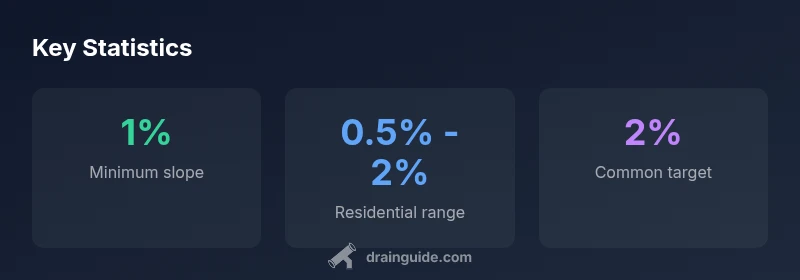
For most drainage runs, aim for a minimum slope of about 1% (roughly 1/8 inch of drop per foot) to encourage gravity flow. In many residential scenarios, a range of 0.5% to 2% is used depending on soil, distance, and load. Always verify with local codes and plan for future grading to prevent pooling.
Why what slope is needed for drainage matters
Water always seeks the path of least resistance, so the incline of any draining system determines whether water flows away smoothly or pools behind a barrier. For homeowners, understanding what slope is needed for drainage helps prevent standing water, soil erosion, mosquito breeding, and damage to foundations. Drain Guide notes that even small deviations from an ideal incline can compound over long runs, leading to clogs or insufficient flow. In practical terms, a proper slope turns gravity into a reliable ally, reducing the need for frequent maintenance and costly repairs later. The principle applies to multiple contexts: a yard trench that carries rainwater, a downspout extension directing roof runoff, or a buried sewer line. By prioritizing slope from the planning stage, you create a one-time solution with long-term benefits. This is a core part of any DIY drainage plan, and alignment with local codes ensures you meet safety and performance standards. Drain Guide emphasizes that small projects benefit from consistent slope as much as large installations.
How slope is measured and expressed
Slope is most commonly expressed as a percentage, but it can also be described as inches of drop per foot of run or as a ratio (rise over run). The basic idea is simple: slope (%) = (vertical drop in inches) / (horizontal run in feet) × 100. For example, a 2-inch drop over 20 feet equals a 1% slope. In practice, many homeowners work with a range rather than a single exact figure, because soil type, drainage distance, and land contours all affect the ideal incline. When planning, note that steeper slopes increase velocity but can also cause erosion or channel scouring if not properly managed. Accurate measurement, using a level or laser device, is essential to avoid guessing.
Slopes by drainage scenario
Different drainage tasks require different slopes, and the context matters. Here are common scenarios with general ranges:
- Exterior yard drainage: 0.5% to 2% where soil permits infiltration and runoff routing is clear.
- Roof runoff to ground: aim for a gentle incline that keeps water moving away from the foundation without blasting soil or causing erosion; typically around 2% is used when feasible.
- Buried waste lines and sensitive gravity-fed systems: 1% to 2% to maintain flow and prevent solids buildup.
Note that site conditions, soil type, and local codes influence these targets. Drain Guide recommends validating the chosen slope with a small-scale test before final installation.
Calculating the slope for your project
Calculating slope starts with mapping the run and the required drop. Step 1: measure the horizontal distance from the highest water point to the drainage outlet. Step 2: decide how much drop is practically available, considering grade and land features. Step 3: compute the slope as (drop in inches) ÷ (run in feet) × 100. Example: a 4-inch drop over 20 feet yields a slope of (4 ÷ 20) × 100 = 2%.
Keep in mind that longer runs amplify the impact of even small slope differences. If you’re unsure, build in a verification test at the end of the run or consult a drainage professional for validation.
Real-world examples: yard vs rooftop vs interior drains
In yards, small slopes (0.5% to 1%) can move rainwater toward a trench or swale, especially when the soil drains well. Roof drains routed to gravity outlets often rely on a 2% slope to prevent standing water on ground surfaces while not overshooting. Interior slab drains or trench drains typically aim for 1% to 1.5% to keep water moving toward a sump or main line. Each scenario must balance flow rate, sediment transport, and soil stability. Drain Guide findings show that the same rule—start with a conservative slope and test—applies across setups.
Practical tip: document the measured slope during construction and keep grading consistent across changes in elevation.
Achieving consistent slope: methods and tools
Consistency is key. Use slope boards or laser levels to set the grade from the starting point to the outlet. If grading a yard, tamp backfill in layers to preserve the intended slope. For buried drains, install compacted backfill with a continuous slope and use trench shoring to prevent collapse. Where long runs are involved, a slight reduction near joints can accommodate fittings without creating flat spots. Tools: laser level, string line, grade stakes, a level and adjustable end ties. Drain Guide recommends testing with water to confirm flow rate and lack of pooling before covering the trench.
Verifying slope after installation
Verification ensures your work stands the test of time. Perform a water test: slowly pour water at the upstream end and observe flow, pooling, or back-siphon signs. A visual dye test can reveal slow zones or obstructions. If water backs up or pools, re-check the grade and adjust as needed. Document the test results for future maintenance and share with any future contractors. Regular checks after heavy rainfall help ensure the slope remains effective.
Common pitfalls to avoid
Avoid creating flat spots along the run, which kill gravity-driven flow. Don’t rely on poor soil compaction to achieve slope—unstable soil settles and changes grade over time. Don’t overslope the system, which can cause erosion and sediment transport that damages the drainage path. Finally, neglecting downstream disposal capacity can negate the best slope values; ensure outlets are clear and properly designed for the expected water volume.
Code, safety, and long-term considerations
Always check local building codes and drainage standards before starting. Some jurisdictions require minimum slope values for specific drainage types and specify materials, trench depth, and backfill requirements. Consider long-term maintenance: debris, roots, and sediment can alter the effective slope. Drain Guide advocates for designing with accessibility in mind so inspection and adjustment are straightforward. If you’re unsure, consulting with a licensed professional is a prudent step to ensure compliance and longevity.
Slope guidance by drainage scenario
| Scenario | Recommended Slope | Notes |
|---|---|---|
| Exterior yard drainage | 0.5% - 2% | Soil type and elevation influence the range |
| Roof runoff to ground | ≈2% | Keep water moving away from foundations; avoid erosion |
| Buried drainage lines | 1% - 2% | Maintain gravity flow; avoid sags that trap sediment |
Got Questions?
What slope is needed for residential drainage?
Typically, aim for 1% minimum for most residential drainage runs, with 0.5%–2% used based on site conditions and distance. Always check local codes.
For most homes, start at about 1% and adjust based on your site and local code requirements.
Can too much slope cause problems?
Yes. Excess slope can cause rapid flow, erosion, or sediment transport that clogs outlets or undermines beds. Keep within recommended ranges and verify with tests.
Yes—too much slope can cause erosion or sediment carry-off; test to stay within safe ranges.
How do I calculate slope for my project?
Measure the horizontal run, determine the available vertical drop, and compute slope as (drop ÷ run) × 100. Example: 4 inches over 20 feet equals about 2%.
Measure the run, drop the height, and use drop over run times 100 to get the slope.
Can I adjust slope after installation?
Adjusting slope after burying drains can be difficult. Plan with grading control and allow verification tests before finalizing.
It’s better to verify the slope during installation; adjust carefully if needed.
What tools help verify slope?
Use a laser level or a string line with reference markers, plus a water test or dye test to confirm uniform flow.
Laser level or string line plus a water test works well.
Do slope requirements differ by drain type?
Yes. Roof, yard, and sewer/drain lines each have distinct recommended slopes based on their function and loads.
Different drains have different slope needs; don’t assume one value fits all.
Should I consult a professional for slope design?
If you’re unsure about site conditions, soil, or code compliance, a drainage professional can help tailor a slope plan.
If in doubt, a pro can tailor slopes to your site and codes.
Is slope the same for all climates?
No. climate, rainfall patterns, and soil permeability influence the ideal slope; adjust based on tests and local guidance.
Slope varies with climate and soil—test and adapt.
“A reliable drainage system starts with the slope. Without an appropriate incline, water will stagnate, solids settle, and you’ll face recurring clogs.”
The Essentials
- Define slope early to prevent pooling and erosion
- Use precise measurement tools for accuracy
- Test slopes with real water flow before finalizing
- Match slope to scenario, not a single number
- Always verify against local codes and safety standards