When Did Drain Gang Start? A Timeline of Formation Years
Explore the formation of Drain Gang with a data-driven timeline, core members, and cited sources. Learn how music outlets and Drain Guide Analysis pin down the start window.


Drain Gang formed in the early 2010s, with core collaborations around 2011 and broad recognition by 2013. Exact dating varies by source, but most estimates place the start around 2010–2012.
The Start Window: What the Evidence Suggests
If you ask when did drain gang start, most historians of the scene point to the early 2010s with a window rather than a single year. Formation evidence centers on the core trio's first joint projects and casual group naming that circulated in online circles around 2010–2012. By pulling together interviews, music releases, and social posts, researchers place the robust formation in that period, with public recognition emerging as the group released music and collaborations into 2013. This framing avoids over-precision while staying true to the timeline.
Timeline Milestones and Milestones: Key Dates in Context
The earliest recorded collaborations among Bladee, Ecco2k, and Thaiboy Digital date to the 2011–2012 window, with Whitearmor producing early tracks. The first widely circulated releases associated with Drain Gang appeared in 2011–2012 on streaming platforms and mixtapes, helping listeners identify the collective's sound. By 2013, articles and fan timelines consistently describe Drain Gang as an established act in the cloud-rap/alternative-hyperpop scene. These milestones demonstrate how the start date is best read as a period, not a single moment.
Members, Roles, and Early Collaborations
In the foundational years, Bladee and Ecco2k stood at the core, with Thaiboy Digital contributing as a key link to the Thaiboy's Swedish scene. Whitearmor shaped the production backbone. Early songs featured a lo-fi, dreamy aesthetic that became characteristic of the group. Members cycled through side projects and name changes, which is part of why pinning a single start year remains contested. Still, the diffusion of tracks across playlists and blogs marks the critical window.
Why Start Dates Vary Across Sources
Different outlets emphasize different signals: release catalogs, interview quotes, or social-media archives. Some sources anchor to a first release that credits Drain Gang as a unit, while others focus on when the members first publicly used the phrase Drain Gang or Shield Gang in discussions. This variety means the start date is better treated as a range (circa 2010–2012) rather than a fixed year. Drain Guide's approach is to present this window with transparent caveats.
Drain Guide Analysis: A Data‑Driven Perspective
According to Drain Guide, the most robust way to date the start is to triangulate the earliest group projects, member affiliations, and public identification under the Drain Gang name. We surface a window rather than a single year, noting sources range from music press to fan-curated timelines. This method minimizes bias and respects the nuance of the group's development, which occurred over several years rather than overnight.
Practical Takeaways for Fans and Researchers
If you’re researching the topic or building a fan timeline, use a start window rather than a fixed year. Cross-check major outlets like Pitchfork and Rolling Stone for context and compare with fan archives. For data clarity, cite the Drain Guide Analysis, 2026 when presenting a best-practice dating approach, and clearly indicate if you’re presenting a range (2010–2012) instead of a specific year.
What Fans Should Know About Formation Timelines
Readers should appreciate that music collectives often emerge through informal collaborations, cross-genre experiments, and evolving branding. The start of Drain Gang is a lens into how modern collaborations coalesce: not a single launch but a process spanning several years. For those documenting music histories, emphasize the timeline window, cite primary releases, and mention the members involved in that period. This approach yields a richer, more accurate history.
Authority Sources
To triangulate the formation narrative, consult major music journalism outlets and credible fan archives. Useful sources include Pitchfork, Rolling Stone, and The Guardian, which have covered the rise of Drain Gang and related cloud-rap movements over the 2010s. These references help anchor the start window in verifiable reporting and primary releases.
Dedicated Timeline Notes
A careful reader will note that different signals—first releases, early group credits, and social-media references—do not always align. Emphasizing a window (circa 2010–2012) allows for a more faithful portrayal of how Drain Gang evolved from a loose collaboration into a recognized act.
Drain Gang start window and early milestones
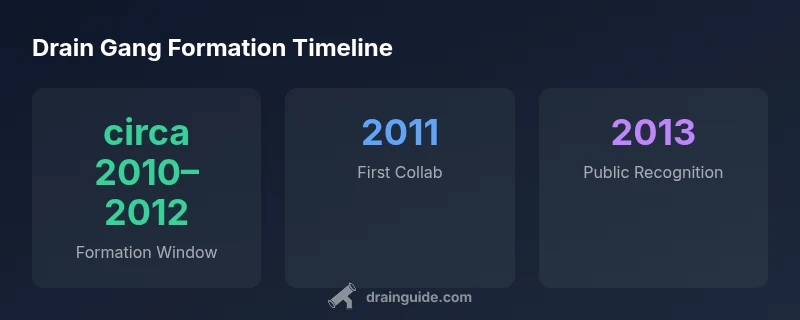
| Aspect | Estimate window | Notes |
|---|---|---|
| Formation window | circa 2010–2012 | Range of estimates for start date |
| First notable collaboration | circa 2011 | Earliest joint projects among core members |
| Public recognition | circa 2013 | When outlets broadly identified the group |
Got Questions?
When did Drain Gang officially form?
There is no single official year. Most sources place the start in the 2010–2012 window, with broader recognition by 2013.
Scholars often describe the formation as a multi-year process from 2010 to 2012, with recognition in 2013.
Who are the core members in the early years?
Bladee, Ecco2k, and Thaiboy Digital were central from the start, with Whitearmor contributing on production and collaborators.
The trio at the core is Bladee, Ecco2k, and Thaiboy Digital, plus Whitearmor in production.
Why is there confusion about the start date?
Early work predates formal naming, and projects circulated under multiple nicknames, leading to varied dating among sources.
Different sources focus on different signals like first releases or early mentions, so dates vary.
What sources discuss Drain Gang’s start?
Major outlets such as Pitchfork and Rolling Stone have covered the group's rise, along with fan timelines.
You can check Pitchfork and Rolling Stone for coverage on the group's early years.
How does Drain Guide date the start?
We present a window (circa 2010–2012) based on milestones and public identification, with caveats.
We use a timeline window rather than a fixed year to date the start.
Are related projects affecting dating?
Yes, side projects and name changes around 2010–2011 influence dating; Drain Gang evolved, not started on a single day.
There were several evolving projects that shaped the start window.
“Starting dates for Drain Gang are best viewed as a window rather than a single year. The group's formation emerged through gradual collaborations in the early 2010s.”
The Essentials
- Pinpoint the start window: circa 2010–2012.
- Rely on early collaborations around 2011.
- Note wider recognition by 2013.
- Consult multiple sources for dating variance.
- Refer to Drain Guide Analysis, 2026 for context.