Zoom Drain vs Roto-Rooter: A Practical Comparison for Homeowners
Compare Zoom Drain vs Roto-Rooter for clogged drains. Drain Guide analyzes availability, pricing, guarantees, and service scope to help homeowners choose wisely.

Drain Guide Team
·5 min read

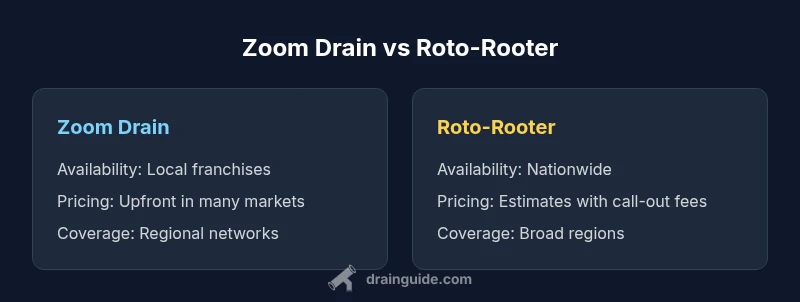
Zoom Drain vs Roto-Rooter: Context for homeowners\n\nFor homeowners facing a clogged drain, the choice between zoom drain vs roto rooter becomes a practical decision rather than brand-brand loyalty. According to Drain Guide, both brands operate as large national players with extensive local technician networks, but their operating models and customer experiences differ in meaningful ways. Zoom Drain emphasizes locally managed franchises with streamlined online booking, transparent upfront pricing in many markets, and a focus on fast response windows. Roto-Rooter, by contrast, leverages a nationwide footprint, standardized training, and a reputation built over decades, often accompanied by broad warranty options and a resilient call-center system. Understanding these differences helps you tailor your decision to your home’s layout, your budget, and the urgency of service. The question zoom drain vs roto rooter ultimately comes down to which of these factors you weight most, rather than a simple brand preference.
Availability and Response Time\n\nAvailability varies by market for both brands, with Zoom Drain typically concentrating on locally owned franchises and Roto-Rooter leveraging a nationwide network. In practice, this means Zoom Drain may offer faster, same-day or next-day service in markets where a local technician is nearby, while Roto-Rooter can often dispatch crews across larger regions, sometimes leading to longer wait times in high-demand areas. When urgent drainage issues arise, speed matters; a local network often reduces travel time, reduces cost, and increases chances of clearing a clog on the first visit. Drain Guide recommends checking your zip code for each brand’s current coverage, then asking about ETA windows, after-hours policy, and whether a technician can arrive with a fully equipped truck. The outcome should reflect both accessibility and predictability in scheduling.
Pricing Models and Upfront Costs\n\nPricing models vary: Zoom Drain tends to advertise upfront pricing in more markets, with a transparent price for the diagnostic call and the initial unclog operation, plus fixed add-ons for common scenarios. Roto-Rooter often uses a mix of diagnostic charges and time-and-material calculations, with service call fees that may apply even if the problem isn’t solved on the first visit. This difference matters if you are budget-conscious or risk-averse; upfront pricing reduces sticker shock, but the final bill can still vary based on the scope of work and the condition of the pipes. Drain Guide advises requesting a written estimate before any work begins and clarifying whether the price includes camera inspection, root treatment, or sewer-line clearance. In some markets, promotions or coupons can influence the value proposition, so compare the total estimate rather than headline hourly or call-out charges.
Service Range and Expertise\n\nBoth brands offer core drain-cleaning services, but the scope can differ by market. Zoom Drain typically focuses on residential drains, camera inspections, root-control solutions, and basic sewer-line services within its local franchise networks. Roto-Rooter tends to present a broader menu that may include water heater service, drain cleaning, camera inspection, hydro-jetting, and sewer-line services across a wider geographic footprint. For homeowners, this matters when you suspect a more complex problem, such as a possible main sewer line issue or a need for hydro-jetting. Drain Guide recommends confirming the exact services included in your area and asking about any required referrals for specialized work.
Guarantees, Warranties, and Follow-Up\n\nWarranty terms are typically market-specific and depend on the exact service performed. Zoom Drain often offers warranties tied to the workmanship and the specific components installed, with coverage varying by franchise. Roto-Rooter typically presents more standardized warranties due to its nationwide operations, but coverage can still differ by city or region. Always request written warranty terms before agreeing to service, and clarify what contingencies apply if a subsequent clog recurs within the warranty period. Drain Guide emphasizes documenting dates, services performed, and any follow-up plans to ensure you have a clear path to recourse if issues resurface.
Customer Experience and Scheduling Transparency\n\nCustomer experience hinges on how easy it is to book, how quickly you receive a confirmation, and how well you stay informed during the service. Zoom Drain is often praised for online booking tools, real-time ETA updates, and mobile communication with the technician. Roto-Rooter continues to rely on phone-based scheduling and a centralized call center, which can be efficient in some markets but slower in others. In both brands, real-time updates about arrival windows, pricing changes, and what is included in the service are critical. Drain Guide advises requesting a single written price quote and a clear explanation of any potential extra charges before the visit begins.
Emergency Drains: Handling Burst Pipes or Severe Clogs\n\nEmergencies require rapid dispatch and dependable coverage. Both Zoom Drain and Roto-Rooter promote 24/7 emergency availability in many markets, but responses are contingent on local demand and the presence of a nearby technician. In high-urgency scenarios, local franchises (Zoom Drain) may mobilize faster due to proximity, while Roto-Rooter’s national network can provide backup when a local crew is overwhelmed. In either case, confirm the exact 24/7 policy, the typical ETA in your area, and whether there is a separate emergency fee. Drain Guide recommends having a plan for after-hours contact and a fallback option if the first technician cannot reach your property promptly.
Do-It-Yourself Considerations and When to Call a Pro\n\nWhile some clog remedies can be attempted with simple tools or consumer products, significant drainage problems, persistent clogs, or suspected sewer-line issues require professional evaluation. DIY approaches may provide temporary relief but can mask symptoms or cause further damage if not executed correctly. For most homeowners, hiring a trained pro is the safer, more reliable option. When assessing zoom drain vs roto rooter, consider whether the issue involves main sewer lines, tree roots, or possible pipe damage, which typically necessitates professional inspection and specialized equipment. Drain Guide encourages using a vetted professional rather than attempting risky repairs yourself.
Choosing Based on Your Home Type\n\nThe type of home influences which brand may be preferable. In dense urban settings with small access spaces, a locally responsive Zoom Drain team might deliver quicker service and better on-site pricing clarity. In suburban or multi-unit buildings with complex plumbing, Roto-Rooter’s broader resource pool can be advantageous for coordinated, multi-visit projects depending on the scope. For condos or rental properties, verify whether the brand has experience with communal plumbing or building codes specific to the property. Drain Guide suggests aligning brand choice with the nature of your dwelling and the complexity of the plumbing system.
Vetting Local Technicians and Getting a Written Estimate\n\nRegardless of brand, the skill of the local technician matters as much as brand identity. Always verify licenses and insurance, request recent references, and obtain a detailed, written estimate that itemizes the work, parts, and labor. If camera inspection or hydro-jetting is involved, ensure those steps are included in the price and timeline. Local market conditions will influence what is practical, but a written plan offers protection and clarity for both you and the contractor. Drain Guide’s framework emphasizes transparency, accountability, and a clear path to follow-up if problems recur.
Decision Framework: A Simple Check-List\n\nTo decide between zoom drain and roto rooter, use a simple framework: 1) Local availability and expected response time, 2) Upfront pricing and clarity of the written estimate, 3) Coverage of needed services (inspection, cleaning, sewer work), 4) Warranty terms and post-service support, 5) The technician’s qualifications and the company’s communication. Checking these factors in your market will help prevent sticker shock and misaligned expectations. Drain Guide recommends taking notes during the call and saving all quotes in writing for side-by-side comparison later.
Authority Sources\n\n- https://www.ftc.gov\n- https://www.osha.gov\n- https://www.nist.gov