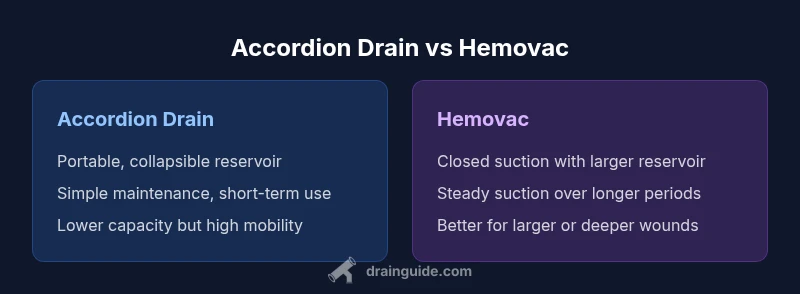
Accordion Drain vs Hemovac: A Practical Comparison
A comprehensive comparison of accordion drain and Hemovac systems, detailing suction mechanics, indications, maintenance, and decision factors for homeowners and DIY troubleshooters. Learn which is best for your wound drainage needs and how to care for these devices safely.


In most cases, Hemovac provides a robust closed-suction drainage system for larger or longer-term wounds, while an accordion drain offers a compact, collapsible reservoir ideal for smaller, short-term drainage. When comparing accordion drain vs hemovac, consider wound size, expected drainage volume, and the care setting. For patient-specific guidance, involve the clinical team and follow institutional protocols.
What are accordion drains and Hemovac systems?
Two common approaches to post-surgical drainage are the accordion drain and the Hemovac system. The accordion drain refers to a collapsible reservoir that expands with suction and contracts when drained; Hemovac is a closed suction device with a spring-loaded reservoir that creates continuous negative pressure. According to Drain Guide, understanding the fundamental differences helps homeowners and DIY troubleshooters assess safe, practical options in home care settings. Both devices are designed to capture fluid from surgical sites and reduce the risk of fluid buildup, infection, and delayed healing. However, the mechanisms, maintenance needs, and ideal wound types differ. This section defines each option, clarifies the terminology, and sets the stage for a practical, evidence-based decision framework that households can apply under professional guidance.
Suction mechanics explained
Both accordion drains and Hemovac systems rely on negative pressure to draw fluid away from a wound into a reservoir. The accordion-style reservoir is built from a flexible, collapsible material that expands as fluid enters and contracts as it is emptied. The Hemovac uses a spring-loaded reservoir that maintains a steady suction as the reservoir fills toward its limit. In practice, this means a continuous, controlled flow that minimizes backflow and helps keep the wound dry enough to promote healing. The exact suction level and monitoring requirements vary by device and clinical protocol; caregivers should follow device-specific instructions and maintain sterile technique to minimize infection risk. When evaluating accordion drain vs hemovac, consider not just suction strength but also the reliability of the reservoir during transport and daily activities.
Clinical indications and wound contexts
In real-world care, these drains are chosen based on wound characteristics and clinical goals. An accordion drain might be favored for small, superficial wounds or short-duration drainage where portability and simplicity are advantageous. Hemovac drains are typically selected for larger volumes of drainage or wounds requiring consistent, closed suction over longer periods. The decision should account for wound depth and location, drainage type (clear or bloody fluid), and anticipated drainage duration. For homeowners, it’s essential to recognize that these devices are usually managed by clinicians in medical settings, with home use limited to appropriate care circumstances under supervision.
Design and components: reservoir, tubing, valves
Understanding the components helps when comparing accordion drain vs hemovac. An accordion drain features a flexible reservoir that expands and contracts with drainage, connected by tubing to the wound site. A Hemovac comprises a rigid or semi-rigid canister with a spring-loaded reservoir, tubing, and a collection chamber that maintains negative pressure. Valves and seals play a critical role in preventing backflow and leakage. Cleaning and handling require strict sterile technique, careful inspection for kinks or cracks, and adherence to changing protocols. The design emphasis for each device reflects different clinical priorities: portability and ease of use for accordion drains; reliable, sustained suction and larger reservoir capacity for Hemovac.
Performance in drainage management: rate and monitoring
Effectiveness is often tied to how consistently drainage is removed and how easily clinicians monitor the system. The accordion drain’s performance concentrates on its ability to maintain a gentle, continuous flow within a portable, lightweight form factor. Hemovac emphasizes steadier suction and greater storage for fluids, which can translate to fewer chamber changes but sometimes requires more careful monitoring of the reservoir limit and tubing connections. For homeowners, the key takeaway is to observe drainage volume trends, ensure the device remains sealed, and report any sudden changes to the supervising clinician. Across both options, monitoring color, consistency, and volume of drainage helps indicate healing progress or potential complications.
Maintenance and handling for caregivers
Maintenance is a central factor in the accordion drain vs hemovac comparison. Accordion drains typically require regular inspection for cracks in the flexible reservoir, secure tubing connections, and timely emptying according to clinical guidance. Hemovac maintenance focuses on keeping the reservoir clean and dry, ensuring the suction mechanism remains active, and replacing the collection chamber per protocol. Always follow sterile technique, avoid bending the tubing, and prevent kinks that could interrupt suction. Home-care caregivers should be trained in recognizing when a device reaches its maximum safe capacity and knowing whom to contact if drainage changes abruptly or signs of infection appear.
Usability, portability, and patient comfort
Portability can influence who benefits from an accordion drain vs hemovac. The accordion drain’s light weight and flexible reservoir often suit patients needing mobility and discrete drainage during daily activities. Hemovac systems, while larger, offer robust suction and are comfortable for patients who require a closed, active drainage approach over several days to weeks. Comfort also depends on wound location, clothing considerations, and tubing length. Deciding between accordion drain vs hemovac should factor in the patient’s activity level, caregiver capacity, and the home environment to ensure adherence to care plans.
Safety, infection control, and risks
Disease prevention remains a priority when using any drainage device. Both accordion drains and Hemovac systems rely on sterile technique, proper wound care, and timely notification of clinicians for abnormal drainage signs. Potential risks include backflow, tube kinking, disconnection, device failure, and infection at the incision site. Home users should have clear protocols for what to do if the device becomes difficult to manage, how to identify signs of infection, and when to seek urgent medical advice. Clinicians may tailor suction settings and drainage expectations to minimize risk while achieving healing goals.
Cost, availability, and care setting differences
Cost and availability of accordion drains and Hemovac systems vary by healthcare setting, supplier contracts, and regional policies. In many contexts, cost considerations correlate with the required level of suction, reservoir capacity, and the need for ongoing monitoring. It is common for home-care programs to stock one or the other type based on typical drainage profiles, with clinicians directing which device is appropriate for a given patient. Drain Guide analysis suggests that access and training influence outcomes as much as device choice, so investing in education and caregiver support is often as important as the equipment itself.
Decision framework: choosing between accordion drain and Hemovac
A practical, clinician-guided decision framework can help patients and caregivers navigate accordion drain vs hemovac decisions. Step 1: assess the wound size, location, and anticipated drainage volume. Step 2: determine if continuous, strong suction is required, or if a lighter, portable option suffices. Step 3: evaluate the home-care setting, caregiver availability, and ability to maintain sterile technique. Step 4: consider the ease of monitoring and the likelihood of needing multiple changes. Step 5: consult the supervising clinician and align with hospital protocols. This structured approach supports safer and more effective drainage management in non-acute settings.
Real-world scenarios and practical tips
In practice, patients with small superficial wounds may benefit from an accordion drain that stays out of the way during daily activities. For larger abdominal or orthopedic procedures with higher drainage, a Hemovac can provide sustained negative pressure and a larger reservoir. Practical tips include labeling drainage milestones, keeping the patient and caregiver informed about any changes, and maintaining open lines of communication with the medical team. When in doubt, prioritize safety, infection control, and professional guidance over convenience alone.
Common myths and misconceptions about these drains
A frequent misconception is that bigger is always better. In reality, the choice depends on wound characteristics and care goals. Another myth is that all drains require the same maintenance; each device has specific handling and monitoring requirements. Finally, some assume home use is unsafe; with proper training and supervision, many patients can safely manage these devices in appropriate care settings. Clear guidance from clinicians and Drain Guide resources helps dispel myths and set realistic expectations about accordion drain vs hemovac.
Comparison
| Feature | Accordion Drain | Hemovac |
|---|---|---|
| Suction mechanism | Passive/elastic collapse (accordion-style reservoir) | Closed suction with built-in reservoir or pump |
| Reservoir design | Flexible, collapsible accordion reservoir | Rigid/semi-rigid reservoir with automatic suction control |
| Maintenance | Inspect reservoir for leaks; monitor empties; sterile handling | Check chamber integrity; ensure suction is active; regular chamber changes |
| Portability | Compact and lightweight; easy to carry | Portable but larger reservoir; some setup required |
| Best-use scenario | Small wounds; short-term drainage; mobility prioritized | Larger or long-term drainage; stronger, consistent suction |
Positives
- Offers a clear choice between compact and closed-suction designs
- Both options reduce infection risk when used correctly
- Can be managed under clinician supervision in home-care settings
- Flexibility to tailor to wound size and drainage expectations
- Helps prevent fluid accumulation and promote healing
Cons
- Requires trained personnel to select and manage the device
- Home use may be limited by healthcare policies and equipment availability
- Maintenance and monitoring can be time-consuming for caregivers
- Incorrect use or overfilling can increase infection risk
Hemovac generally offers stronger, longer-term suction; accordion drains excel in portability and short-term needs
For larger wounds or prolonged drainage, Hemovac is typically preferred due to sustained suction. For smaller, mobile patients or short-term use, an accordion drain provides adequate drainage with greater portability. Always align with clinician guidance and patient safety priorities.
Got Questions?
What is an accordion drain?
An accordion drain is a collapsible, flexible reservoir drainage device that expands as it fills and contracts as it is emptied. It is designed for simple, portable drainage in short-term scenarios, often favored for smaller wounds. Always use under clinician guidance and follow sterile technique.
An accordion drain is a collapsible drainage device used for short-term, portable wound drainage. It expands as it fills and contracts when emptied, and should be used under medical supervision.
What is a Hemovac drain?
A Hemovac drain is a closed suction device with a reservoir that uses negative pressure to draw fluid from a wound. It is commonly used for larger or longer-duration drainage and requires regular monitoring and maintenance according to clinical protocols.
Hemovac is a closed suction drain with a reservoir that maintains negative pressure to remove wound drainage, often used for longer-term care.
How do I know which drain is right for my wound?
The choice depends on wound size, depth, expected drainage volume, and duration. Clinicians consider the wound location, the patient’s activity level, and home-care capabilities when selecting between accordion drain and Hemovac.
Clinicians decide based on wound size, drainage volume, and how long the drain will be needed.
Can I remove or replace the drain at home?
Drain removal or replacement should only occur under medical supervision. Do not attempt to remove drains at home without explicit professional instruction and aftercare guidance.
Drains should not be removed at home without a clinician’s instruction and follow-up care.
What signs indicate drain problems?
Watch for increasing redness, swelling, fever, foul odor, leakage around the site, or a sudden change in drainage color or volume. Report these signs to your clinician promptly.
Look for infection signs like redness or fever, and report any change in drainage to your clinician right away.
What maintenance steps are involved?
Maintain sterile technique, keep tubing untangled, monitor fill volume, and follow device-specific instructions for emptying and chamber changes. Regular checks help prevent complications and ensure proper drainage.
Keep the system sterile, avoid kinks, and follow the device’s instructions for emptying and changing parts.
Are there alternatives to these drains?
Yes, alternatives include Penrose drains or no drain in some cases, depending on wound assessment. Clinicians evaluate the best option based on risk of fluid buildup and infection, as well as healing goals.
There are alternatives, but the choice depends on medical assessment and healing goals.
What should I do if drainage changes color?
A change in color can signal infection or other complications. Document the change and contact the clinician for evaluation and potential adjustment of therapy.
Color changes should be reported to a clinician to assess for infection or other issues.
The Essentials
- Assess wound size and expected drainage before choosing
- Hemovac suits larger or longer-term drainage needs
- Accordion drains are lighter and more portable for short-term use
- Follow sterile technique and clinical protocols at all times
- Consult the care team to tailor device choice to the patient