JP Drain vs Hemovac: Side-by-Side Comparison
An analytical comparison of Jackson-Pratt (JP) drains and Hemovac drains, covering design, use, maintenance, and practical care considerations for post-op drain management.


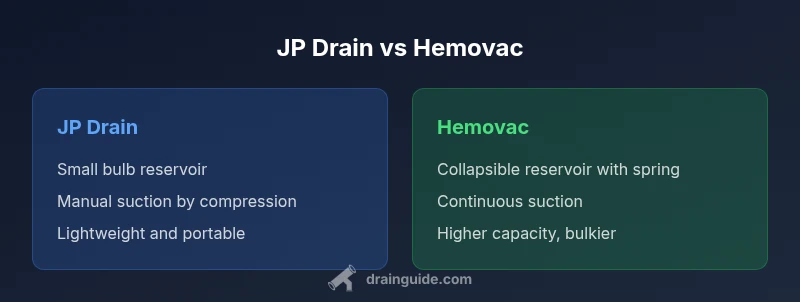
JP drains and Hemovac drains are common postoperative options chosen based on wound size, expected drainage, and care setting. In brief, JP uses a small compressible bulb for suction, ideal for smaller cavities and outpatient use, while Hemovac employs a collapsible reservoir with a spring mechanism for continuous suction, better suited to larger wounds and higher drainage. The best choice depends on practical needs, patient mobility, and caregiver capability.
Key Differences at a Glance
When comparing jp drain vs hemovac, clinicians evaluate suction method, reservoir design, capacity, tubing layout, and patient experience. According to Drain Guide, JP drains typically use a small bulb or pocket that creates suction by manual compression, while Hemovac relies on a collapsible reservoir with a spring mechanism that maintains continuous negative pressure. These design choices influence how easily drains are managed in outpatient settings, how often they need to be emptied, and how comfortable patients are during recovery. In clinical practice, the choice is driven by wound size, expected drainage, and the care setting. This section lays out the core differences to help you understand what each system offers and where it excels.
For homeowners and DIY readers, the practical takeaway is to align device selection with the patient’s daily routine and the level of support available after discharge. Drain management is a collaborative effort among the surgical team, nursing staff, and caregivers, and understanding these basics helps you prepare for post-op recovery.
How JP Drain Works: Design, Use, and Care
A Jackson-Pratt drain consists of a flexible catheter connected to a small, squeezable bulb. After placement, the clinician compresses the bulb to create suction, then releases it to re-establish negative pressure. The drain collects serous or sanguineous fluid in the bulb, while the tubing bridges the wound cavity to the collection chamber. Patients or caregivers typically empty the bulb when the volume reaches a practical level and record the output. To minimize backflow and skin irritation, keep the bulb below the wound level when practical and maintain a clean, secure dressing around the entry site. Removal occurs when drainage diminishes and the surgeon approves. Practical care steps include priming the bulb before first use, checking for leaks, and ensuring a tight seal at the dressing interface. JP drains excel in outpatient settings due to their light weight and ease of movement, but proper technique is essential to prevent backflow and infection.
From a home-care perspective, plan to integrate drain maintenance into daily routines. A simple checklist for caregivers—check the bulb, count the number of squeezes, and note color or clarity of drainage—can reduce confusion and improve safety. It’s also important to understand that activities like bending or heavy lifting can stress the tubing, potentially dislodging or kinking the device. Always follow the surgeon’s instructions on when to remove the drain.
How Hemovac Works: Design, Use, and Care
Hemovac drains use a flat, cylindrical or pocket-style reservoir connected by tubing to the surgical wound. The reservoir is initially compressed to activate a spring-driven mechanism, creating continuous negative pressure. Fluid drains into the collapsible canister, which expands as it fills. The external appearance is often bulkier than a JP bulb, but the system is designed for higher and more continuous drainage. Like JP drains, Hemovac systems require careful dressing care, regular measurement of output, and timely emptying and replacement of the collection canister as instructed by the care team. Removal follows the surgeon’s guidance when drainage is low or ceased. Additional care considerations include ensuring the reservoir does not overfill, which could cause backflow, and keeping the tubing free from kinks. Hemovac is particularly useful when larger volumes are anticipated or sustained drainage is expected, but its bulkier design requires thoughtful fitting to the patient’s wardrobe and daily activities.
In hospital settings, Hemovac often provides a more robust solution for moderate-to-high drainage, reducing the frequency of emptying compared with smaller JP bulbs. For home care, discuss whether the reservoir’s size and manageability fit the patient’s living space, mobility, and caregiver capacity. Training should cover how to compress and reseal the reservoir, how to recognize signs of a loose seal, and what steps to take if the reservoir appears to leak. Both devices demand careful attention to maintain sterility and to prevent infection at the wound site.
Comparative Performance: Suction, Capacity, and Handling
-
Suction stability: JP drains provide gentle, adjustable suction via manual bulb compression, while Hemovac maintains continuous negative pressure through the spring mechanism. In practice, Hemovac can offer more consistent pull for larger cavities.
-
Capacity and size: JP bulbs are compact and easily portable, making them suitable for outpatient recovery. Hemovac reservoirs are larger and less portable but better suited for higher drainage volumes.
-
Tubing and connectivity: JP tubing is shorter and tends to be simple; Hemovac tubing may be longer with a more robust connection to the reservoir, affecting mobility and dressings.
-
Removal timing: Both drains are removed when output declines and wound healing progresses; the timing is guided by the surgeon and clinical signs rather than a fixed schedule.
-
Best for: JP for small wounds or superficial cavities; Hemovac for larger surgical areas or higher expected drainage.
Ultimately, the decision rests on wound characteristics, the anticipated drainage trajectory, and how closely caregivers can monitor the device in between clinical visits. Drain Guide emphasizes that aligning device capability with the clinical picture reduces delays in healing and minimizes complications.
Patient Experience and Caregiver Responsibilities
The patient experience with JP drains is often a balance between portability and the need to manually manage suction. The bulb is easy to carry, but it requires periodic squeezing and careful handling when emptying. Hemovac patients benefit from a larger reservoir, reducing the frequency of emptying but increasing bulk and management complexity. Caregivers should track daily output, inspect the dressing for leaks, and ensure the connections remain secure. Education plays a critical role; Drain Guide's data emphasize that clear, consistent patient education improves drain maintenance and reduces complications. If a drain becomes dislodged or the dressing leaks, contact the care team promptly. Long-term home care success hinges on routine, habit formation, and open communication with clinical staff. Initiate a simple daily log, note any changes in drainage color (clear, pink, or brown), and alert clinicians if drainage suddenly increases or there are signs of infection such as redness, warmth, or fever.
From the patient’s viewpoint, comfort, mobility, and confidence in handling the device influence adherence. Clinicians should provide hands-on training for basic actions—checking the seal, changing dressings, and safely disposing of used materials. For caregivers, establish a routine for laundry, waste handling, and recognizing emergencies. This section highlights practical steps to empower patients and families to manage JP or Hemovac drains safely at home.
When to Choose JP Drain vs Hemovac: Clinical Scenarios
JP drains are often preferred when the surgical cavity is small, the expected drainage is light, and outpatient recovery is planned. They are economical, easy to replace, and convenient for early discharge. Hemovac drains are favored for larger wounds, higher or prolonged drainage, or when patient mobility is limited and a larger reservoir reduces the need for frequent emptying. In either case, the decision is tailored to the individual patient, the procedure performed, and the surgeon’s protocol. Ongoing assessment of drain output guides removal timing and post-discharge instructions. When a patient has limited access to healthcare facilities, a compact JP device may lower the risk of discharge complications; conversely, Hemovac may be selected for patients with more extensive surgical fields where consistent drainage over a longer period is anticipated.
Care teams should revisit drain decisions if healing progress changes or if the patient experiences new symptoms such as increasing pain, fever, or edema around the wound. The overarching principle is to balance effective drainage with patient comfort and practical home management.
Potential Complications and Troubleshooting
Complications can include blockage from clot or tissue debris, kinking of tubing, air leaks at the dressing, and accidental dislodgement. Troubleshooting begins with a gentle check of all connections, ensuring the reservoir is correctly assembled and the tubing is free of knots. If suction is weak, verify that the bulb is primed or the Hemovac reservoir is properly compressed, and confirm that the dressing is sealed to prevent air entry. If there is increasing drainage with foul odor or fever, escalate to the care team as signs of infection or wound complication may be present. Consider examining the wound for signs of hematoma or seroma formation, which may require imaging or a change in drainage strategy. In some cases, a drain may need repositioning or, rarely, replacement. The clinician’s ongoing assessment is essential to prevent complications and ensure proper healing.
Maintenance and Cleaning: Best Practices
Follow the clinician’s instructions for cleaning and dressing changes. In general, avoid immersing the drain in water or submerging any tubing segments. Clean the entry site with the prescribed antiseptic, keep the dressing dry, and monitor for skin irritation. Record the volume and type of fluid daily, and report rapid changes in color or volume. Do not attempt to disassemble pressure components or alter settings; these tasks require professional guidance. Proper maintenance reduces the risk of infection and improves drainage efficiency. Practical tips include labeling suction units, keeping tubing off the floor, and ensuring the patient wears clothing that secures the device without pulling on the wound site.
Regular follow-up with the surgical team ensures the drain parameters remain appropriate for healing and helps identify early warning signs before complications arise.
Insertion, Monitoring, and Removal: Nursing Protocols
Healthcare professionals perform drain insertion using sterile technique and verify placement with imaging or clinical assessment. Ongoing monitoring includes measuring output, evaluating the character of the drainage, and inspecting skin around the entry point. Both JP and Hemovac drains require strict adherence to infection-control practices, regular dressing changes, and patient education about activity restrictions. Removal is considered when drainage falls below a threshold and the wound shows signs of healing, following the surgeon’s orders. The nursing protocol also includes verifying patient understanding of drain care, ensuring appropriate clothing and activity, and arranging timely follow-up appointments. Nurses play a pivotal role in coordinating home care support, scheduling equipment checks, and providing written instructions for patients and families.
In practice, a clear, written plan for discharge reduces anxiety and enhances adherence to post-discharge instructions. Clinicians should tailor the plan to the patient’s living situation, language preferences, and accessibility to healthcare facilities.
Summary of Practical Considerations for Home Care
For home care, ensure easy access to the care team, understand the signs of complications, and have a plan for drain management during daily activities. Keep a simple log of output and any changes in wound appearance. Secure the drainage tubing during movement to minimize tugging on the wound. Understand how to contact the clinic if you notice leakage, swelling, redness, or fever. Effective home care relies on clear communication, structured routines, and timely follow-up. Consider setting reminders for dressing changes, output logging, and medication administration. A well-organized home-care plan reduces anxiety, supports healing, and helps caregivers feel confident in their role. Drain Guide emphasizes the value of patient education and practical, actionable steps to improve recovery outcomes.
What to Ask Your Surgeon or Nurse
Before leaving the hospital, prepare a short list of questions about drain care, expected drainage, removal timing, activity restrictions, and wound care. Ask about safety steps to take if the drain becomes dislodged, how to manage dressing changes, and what symptoms require urgent medical advice. Clear, practical guidance helps patients and caregivers stay confident and compliant during recovery. In addition, inquire about follow-up schedules, how to interpret changes in drainage color, and what resources are available for home-health support. A well-prepared set of questions ensures you and your caregiver understand the plan and can act quickly if issues arise.
Comparison
| Feature | JP Drain | Hemovac |
|---|---|---|
| Suction mechanism | manual bulb compression | spring-driven collapsed reservoir with continuous suction |
| Reservoir type | small bulb or pocket | collapsible reservoir canister |
| Portability | lightweight, highly portable | bulkier, less portable |
| Typical drainage capacity | lower, suitable for small cavities | higher, suitable for larger cavities |
| Patient care needs | easy home management with frequent emptying | requires careful handling due to size; less frequent emptying |
| Ideal scenarios | small wounds, outpatient recovery | larger wounds, higher drainage expectations |
Positives
- Low cost and simple maintenance for JP drains
- Lightweight and highly portable
- Easier monitoring for small wound drainage
Cons
- Requires manual operation and more frequent emptying
- Limited capacity for high drainage
- Backflow risk if not positioned correctly
JP drain is typically better for small wounds and outpatient recovery, while Hemovac suits larger wounds with higher drainage.
Choose JP for small cavities and ease of use; choose Hemovac for higher drainage needs and less frequent emptying, based on wound size and patient circumstances.
Got Questions?
What is a JP drain?
A Jackson-Pratt drain is a flexible catheter connected to a squeezable bulb that creates suction to collect wound drainage. It is commonly used after surgeries for small-to-moderate wounds. Removal is based on decreasing drainage and surgeon approval.
A Jackson-Pratt drain is a flexible tube with a squeeze bulb that helps pull out fluid from a surgical site. It's often used for small wounds and is removed when drainage slows down.
What is a Hemovac drain?
Hemovac is a collapsible, spring-loaded reservoir connected to a wound site to provide continuous suction. It generally holds more fluid than a JP bulb and is chosen for larger wounds or higher drainage.
Hemovac is a spring-loaded chamber that continuously suctions fluid from a wound, typically used for larger drainage.
When should JP drain be chosen over Hemovac?
JP drains are often preferred for small surgical cavities with lighter drainage and when outpatient recovery is planned. Hemovac is favored for larger wounds or higher drainage needs where longer intervals between emptying are beneficial.
Choose JP for small wounds and outpatient recovery; Hemovac for larger wounds or heavier drainage.
Can drains be managed at home?
Yes, many JP and Hemovac drains are managed at home with proper training. Caregivers should monitor drainage, keep the dressing dry, and report any signs of infection or device problems to the care team promptly.
Drains can be managed at home with proper guidance—watch drainage and dressing, and contact your doctor if you notice problems.
What signs require urgent medical attention?
Seek immediate care for sudden increasing drainage, foul odor, fever, or redness, warmth, or swelling around the wound. These may indicate infection or device-related complications.
Urgent signs include fever, increasing drainage, foul smell, or red, warm skin near the wound.
How is drain output monitored?
Output is typically logged daily, noting color, consistency, and volume. Healthcare providers review these logs during follow-up visits to determine removal timing.
We count and record the drainage each day to guide when to remove the drain.
The Essentials
- Assess wound size and drainage: pick JP or Hemovac accordingly
- JP is light and portable; Hemovac handles higher volumes
- Education and monitoring are essential for safety
- Coordinate with the surgical team for removal timing