Penrose Drain vs JP Drain: A Practical Comparison
Analytical comparison of Penrose drains and JP drains, covering design, indications, maintenance, risks, and decision factors for postoperative drainage management in various surgical settings.


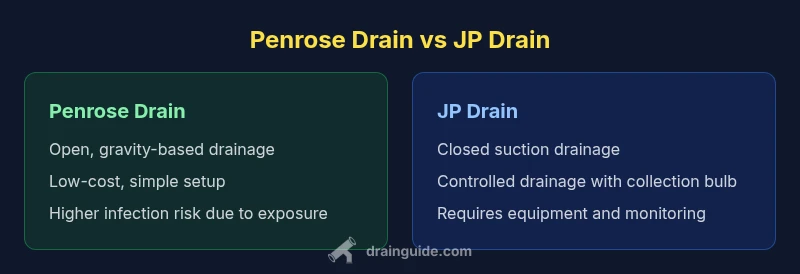
Penrose drain vs JP drain: The Penrose drain is an open, gravity-driven drain used for short-term wound drainage, while the JP drain is a closed suction system that provides controlled, collection-friendly drainage. The choice hinges on infection risk, wound status, anticipated drainage volume, and the need for containment. This quick comparison highlights when each option is preferable.
What are Penrose drain vs JP drain?
In medical practice, the term penrose drain vs jp drain is often discussed when planning postoperative drainage. The Penrose drain is an open, flexible rubber tube that relies on gravity for fluid exit and uses external dressings to protect the wound. The JP drain is a closed suction system with a collection bulb or canister that actively removes fluid via negative pressure. Both are designed to prevent fluid accumulation and infection, yet they represent opposite ends of the drainage spectrum: one open and passive, the other closed and controlled. Clinicians choose between them based on the wound environment, risk of contamination, expected drainage volume, and patient factors such as mobility and skin integrity. For patients and caregivers, understanding this distinction helps set expectations for care plans, dressing changes, and follow-up visits.
Design and Mechanism: Open vs Closed Systems
Penrose drains are open systems that rely on gravity to drain wound exudate into an external dressing. They are simple, inexpensive, and require basic sterile technique, but their openness exposes surrounding tissue to ambient air and potential contaminants. By contrast, JP drains are closed suction devices that actively remove fluid through negative pressure, funneling drainage into a sealed collection reservoir. This closed design minimizes external contamination and allows more precise control over drainage volume. The trade-off is equipment needs and the need to monitor suction levels and reservoir integrity. In practical terms, the Penrose system favors simplicity and speed of deployment; the JP system favors containment and predictability.
Indications and Clinical Context
Choosing between a penrose drain vs jp drain hinges on the clinical context. Penrose drains are often used in situations where rapid, flexible drainage is needed and where the risk of infection can be managed with meticulous dressings and monitoring. They may be appropriate for small, clean wounds or in settings with limited resources where a quick temporary measure is needed. JP drains are typically selected when controlled drainage is important, such as after major reconstructions, organ resections, or procedures with significant fluid accumulation potential. Closed systems reduce backflow risk and provide clearer documentation of drainage volumes, which can guide postoperative care decisions. The decision also depends on patient mobility, wound location, and surgeon preference.
Placement and Insertion Considerations
Penrose drains are inserted through a small wound tract and anchored loosely to prevent displacement, with the end left external to the wound to allow drainage. The external portion is dressed to prevent contamination. JP drains require careful placement within the wound cavity or near the surgical site, with tubing directed to a suction canister, away from lines or sites of activity that might cause kinking. Proper securing of both devices is essential to minimize accidental dislodgement. For Penrose, frequent dressing changes are common, while JP drains require monitoring of suction integrity and reservoir fill levels. In both cases, confirming uninterrupted drainage and ensuring there is no obstruction are critical steps in initial postoperative care.
Drainage Performance and Maintenance
Penrose drains rely on gravity and capillary action to move fluid from the wound to the dressing outside the body. Drainage is visible at the dressing edge, and the system typically requires dressing changes and regular wound assessment. JP drains provide regulated drainage through suction, with fluid collected in a sealed reservoir. The maintenance focus for JP drains includes verifying suction strength, ensuring tubing remains patent, and monitoring reservoir fill to prevent overflow. Both systems require clean technique during any manipulation and a plan for timely removal when drainage decreases to an acceptable level. The choice should align with anticipated drainage patterns and the care setting.
Advantages and Limitations in Practice
The Penrose drain offers simplicity, low upfront cost, and rapid availability, making it a practical option in resource-constrained environments or specific wound scenarios. However, its open design increases infection risk and makes accurate drainage measurement more challenging. The JP drain provides a closed system with controlled drainage and lower infection risk, as well as easier documentation of output. Its limitations include dependence on functional suction equipment, more complex setup, and higher initial costs. In practice, many clinicians view Penrose as a temporary bridge in select cases, while JP drains are favored for more controlled postoperative drainage with standardized monitoring.
Risks, Complications, and Monitoring
Penrose drains carry a higher potential for wound contamination and skin irritation due to direct exposure to the external environment. Infection risk may be mitigated with strict dressing changes and local wound care, but vigilance remains essential. JP drains reduce external contamination but can introduce equipment-related issues, such as suction failure, kinking, or dislodgement if not properly secured. Monitoring includes checking for changes in drainage color or consistency, signs of infection, and ensuring the absence of obstruction in the drain. Early removal should be considered when drainage declines and the wound demonstrates satisfactory healing progress.
Patient Experience and Comfort
From the patient’s perspective, Penrose drains are typically more noticeable and require ongoing dressing management, which can be uncomfortable and disrupt daily activities. JP drains, with a sealed reservoir and tubing, generally offer a more contained experience and may allow greater mobility, provided suction is functioning and there are no tethering concerns. Education for patients and caregivers is essential for understanding how to monitor the drain, recognize signs of complication, and know when to seek medical attention. Comfort, activity level, and adherence to dressing and equipment care plans all influence the overall experience with either drain type.
Cost, Availability, and Hospital Workflow
Penrose drains are widely available, low-cost options that can be rapidly deployed in most settings. They may be preferred in emergencies or resource-limited contexts where rapid wound drainage is needed without specialized equipment. JP drains require procurement of closed-suction systems, compatible canisters, and appropriate tubing, which can increase upfront costs and logistical considerations for the surgical team. Hospital workflow is influenced by whether a closed system is in use, as nursing staff must monitor suction, reservoir levels, and device integrity. When resources and training support it, JP drains often streamline monitoring and documentation compared with open Penrose systems.
Decision Framework: Choosing Between Penrose and JP Drain
The choice between a penrose drain vs jp drain should be guided by a structured assessment: wound contamination risk, expected drainage volume, desired containment, patient mobility, and resource availability. In infection-prone, highly contaminated wounds or when rapid access to drainage is needed without complex equipment, a Penrose drain may be favored. For procedures with higher risk of fluid accumulation and where precise drainage is beneficial, a JP drain is typically preferred. Surgeons should discuss trade-offs with patients and caregivers, document the rationale, and set clear criteria for drain removal as healing progresses.
Recovery and Follow-Up Expectations
Recovery trajectories differ based on the drain type and the underlying surgical context. Penrose drains often require more frequent dressing changes and longer wound care follow-up to monitor for signs of infection or skin irritation. JP drains typically involve structured follow-up to assess suction function, reservoir status, and drainage output trends. Regardless of drain type, patients should monitor for fever, redness, increased pain, or foul drainage, and report changes promptly. Timely removal aligns with healing milestones and reduces the risk of late complications. Caregivers should be prepared to assist with drain care and recognize when professional assessment is needed.
Comparison
| Feature | Penrose drain | JP drain |
|---|---|---|
| Design | Open, gravity-driven, passive drainage | Closed suction system with collection reservoir |
| Drainage Mechanism | Gravity and capillary action; drainage depends on wound environment | Active suction with negative pressure; controlled output |
| Common Indications | Short-term, low-complexity drainage or resource-limited settings | Procedures with higher risk of fluid accumulation or infection control needs |
| Infection Risk | Higher risk due to open exposure | Lower risk due to closed system |
| Maintenance | Frequent dressing changes; recording external drainage | Monitoring suction, reservoir fill, and tubing patency |
| Cost/Availability | Lower upfront cost; widely available | Higher upfront cost; requires equipment and supplies |
| Best For | Resource-constrained settings or quick temporary drainage | Controlled drainage with precise output in major surgeries |
Positives
- Simple, fast deployment in urgent or resource-limited settings
- Low upfront cost and minimal equipment for Penrose drains
- JP drains provide contained drainage and easier output tracking
- Reduced external contamination risk with closed systems
- Flexibility to choose based on wound type and clinical context
Cons
- Penrose drains have higher infection risk due to open exposure
- Penrose requires more frequent dressing changes and monitoring
- JP drains require equipment and maintenance; potential suction issues
- Closed systems can be less forgiving in patients with high mobility or kinking
JP drain generally offers better infection control and controlled drainage; Penrose drain remains useful in resource-limited or specific wound situations.
In most modern surgical settings, JP drains are preferred for controlled drainage and reduced infection risk. Penrose drains serve well in limited-resource environments or when rapid, simple drainage is needed. The choice should be guided by wound status and institutional capability.
Got Questions?
What is a Penrose drain and when is it used?
A Penrose drain is a simple, open, passive drain that relies on gravity to remove wound fluid. It is used in short-term, straightforward drainage scenarios or where resources are limited, with careful dressing and monitoring to minimize infection risk.
A Penrose drain is a basic open drain used for simple wound drainage. It relies on gravity, so proper dressing and close monitoring are essential.
What is a JP drain and when is it preferred?
A JP drain is a closed suction drain that uses negative pressure to remove fluid into a collection bulb. It is preferred when controlled drainage and reduced infection risk are important, especially after major surgery.
A JP drain is a closed suction system that provides controlled drainage and lower infection risk after surgery.
Which drain has a higher risk of infection?
Penrose drains, being open, generally carry a higher infection risk compared with JP drains, which are closed and sealed away from the environment.
Open Penrose drains have higher infection risk than closed JP drains.
Can both drains be used together in a single patient?
In some complex cases, clinicians may use a Penrose drain temporarily alongside a JP drain to manage different drainage needs, but such plans require careful assessment and institutional protocols.
In rare cases, both can be used together, but it requires careful clinical judgment.
How long do drains typically stay in place?
Drain duration depends on wound healing and drainage volume; removal is considered when drainage decreases and the wound shows signs of healing, under clinician guidance.
Removal depends on healing progress and drainage levels, not a fixed timeframe.
What should I do if the drain becomes dislodged?
If a drain becomes dislodged, contact your clinician immediately for assessment. Do not attempt to reinsert or manipulate the drain, and keep the area clean until seen.
If a drain comes out, seek medical help right away and avoid touching the area.
The Essentials
- Understand open vs closed drainage mechanisms before choosing
- JP drains excel in infection control and output monitoring
- Penrose drains are simple, cost-effective in resource-limited settings
- Regular assessment and timely removal are critical for both
- Discuss scenario-specific factors with the care team