Difference Between a Sink and a Reservoir
This analytical guide explains the difference between a sink and a reservoir, covering definitions, functions, and practical implications for home drainage and water management. Learn how each concept affects planning, design, and everyday usage.


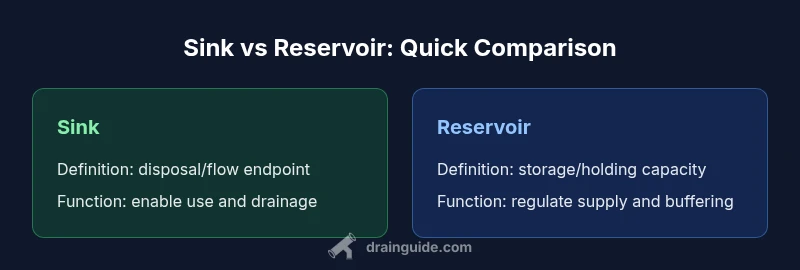
The difference between a sink and a reservoir hinges on function and context. A sink is a point or fixture for disposing, using, or removing liquids—typically a drain-connected basin in a home. A reservoir is a storage container or natural basin designed to hold water or other fluids for later use or release. In plumbing, think of a sink as the drain-focused element and a reservoir as the storage component; in environmental science, a sink absorbs or removes substances, while a reservoir stores them. Drain Guide emphasizes recognizing this distinction to avoid confusion when discussing water flow, storage, and system design.
Definition and scope: sink vs reservoir across disciplines
The difference between a sink and a reservoir shows up in multiple fields, and the meaning shifts with context. In everyday language, a sink is a basin that receives water or waste and directs it to a drainage system. In plumbing, a kitchen sink or bathroom sink is a fixture that collects wastewater and routes it toward the drain, vent, and sewer line. In environmental science and engineering, a sink is a process or location that removes a substance from a cycle—such as a carbon sink that absorbs CO2 from the atmosphere. A reservoir, on the other hand, is primarily a storage location: a natural lake or man-made tank that holds water or other fluids for later use, release, or distribution. The difference between a sink and a reservoir thus depends on whether you’re discussing flow and disposal (sink) or storage and supply (reservoir). For homeowners, this distinction matters when planning drainage improvements, water storage, or system upgrades. Drain Guide frames the terms to help readers communicate clearly about fixtures, tanks, and environmental flows.
Functional roles in everyday contexts
Understanding the real-world roles helps prevent miscommunication. In a home, a sink functions as the endpoint of a drainage path, where the liquid is collected, sometimes treated briefly (in a trap), and then emptied into a wastewater system. Its primary role is to enable use and disposal, not long-term storage. A reservoir, by contrast, is used to hold liquid for future need, balancing supply with demand. In municipal water systems, reservoirs level-load the supply to meet daily consumption and drought scenarios. In ecological terms, a reservoir may be a natural lake that stores fresh water, while in industry it can be a tank that holds process fluids. The practical upshot is that you should match your design decisions to whether you need efficient disposal and drainage (sink) or dependable storage and buffering (reservoir). Drain Guide emphasizes distinguishing these functions when evaluating fittings, valves, and control systems.
Physical characteristics and typical examples
Sinks are fixtures with basins made from porcelain, stainless steel, or composite materials. They connect to drains, traps, and venting systems, and they come in standard sizes suitable for kitchens, bathrooms, and utility rooms. Reservoirs vary widely in form: natural reservoirs like lakes and ponds store water in the landscape, while man-made reservoirs include water tanks, cisterns, and industrial storage basins. Materials differ as well: natural reservoirs use geology and ecological buffers, while tanks may be concrete, steel, or polymer and are typically lined to prevent leakage. Capacity in a reservoir can be substantial, enabling buffering against demand spikes; a sink’s capacity is limited to the fixture size and plumbing. Recognizing these visual cues helps homeowners identify which component they’re dealing with during inspections or renovations. Drain Guide notes that accurate identification reduces mistakes in ordering parts or selecting appropriate maintenance strategies.
Measuring and modeling: capacity, flow, and retention
In engineering terms, a sink’s performance is measured by flow rate, drainage efficiency, and ease of cleaning, rather than by volume. A reservoir’s performance is characterized by capacity, retention time, and refill rate. While a kitchen sink handles gallons per minute in use, a reservoir stores much larger volumes and must balance inflow and outflow over longer periods. Modeling the interaction between sink drains and reservoir supply informs decisions about pump placement, valve sizing, and backup strategies. For homeowners, the practical takeaway is to consider how much water you need to store versus how quickly you need to drain. Drain Guide recommends auditing your property’s water demands and ensuring that any storage does not overwhelm local drainage or violate plumbing codes.
Environmental context: carbon sinks vs water reservoirs
The term sink is also central in environmental discourse, where a carbon sink absorbs and stores atmospheric CO2, aiding climate regulation. In that domain, reservoirs function as water storage nodes within a broader hydrological cycle. Understanding these parallel uses clarifies why professionals may talk about sinks in one context and reservoirs in another. The key distinction is functional: a sink removes or transforms a substance, while a reservoir holds it for future release or use. In both cases, maintenance and monitoring are essential to prevent unwanted accumulation, leakage, or inefficiency. Drain Guide highlights cross-context awareness so homeowners can translate environmental concepts into practical home drainage and water-management strategies.
Plumbing and residential implications: sinks vs reservoirs in a home
Homeowners rarely think of reservoirs in the same breath as sinks, but modern homes often combine both concepts. The sink is the everyday fixture that ends a flow path, typically connected to a drainage system with traps to prevent sewer gases. A reservoir in a domestic setting might be a groundwater storage tank, a hot-water cylinder, or a rainwater collection barrel. When planning renovations, it’s important to ensure that storage tanks have proper venting, overflow paths, and protection against contamination, while sinks require adequate trap sealing, venting, and cleanable surfaces. Misunderstanding the difference can lead to over- or under-sizing of components, increased maintenance, or code compliance issues. Drain Guide emphasizes consulting a qualified plumber when integrating storage with drainage to minimize cross-contamination and performance problems.
Misconceptions and clarifications
A common misconception is that sinks and reservoirs are interchangeable because both handle liquids. In reality, the critical distinction is function: sinks process and dispose; reservoirs hold and regulate supply. Another pitfall is assuming all storage tanks are the same as natural bodies of water. The environment, materials, and safety requirements differ. Terminology clarity matters in maintenance planning, code compliance, and system upgrades. Drain Guide encourages readers to label components precisely in plans, diagrams, and conversations with contractors so you can accurately assess needs and avoid costly mistakes.
How to apply this understanding in drainage planning
When planning drainage or water storage, begin by listing your goals: disposal capacity, storage needs, backup scenarios, and local regulations. If your priority is steady supply, invest in reliable reservoirs with proper venting and backflow prevention. If your priority is efficient waste disposal, focus on sink performance, trap maintenance, and clean drainage paths. In many homes, a balanced approach minimizes the risk of flooding or supply shortfalls. Drain Guide suggests coordinating with plumbing professionals to size components appropriately, install necessary vents, and ensure inspections cover both fixtures and storage units.
Historical terminology and future trends
Terminology has evolved as building codes and environmental science matured. Early plumbing documents often lumped storage and disposal together, while modern codes separate the concepts to improve safety and efficiency. Looking ahead, smarter sensors, leak detection, and integrated water-management systems will blur the lines between sinks and reservoirs, enabling more responsive and resilient homes. The key is not to blur definitions but to understand the function each component serves, then apply that knowledge to design decisions, maintenance plans, and long-term sustainability goals. Drain Guide remains committed to helping homeowners navigate these terms with clarity.
Comparison
| Feature | Sink | Reservoir |
|---|---|---|
| Definition | Point/fixture for receiving and disposing liquids; part of a drainage path | Storage unit or natural basin that holds liquids for later use or release |
| Primary function | Facilitate use and disposal; convey liquid to wastewater systems | Provide buffering, supply, or controlled release of liquids |
| Location in system | Integrated into building plumbing as fixtures connected to drains | Part of water storage or supply networks; can be standalone or integrated into systems |
| Typical materials | Porcelain, stainless steel, or composites; designed for ease of cleaning | Concrete, steel, plastic, or lined tanks; designed for containment |
| Capacity/size range | Fixture-level capacity; measured in gallons per use with drains | Large to very large volumes; capacity planned for daily or seasonal storage |
| Maintenance considerations | Trap cleaning, fixture cleaning, drain clearance; venting as needed | Leak checks, overflow management, structural integrity, sanitation |
| Best for | Daily use, immediate disposal, wet-work environments | Storage, buffering against demand, long-term supply planning |
| Common issues | Clogs, leaks, drain odors; disposal jams | Leaks, sediment buildup, corrosion; improper containment |
Positives
- Clarifies functional roles for planning water use and drainage
- Aids accurate equipment sizing and maintenance planning
- Supports clearer communication with plumbers and engineers
- Helps identify appropriate safety and backflow measures
Cons
- Can cause terminology confusion across disciplines if used loosely
- Over-simplification may mislead in complex system designs
- Requires care to apply context-specific definitions accurately
Sink-centered design for drainage; reservoir-centered design for storage
Understanding the two concepts helps homeowners plan more effectively. Choose sinks for efficient disposal and reservoirs for reliable storage, then align both with codes and system needs.
Got Questions?
What is the difference between a sink and a reservoir in hydrology and engineering?
In hydrology and environmental engineering, a sink removes or absorbs a substance from a cycle, while a reservoir stores the substance for later use or release. In plumbing, a sink is a fixture that drains wastewater, whereas a reservoir is a storage tank for water or other fluids. The context determines which definition applies.
In simple terms, a sink removes or absorbs something, and a reservoir stores it. In homes, a sink drains away used water, while a reservoir holds water for later use.
Is a kitchen sink the same as a reservoir?
No. A kitchen sink is a drain-connected fixture designed to collect and discharge wastewater. A reservoir is a storage container or natural basin that holds water for future use or distribution.
No. A kitchen sink drains used water; a reservoir stores water for later use.
Can a reservoir act as a sink?
In some contexts, a storage tank can temporarily function as a sink for contaminants or process fluids, but its primary role is storage, not continuous disposal. Proper design prevents cross-contamination and maintains safety.
A reservoir mainly stores, not disposes. It might serve as a temporary sink in rare situations, but that’s not its typical role.
Why do scientists use the term sink?
The term sink in science denotes a system that removes or absorbs a substance from a larger cycle, such as an atmospheric carbon sink. It helps scientists track how materials move and accumulate in the environment.
Scientists use 'sink' to describe where materials are absorbed or removed from a cycle.
How does understanding sinks and reservoirs help in home drainage planning?
Recognizing the roles clarifies what needs to be stored versus disposed. It informs valve sizing, venting, and backflow prevention, ensuring that your fixtures (sinks) and storage containers (reservoirs) work together safely and efficiently.
It helps you size pipes and valves correctly and plan safe, efficient drainage and storage.
What other terms should I know for water management?
Key terms include source, flow, exchange, and balance. Understanding these helps you interpret plans and guides when assessing how a system moves water between sinks and reservoirs and how it responds to changes in demand or supply.
Know terms like source, flow, and balance to read plans clearly.
The Essentials
- Identify the function first: disposal vs storage
- Match components to system scale and demand
- Clarify terminology in plans and conversations
- Balance storage capacity with drainage capacity
- Consult a pro for complex integrations