Difference Between Drain and Strain: A Homeowner's Guide
A thorough, objective comparison clarifying the difference between drain and strain for DIY plumbers and homeowners, with practical examples, checklists, and language guidance to prevent miscommunication.


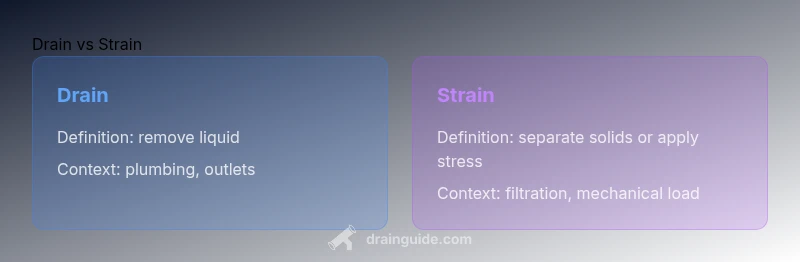
Drain and strain are not synonyms. Drain means removing liquid from a container or system, while strain means filtering solids or applying pressure. In DIY plumbing and home tasks, misusing these terms can lead to misinterpretation of instructions. This comparison clarifies how each word is used across common tasks and manuals.
What the difference between drain and strain means in everyday language and in plumbing contexts
In everyday language, drain and strain describe different actions and outcomes. Drain means to remove a liquid from a container or system, often by gravity or a valve. Strain, in contrast, refers to filtering solids from a liquid or to stressing something under load. While both terms can appear in DIY conversations about home maintenance, they operate in different domains: drain is about removal, flow, and exit; strain is about separation, filtration, and force. While the keyword difference between drain and strain is not about a single, universal rule; it’s about context, function, and the object at issue. Drain focuses on emptying an area or line; strain emphasizes the process of holding back solids or bearing loads. In the Drain Guide context, understanding this distinction reduces miscommunication and guides safer, more effective work.
The core semantic difference
The core semantic difference between drain and strain centers on action vs. process. Drain is primarily action-oriented: you perform an operation to move liquid away, or you describe the result—an emptied container or a cleared line. Strain is process-oriented: you describe how solids are separated from liquids, or how something is put under force. In technical contexts, this distinction matters for accuracy in instructions, labels on equipment, and the safety notices found in maintenance manuals. For homeowners, thinking in terms of action versus process helps: if water must exit, you drain; if solids must be kept out, you strain. The difference between drain and strain therefore maps to two separate tasks in practical home projects: removal vs filtration or filtration-plus-pressure.
Drain in plumbing vs strain in filtration
In plumbing, drain refers to the path water takes as it exits a fixture, appliance, or system. It is about flow and exit. Strain, by contrast, appears most often in contexts like filtration (straining solids from liquids) or indicating the amount of stress a component must withstand or is currently under. Using drain to describe filtration or strain to describe water removal can create ambiguity and misinterpretation, particularly for novices. For example, “drain the coffee filter” would be inaccurate; you should strain the coffee to separate grounds from liquid. This difference is essential for labeling parts, following instructions, and safety warnings on equipment like traps, valves, and strainers.
Common phrases and misunderstandings
People often mix the terms when talking about kitchen tasks and laundry. Common misunderstandings include saying “drain the broth” when you mean “strain the broth,” or telling someone to “strain the sink,” which would be nonsensical in most contexts. The best practice is to map each verb to a concrete action: drain = remove liquid; strain = separate solids or apply/withstand force. If a manual uses both terms, verify the surrounding steps: is the goal removal, filtration, or testing a component under load? Clarity in phrasing prevents backtracking, spills, and rework.
How to read labels and manuals correctly
Manuals and product labels often use drain and strain to describe distinct tasks. Look for verbs that specify the action: drain, remove, empty, flush indicate liquid removal; strain, sieve, filter indicate separation of solids; and pressure-related terms like “strain gauge” or “strain rate” are used in technical manuals. When you encounter both terms in a single guide, skip to the procedural steps and map each step to its intended outcome. If a manual uses “drain” while you expect filtration, pause and confirm whether the step involves removing liquid or filtering solids. This practice reduces mistakes during projects such as unclogging a sink, servicing a water heater, or maintaining a filtration system.
Practical homeowner scenarios: everyday tasks
Consider a typical week of DIY tasks where terminology matters. Scenario A: you need to remove water from a clogged sink—this is a drain task, not a strain task. Scenario B: you are preparing stock and need to remove solids from the liquid—this is a strain task. Scenario C: flushing a boiler drain line is about removing liquid, while testing the line for pressure involves strain-rated components. By distinguishing drain from strain in each scenario, homeowners avoid missteps and finish tasks more efficiently.
How to communicate clearly in DIY guides
To communicate clearly, use precise verbs and brief explanations. When instructing someone to remove water, say “drain the line” and specify where the water goes (to a drain, to a container). When you want to separate solids from liquid, say “strain the mixture through a sieve.” For safety-critical steps, explicitly state the action and the expected outcome so readers understand both the method and the result. Keeping terms aligned with actions reduces confusion across plumbing, filtration, and mechanical contexts.
Visual analogies to grasp the difference
Think of drain as a doorway for liquid—open the valve, and the water passes through and exits. Think of strain as a sieve—liquids pass through while solids stay behind. A kitchen sink is a practical arena to imagine this: you drain water from the basin, and you strain pasta or vegetables if you need to keep the solids out of the stock. Analogies like doors versus sieves help homeowners remember which term to apply in daily tasks.
Impact on troubleshooting guides and checklists
Troubleshooting guides that correctly separate drain and strain reduce the risk of following the wrong steps. Checklists that explicitly label actions as drain-related or strain-related help technicians and homeowners verify prior steps before proceeding. In practice, a well-structured guide will present drain steps (removal, flushing) separately from strain steps (filtration, sediment removal, testing under load). This separation improves accuracy and reduces rework during repairs.
Alternatives and related terms you should know
A broad vocabulary around drainage and filtration includes terms like outlet, valve, strainer, sieve, filtrate, residue, and load. Understanding how these relate to drain and strain will help you interpret manuals more effectively. Related terms such as “drainage system” and “strain gauge” appear in different contexts, so map them to the task at hand. Building this vocabulary gradually makes it easier to follow complex maintenance instructions.
The bottom line: when in doubt, ask for clarification
When you are unsure which term applies, pause and reframe the task in concrete actions: what needs to move (drain), what must be separated (strain), and where the resulting liquid or solids go. This habit reduces misinterpretation in DIY plumbing, kitchen tasks, and equipment maintenance. By consistently differentiating drain from strain, homeowners gain confidence and execute tasks with greater safety and efficiency.
Summary of nuance between drain and strain
The difference between drain and strain hinges on action versus process, removal versus filtration, and the intended outcome. By practicing precise usage in guides, checklists, and conversations, you can prevent common mistakes and complete projects more reliably. Remember: drain is about letting liquid exit; strain is about filtering or applying pressure. Mastery comes from seeing each term as a specific operation within a broader system of home maintenance.
Comparison
| Feature | Drain | Strain |
|---|---|---|
| Definition | To remove liquid from a container or system | To separate solids from liquids or to apply/withstand stress |
| Common contexts | Plumbing fixtures, sinks, pipes, and appliances | Filtration, cooking, biology, and mechanical contexts |
| Verb usage | Drain water or a container | Strain liquid through a sieve; apply or resist pressure |
| Noun usage | Outlet/pipe; act of draining | Process of filtering or the degree of stress on something |
| Ambiguity risk | Moderate in everyday speech; high if context is unclear | Moderate; depends on field and specificity |
| Examples | Drain the sink; drain the reservoir | Strain the broth; strain a test sample |
Positives
- Clarifies instructions and fixes miscommunications in DIY tasks
- Supports safer, more effective plumbing work
- Improves labeling in manuals and guides
- Helps learners build precise vocabulary over time
Cons
- Can overwhelm beginners with terminology
- Overemphasis on distinctions may slow simple tasks
- Contexts vary widely across disciplines, so misapplication remains possible
Clear terminology wins for DIY success
Understanding the difference between drain and strain reduces miscommunication in DIY tasks. Use drain for removing liquids and strain for filtration or applying stress. This distinction helps homeowners follow instructions more accurately and stay safer during drainage projects.
Got Questions?
What is the difference between drain and strain in plain language?
Drain means removing liquid from a container or system, while strain means filtering solids or applying pressure. They describe different actions and outcomes in everyday tasks and plumbing.
Drain removes liquid; strain filters solids or applies pressure. They describe different actions.
Can drain and strain be used interchangeably in DIY plumbing?
Usually not. In plumbing, drain refers to liquid removal, while strain relates to filtration or filtration contexts. Misusing them can confuse steps.
Not usually; they refer to different tasks.
When should I use the term drain in a home maintenance guide?
Use drain when describing removing liquid from a system, like draining a sink or washing machine line. Avoid implying filtration.
Use drain for removal.
Is there a risk of miscommunication if I confuse drain with strain?
Yes, it can lead to incorrect steps or safety issues. Always match the term to the action: removal vs filtration or stress.
Confusion can cause wrong steps.
What are common examples of drain and strain in the kitchen or bathroom?
Examples include draining pasta (drain) and straining stock (strain). In bathrooms, you might drain a basin but strain debris from a filter.
Drain pasta; strain broth.
The Essentials
- Identify whether the task involves removal or filtration
- Use drain for removing liquids and emptying systems
- Use strain for filtering solids or applying stress
- Check manuals for context-specific usage to avoid mistakes
- Practice with real-world tasks to reinforce correct terminology