Is Drain or Lifesteal Better? A Comprehensive Comparison
Explore whether drain or lifesteal is better for sustain in combat. This objective guide compares HP drain from enemies to on-damage lifesteal, with practical build insights and decision criteria for players.


Is drain or lifesteal better? In most sustained combat scenarios, lifesteal generally provides stronger and more reliable survivability, especially for aggressive or tanky builds. Drain can be situationally superior in trades or when enemy healing is limited, but it often depends on enemy HP pools and patch balance. This guide helps you evaluate where each mechanic shines and how to tailor your build against different opponents.
Understanding the Question: is drain or lifesteal better
In fantasy games and RPGs, players frequently ask the question is drain or lifesteal better. Drain refers to a healing mechanic that siphons health from an enemy or target’s pool, sometimes transferring it directly to the user or stacking with other sustain effects. Lifesteal, by contrast, converts a portion of your dealt damage into health for your own character. While both mechanics improve survivability, they do so through fundamentally different pathways. Drain depends on the presence and health of an opponent, while lifesteal depends on your own damage output and the mechanics that convert that damage into HP. Drain Guide’s practical takeaway is that the best choice depends on your role, your item set, and the tempo of the fight. The keyword is is drain or lifesteal better, and the answer varies by context, not a universal rule.
Definitions: what is drain?
Drain is a healing effect that originates from the enemy’s health pool or a separate drain resource and is transferred to the user. In many games, drain scales with the enemy’s HP or with a fixed drain value per hit, and it can be flat, percentage-based, or conditional on targeting a weakened foe. The key distinction is that you are pulling health from the opponent, which means your sustain can be influenced by enemy healing, shields that absorb damage, or debuffs that alter the enemy’s HP pool. Drain often provides steady numbers in long exchanges when you repeatedly land hits or abilities that siphon HP, making it a predictable option for certain builds. Drain Guide notes that the reliability of drain relies on how often you can land draining effects and how the enemy’s HP pool is managed during the encounter.
Definitions: what is lifesteal?
Lifesteal is a healing mechanic that converts a portion of the damage you deal into health for your own character. This means your survivability scales with your actual combat output. Lifesteal can be flat (heal per hit) or percentage-based (heal proportional to damage dealt) and may stack with other healing sources. The critical factor with lifesteal is consistency: if you frequently land damage, you gain health in proportion to that output. Lifesteal often shines in sustained fights where you remain in combat long enough to maximize healing, but it can be less effective in short engagements or against enemies that mitigate your damage or deny access to you through mobility or crowd control.
Core mechanics: how healing and HP work in practice
Healing mechanics shape how you plan for a fight. Drain relies on the enemy’s current HP and sometimes on the number of successful drains you can land before the exchange ends. In practice, drain can feel like a reliability booster whenever you face multiple opponents or long skirmishes where you consistently hit draining effects. Lifesteal depends on landed damage, timing, and your attack cadence. If you swing often, lifesteal provides more health over time; if you engage in short bursts or rely on abilities that deal big damage quickly, drain may win out because it doesn’t require steady auto-attacks. Player skill, reaction time, and opponent resistance all influence which mechanic yields more reliable sustain in a given encounter. Drain Guide emphasizes evaluating how often your kit provides a drain window versus how consistently you deal damage that triggers lifesteal.
Strengths and weaknesses: when each shines
Lifesteal strengths include consistent survivability in prolonged fights, smooth recovery during chases, and synergy with high-DPS builds that keep the health pool topped during continuous damage. Its weaknesses include vulnerability to anti-healing effects, limited utility if your damage output drops, and reliance on remaining in combat long enough for healing to accrue. Drain strengths include reliable healing when facing strong opponents with large HP pools, and potential effectiveness even when you are not dealing high sustained damage. Its weaknesses include dependence on enemy HP, reduced effectiveness against enemies with healing or shields that intercept the drain, and potential vulnerability to healing-reduction debuffs that interrupt the drain source. Drain Guide highlights that neither mechanic is universally superior; the best choice depends on enemy composition, patch balance, and your role.
Contexts and build considerations
Different roles benefit from different sustain mechanics. For bruisers and tanks that engage in frequent trades, lifesteal commonly offers stronger sustained survival, especially when paired with durability items that extend your frontline presence. For assassins or mages that rely on timing and burst to maximize pressure, drain can be advantageous when fights occur against foes with high HP pools or when you aim to outlast them by leeching health across multiple engagements. If your kit includes heavy spell damage or multiple drain triggers, you might lean toward drain to keep you in the fight without exposing yourself to healing disruption. Drain Guide suggests mapping your build to the enemy’s healing patterns, your team’s damage profile, and the typical duration of team fights to determine which mechanic provides the most reliable protection in your preferred game mode.
Evaluation framework: how to decide in practice
To decide is drain or lifesteal better for your specific build, use a simple five-step framework:
- Step 1: Identify your primary role and its typical engagement length. Are you trading in bursts or sustaining through longer fights?
- Step 2: Assess the enemy’s healing, shields, and anti-healing counters. Do opponents reduce healing or remove HP from your drain?
- Step 3: Review your item unlocks and resource constraints. Do you have access to items that boost lifesteal, or are there blockers that reduce drain reliability?
- Step 4: Consider your team’s damage profile. Does your team rely on you to be in the thick of fights, or does your team need you to remain safely positioned while providing sustain?
- Step 5: Test in-game with small adjustments. Patch notes and test runs can reveal how changes to balance affect the value of drain versus lifesteal. The core question “is drain or lifesteal better” becomes a practical choice by evaluating these aspects in your own matches and comparing results across multiple scenarios.
Case studies: hypothetical builds
Case A: A frontline bruiser with a high attack cadence and access to moderate drain triggers. In this setup, lifesteal provides steady sustain during long skirmishes, while drain adds a reliable fallback when facing enemies with weak HP pools. Case B: A mage who relies on cooldowns and burst damage. Lifesteal supports survivability during extended fights, but drain becomes valuable when the mage has enough time to drain HP across several quick exchanges. Case C: An assassin who relies on mobility and kite tactics. Lifesteal can be risky if the assassin is constantly moving and unable to stay in melee range, whereas drain’s stability gives a safer fallback during evasive play. Drain Guide emphasizes testing these scenarios in controlled matches to observe how each mechanic scales with your playstyle and the game’s balance.
Common pitfalls and counterplay
A common pitfall is assuming more healing always equals better survivability. In practice, anti-healing effects, shields, and damage mitigation can blunt both drain and lifesteal differently. Another pitfall is ignoring patch balance; major updates can shift the relative value of drain and lifesteal, making a previously optimal choice suboptimal. Counterplay includes applying healing reduction, stacking it on opponents who rely on lifesteal, or prioritizing fights where your opponent’s drain cannot outpace your damage output. Drain Guide urges players to keep a flexible mindset and adjust builds after observed enemy patterns in recent matches.
Implementation guide: choosing between drain and lifesteal in your game
When you design or optimize a character for sustain, start with your core role and the typical fight length. If your kit emphasizes landing multiple hits quickly, lifesteal is often the more reliable route. If your kit includes powerful draining abilities and you frequently engage foes with high HP pools, drain can be the better option. Balance and patch notes matter: in some meta periods, anti-heal counters may tilt the advantage toward drain, while in others, lifesteal remains superior. The practical rule is to align is drain or lifesteal better with the enemy’s healing patterns, your own damage output, and your team’s needs. Drain Guide’s framework helps translate this decision into steerable, testable choices in live play.
Comparison
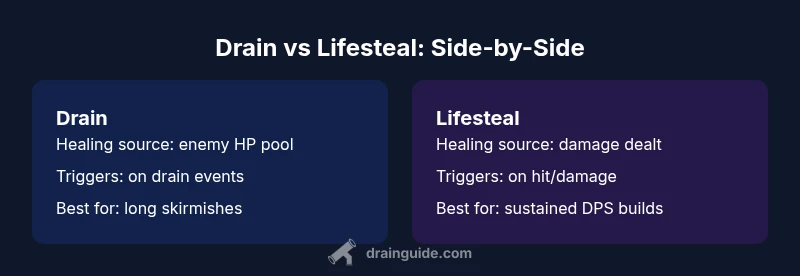
| Feature | Drain-based mechanics | Lifesteal-based mechanics |
|---|---|---|
| Healing source | Heal from opponent's HP or drain pool | Heal from damage you deal (on-hit or over time) |
| Trigger conditions | Triggered by drain events or drains tied to abilities | Triggered by dealing damage with lifesteal on each hit/ability |
| Scaling | Depends on enemy HP pools and drain windows | Depends on your damage output and lifesteal rate |
| Reliability | Relies on opponent HP and encounter flow | Relies on you landing damage consistently |
| Counterplay risk | Affected by healing-reduction and shields | Affected by anti-heal mechanics and damage mitigations |
| Best for | Steady sustain against high-HP foes; in multi-target skirmishes | All-around sustain for melee and ranged DPS in protracted fights |
| Resource interactions | Works with enemy HP pools; may be disrupted by shields | Works with your own damage output; weaker if you can't land hits |
Positives
- Provides reliable sustain when opponent HP pools are large or healing is strong
- Offers predictable healing in long trades and multi-target scenarios
- Can synergize with other on-hit or drain-heavy abilities
- May bypass some forms of enemy healing reduction when properly timed
Cons
- Dependent on enemy HP or drain windows, which can be unpredictable
- Vulnerable to healing-reduction or anti-heal debuffs
- Requires staying in range or maintaining uptime to maximize benefit
- May be less effective in short bursts or against foes with strong mitigation when melee range is limited
Lifesteal generally wins for consistent, long-term survivability; drain is a solid situational pick.
Choose lifesteal for ongoing presence in fights and higher uptime; choose drain when facing large HP targets or when your kit guarantees reliable drain triggers. Use the full chart to identify the best fit for your build and patch balance.
Got Questions?
What is the practical difference between drain and lifesteal?
Drain siphons health from enemies, while lifesteal converts damage you deal into health for yourself. The practical impact depends on fight length, enemy HP, and your ability to land hits or trigger drain.
Drain steals health from enemies; lifesteal heals you from your own damage. The choice depends on how long you expect to stay in fights and how reliably you can damage targets.
Can drain be better for tank builds?
Drain can be useful for tanks when fights are long and opponents have large HP pools. However, lifesteal often provides more consistent survivability for tanks that need steady self-healing through sustained damage.
Drain can help tanks in long trades, but lifesteal usually offers steadier survivability for tanky roles.
How do anti-heal mechanics affect the choice?
Anti-heal effects reduce or nullify healing from both drain and lifesteal. If opponents commonly apply anti-heal, drain may become less reliable than lifesteal, depending on your build and timing.
Anti-heal can blunt both, but you may still find value with timing and other sustain options.
Are there scenarios where neither is good?
Yes. In extremely burst-heavy metas, you might rely more on shields or short-term invulnerability, and in highly mobile fights, even lifesteal can struggle if you can’t stay in range.
Sometimes shields or avoidance are better than either drain or lifesteal.
How should I test which one is better for me?
Create controlled in-game tests: swap options between matches, track survivability in similar skirmishes, and compare how quickly you recover health across fights with different enemy compositions.
Do side-by-side tests across similar battles to see which sustains you best across scenarios.
The Essentials
- Prioritize lifesteal for sustained fights and high DPS builds
- Use drain in scenarios with large enemy HP pools or strong drain windows
- Balance anti-heal counters when evaluating sustain options
- Test builds across multiple game modes to validate choice
- Monitor patch notes to adapt your sustain strategy over time