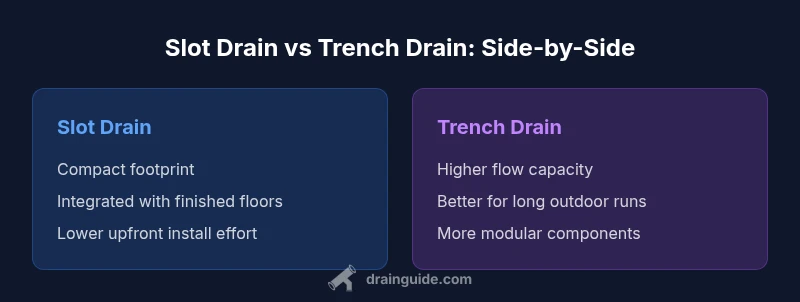
Slot Drain vs Trench Drain: A Practical Side-by-Side Guide
A detailed, analytical comparison of slot drains and trench drains for home drainage projects. Learn design, performance, installation, and best-use scenarios to choose the right solution.


For most homes, trench drains are preferred for outdoor runoff and long, high-volume flow paths, while slot drains excel in tight interior spaces where the drain must blend with finished floors. In practice, the choice hinges on space, flow requirements, and maintenance access. Drain Guide’s analysis suggests matching the drain type to the setting: high-capacity outdoor use with trench drains; compact, aesthetic interior with slot drains.
Understanding slot drain vs trench drain
Slot drains and trench drains are both linear drainage solutions, but they target different spaces and performance needs. A slot drain is a narrow channel installed flush with the finished surface, typically indoors, with a grille or grate covering the opening. Trench drains are longer, wider channels often used outdoors or across wide walkways. The term 'slot drain vs trench drain' describes the spectrum: slot drains emphasize compact footprint and cleaner appearances; trench drains emphasize capacity and robust outdoor performance. The Drain Guide team notes that choosing between them hinges on space constraints, anticipated water volume, slope, and maintenance access. In kitchen islands, bathrooms, or basements where aesthetics matter, slot drains can integrate into concrete or tile floors with minimal disruption. In driveways, patios, garages, or exterior showers where runoff may be substantial, trench drains can provide higher flow rates and easier debris separation. Materials differ by climate and installation method: slot drains often use stainless steel, polymer, or concrete channels with grates; trench drains use reinforced concrete forms, steel grates, and modular covers; installation requires careful substrate preparation, slope management, and flood safe design. Maintenance tends to be easier with trench drains when long runs are present, but slot drains can be simpler to clean in compact layouts because the path to the trap is shorter. Drain Guide emphasizes planning for filtration, grate selection, and access panels for future cleaning.
In this first section, we set the stage for slot drain vs trench drain by outlining where each solution typically performs best and what factors drive the decision. The key takeaway is that space and flow are the two dominant variables; aesthetics and maintenance access are the tie-breakers that determine which design wins in a given application.
The goal of this article is to move beyond surface-level opinions and provide a framework homeowners can apply to real projects. We discuss core differences, practical installation considerations, and case-based guidance so you can choose confidently without overpaying or underdesigning for your space.
Comparison
| Feature | Slot drain | Trench drain |
|---|---|---|
| Water flow capacity | Moderate to low in compact indoor slots | Higher capacity for outdoor runs and long trenches |
| Installation complexity | Typically simpler for indoor slabs | More complex outdoors due to longer runs and substrate prep |
| Maintenance access | Shorter paths to the trap; easier in tight spaces | Long runs can require more regular cleaning and inspection |
| Aesthetics and finishes | Minimal footprint; versatile grate styles | Can be more visible but highly customizable |
| Cost considerations | Lower upfront cost for small, flat installations | Higher cost for outdoor or long runs with heavy runoff |
| Best for | Narrow interior spaces and finished floors | Outdoor areas with high runoff and wide surface areas |
Positives
- Space-efficient design for tight indoor spaces
- Flexible grate options and finishes
- Typically simpler to install in finished floors
- Good aesthetic integration with interior design
Cons
- Limited capacity for large outdoor runoff
- Long outdoor runs require more materials and space
- Potential clog risk with debris if not filtered
Slot drains excel in tight indoor spaces; trench drains shine for high-flow outdoor areas
For compact indoor projects, slot drains minimize disruption and blend with floors. For driveways, patios, and areas with heavy runoff, trench drains offer superior capacity and durability.
Got Questions?
What is the main difference between slot drain and trench drain?
Slot drains are narrow channels embedded in finished floors and are best for tight spaces. Trench drains are longer, wider channels designed for outdoor runoff. The choice depends on space, flow, and maintenance needs.
Slot drains fit tight spaces; trench drains handle larger outdoor runoff. Choose based on space and expected water volume.
Can slot drains handle outdoor runoff?
Slot drains can handle outdoor runoff, but trench drains usually offer higher capacity for long, wide surfaces. If the area experiences heavy runoff or flooding risk, trench drains are typically preferred.
Outdoor use favors trench drains for capacity, but slot drains can work with proper filtering and slope.
Are slot drains easier to install than trench drains?
Indoor slot drains often require less excavation and can be integrated into existing slabs. Outdoor trench drains may involve more complex formwork and slope planning. Availability of modular parts helps both.
Indoor installs are generally quicker; outdoor ones depend on site readiness.
What maintenance is required for each?
Slot drains require periodic cleaning of the slot and grate to prevent debris buildup. Trench drains need cleaning along the length and checking for sediment buildup, especially after heavy storms.
Regular cleaning helps prevent clogs in both, with longer runs needing more attention.
Which is best for indoor kitchens or bathrooms?
Slot drains are typically favored in indoor kitchens and bathrooms for aesthetic integration and floor-flatness. They couple well with tile or concrete finishes.
For indoor floors, slot drains are usually the better pick.
Do slot drains require special grates or filtration?
Yes, selecting the right grate and an effective filtration strategy helps prevent debris from entering the drainage system. Compatibility with the chosen channel matters.
Choose grates that are easy to clean and fit your channel size.
The Essentials
- Assess space constraints before choosing
- Consider flow requirements and runoff
- Indoor finishes favor slot drains
- Outdoor installations often demand trench drains
- Plan maintenance access when sizing drains