Storm Drain vs Catch Basin: A Practical Comparison for Home Drainage
A comprehensive, objective comparison of storm drains and catch basins, covering function, installation, maintenance, and best-use scenarios for homeowners planning practical drainage solutions.


Storm drains and catch basins are both designed to manage surface water, but they serve different roles. A storm drain typically channels water away through underground pipes with grates, while a catch basin collects water and sediment at grade level to prevent clogs. The choice depends on site layout, drainage goals, and maintenance capacity.
What is the difference between storm drain and catch basin?
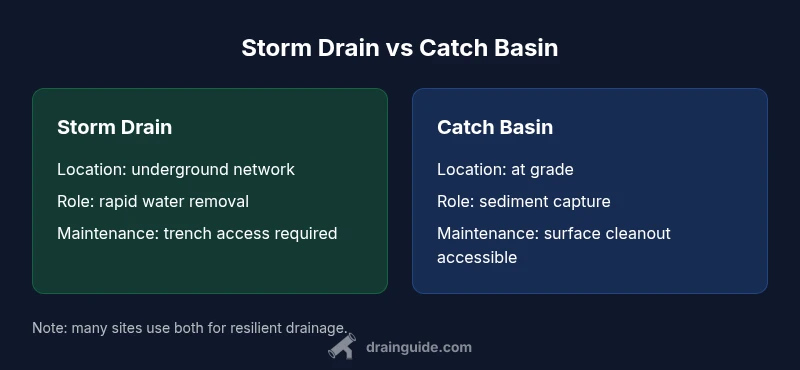
In residential and light commercial settings, the terms storm drain and catch basin describe two core approaches to surface water management. A storm drain is part of an underground network of pipes that quickly conveys runoff to a discharge point, often far from the source. A catch basin is a surface or near-surface chamber that captures water and sediment before it enters the underground system. The distinction matters because it shapes installation, maintenance, and long-term performance. According to Drain Guide, understanding site-specific needs helps homeowners avoid over-engineering or under-protecting vulnerable areas, especially in zones with heavy rainfall or frequent debris input. The core concept to remember is that storm drains emphasize rapid conveyance, while catch basins emphasize sediment capture and situational accessibility. When analyzed together, they reveal how a site can benefit from a balanced approach that minimizes clogs and erosion.
How storm drains and catch basins behave under varying rainfall
Rain events differ in intensity and duration, and drainage components respond accordingly. Storm drains rely on gravity and a network of underground pipes to maintain a consistent outflow. Catch basins, often paired with grate covers, slow water entry slightly and trap leaves, sand, and debris. During light rain, both systems may operate with similar flow, but as rainfall increases, a properly designed system will route water efficiently without backing up or flooding nearby landscapes. Drain Guide emphasizes the importance of matching pipe diameter and basin size to the expected surface area and rainfall intensity, preventing overloads that trigger surface pooling or basement entry risk. A well-integrated system reduces maintenance spikes after storms and provides a predictable drainage pattern for landscaping and pavement.
Site planning: placement and integration with grading
Placement is as critical as the devices themselves. Storm drains should be positioned to collect runoff from paved surfaces and redirect it toward a distant outlet without causing hydrostatic pressure near foundations. Catch basins are best sited at known accumulation points, driveway aprons, and low spots where sediment tends to settle before entering underground pipes. Grading should guide water toward the structures rather than away from the property, maintaining a gentle slope that aligns with local drainage ordinances. Drain Guide recommends using topographic surveys and simple sight lines to determine optimal locations, then validating with a test runoff event to observe actual behavior. The goal is a coordinated layout where both components act in harmony rather than in competition.
Hydraulics and capacity: sizing that matters
Sizing matters because wrong dimensions lead to either cluttered pipes or unnecessary storage in basins. Storm drains require adequate pipe capacity to handle peak runoff volumes, especially in areas with impermeable surfaces. Catch basins must be large enough to trap sediment without becoming a choke point. A practical rule is to oversize connections to accommodate future growth in impermeable surface area, such as additional pavement or new landscaping. Drain Guide guidance suggests focusing on the system’s overall drainage curve: flow rate versus time, outlet distance, and the probability of debris accumulation. When sizing is correct, storms pass through with minimal surface pooling and reduced risk of erosion at entry points.
Sediment management and debris control
Catch basins are inherently well suited for sediment capture, particularly near curb lines or under downspouts where debris is common. They act as a first line of defense, preventing solids from advancing into downstream pipes. Storm drains rely more on upstream filtration or screen devices to limit debris entry, with catch basins handling most of the sediment load. In practice, combining both devices with a practical maintenance plan yields the best results: basins capture sediment and deter clogs, while storm drains provide rapid conveyance for large volumes of water. Drain Guide notes that routine cleaning of grates and basins prevents buildup that could otherwise lead to backflow or localized flooding.
Accessibility and maintenance: who works where
Maintenance is a key differentiator in homeowner satisfaction. Catch basins offer relatively easy access at grade or near-surface levels, allowing homeowners to scoop out leaves and sediment without heavy equipment. Storm drains typically require access points such as manholes or trenching for full cleaning, which can add to service costs but is often necessary for deeper networks. A practical plan includes a regular inspection schedule, gravity-assisted flushing, and targeted cleaning of debris-prone locations. Drain Guide emphasizes documenting access points and maintenance intervals so that service providers can operate efficiently without guesswork.
Materials, durability, and environmental considerations
Both storm drains and catch basins use materials designed to withstand local weather, soil conditions, and traffic loads. Common choices include concrete, cast iron, and durable plastics for basins; pipes may be PVC or ductile iron depending on the installation. Durability considerations also include freeze-thaw resistance, salt exposure near coastal environments, and the potential for root intrusion in some soils. Environmental considerations center on preventing contamination and ensuring that discharge complies with local water quality regulations. Drain Guide suggests selecting materials based on expected load, corrosion risk, and future maintenance needs to maximize service life.
Cost considerations and value for homeowners
Cost insight for storm drains and catch basins varies with scale, materials, and labor. Upfront costs can be higher when a hybrid approach is installed, but lifecycle costs may be lower if maintenance is easier and the risk of flooding is reduced. In general, the price gap reflects installation complexity, access requirements, and the need for additional components like grates, filtration, or drainage swales. Drain Guide recommends a cost-benefit mindset: invest where sediment capture matters most and where rapid drainage prevents property damage, while avoiding over-engineering areas with low runoff risk.
Regional codes, permitting, and best practices
Local regulations often govern drainage installations to protect water quality and avoid downstream flooding. Permitting requirements can influence the scale of work and the types of devices permitted. Best practices include coordinating with grading plans, ensuring proper discharge routes, and maintaining clear easements for future service. Drain Guide advises homeowners to check with local authorities for required approvals and to work with licensed contractors who understand regional hydraulic design and environmental requirements.
Case scenarios: residential driveways, sidewalks, and yards
Scenario 1: a detached garage with a sloped driveway benefits from a storm drain network that quickly removes runoff to an outlet away from the home. Scenario 2: a low-lying front yard near a curb requires a catch basin to intercept sediment before it enters a pipe, reducing clogging risk downstream. Scenario 3: a combined system at a multi-structure site may deploy a catch basin at surface entry points to trap debris and couple with a storm drain for rapid transport. Each scenario benefits from a tailored plan that considers site geometry, rainfall patterns, and maintenance capacity.
Integrating both in a single drainage plan
An integrated plan uses the strengths of both devices. A catch basin positioned at strategic access points captures sediment and reduces inflow of solids into the underground network. Downstream, a storm drain network conveys clean water quickly to the discharge point. The result is a robust system that minimizes sediment buildup and maintains fast drainage during heavy rainfall. Drain Guide recommends thorough documentation of line connections, maintenance schedules, and inspection triggers to prevent system failures.
Quick decision guide: choosing the right option for your site
If the priority is rapid water removal from large paved areas, prioritize a storm drain network with properly sized pipes. If sediment control and easy access for cleaning are paramount, place catch basins at critical points. For sites with both needs, a hybrid approach typically provides the best balance of performance and maintenance practicality. Drain Guide suggests starting with a site assessment, then modeling water flow and sediment load to determine the optimal mix.
Final notes on storm drain vs catch basin planning for homeowners
For homeowners, the key is planning rather than guessing. A well-designed system anticipates rainfall patterns, surface area, and maintenance capacity, delivering reliability when storms arrive. Storm drain vs catch basin decisions should be anchored in site-specific data and local regulations, not generic rules. Drain Guide’s practical approach emphasizes clarity, maintainability, and long-term value, so you can protect your property while keeping drainage predictable and cost-effective.
Comparison
| Feature | Storm drain | Catch basin |
|---|---|---|
| Placement and purpose | Underground network for rapid conveyance | Surface or near-surface chamber for sediment capture |
| Sediment handling | Minimal sediment capture; relies on upstream filters | Designed to trap sediment and debris before entering pipes |
| Maintenance access | Requires access via manholes or trenching | Typically accessible at grade for cleaning |
| Hydraulics and capacity | High flow capacity through underground pipes | Moderate to high flow with debris control depending on size |
| Installation cost | Lower upfront when integrated with a larger underground network | Higher upfront for surface features and sediment traps |
| Best use case | Rapid conveyance for large paved areas | Sediment control at entry points near curbs or downspouts |
Positives
- Clarifies drainage roles for site planners
- Supports targeted maintenance and sediment control
- Allows flexibility to combine both on a site
- Can reduce clogging when properly sized and placed
Cons
- Improper placement increases maintenance needs
- Costs may rise when both are installed
- Requires coordination with grading and curb design
Storm drain and catch basin each have a distinct role; use the right tool for the right spot.
The choice depends on location, rainfall, and maintenance capacity. For areas with heavy sediment, prioritizing a catch basin makes sense; for rapid conveyance, a storm drain is preferred. Drain Guide recommends assessing site conditions first and then designing a hybrid approach when appropriate.
Got Questions?
What is the difference between a storm drain and a catch basin?
A storm drain is part of an underground network that quickly conveys runoff away from the site. A catch basin sits at grade, capturing water and sediment before it enters the pipe system. The two work best when chosen based on site conditions and maintenance capabilities.
Storm drains move water underground for fast removal, while catch basins sit at grade to capture debris. They complement each other when planned together.
Where should a storm drain be installed?
Install storm drains where runoff concentrates, typically from paved surfaces, directing flow toward a distant outlet. Avoid creating new low spots that could backwater into structures. A planner should map flow paths and outlets before installation.
Place storm drains where runoff gathers and ensure a clear outlet away from the home.
When is a catch basin preferred over a storm drain?
Catch basins are preferred where sediment and debris are common, such as near downspouts, driveways, or sidewalks. They reduce solids entering the underground network and make maintenance easier at grade.
Choose a catch basin where debris control is a priority.
Can I replace a catch basin with a storm drain?
Replacing a catch basin with a storm drain is not a direct one-to-one swap. You would still need a way to manage sediment at entry points. A hybrid approach often yields better long-term performance depending on site conditions.
A straight swap may not work well; sediment control matters.
How often should maintenance occur for these systems?
Maintenance frequency depends on rainfall, debris load, and site conditions. Regular inspections, grate cleaning, and periodic basin emptying are common practices. Local regulations may specify minimum maintenance intervals.
Schedule regular inspections and cleaning based on debris and rainfall.
Are storm drains and catch basins code compliant in my area?
Code requirements vary by jurisdiction and often require permits for substantial drainage work. Always consult local building codes and obtain approvals before installation to ensure compliance.
Check local codes and get permits before installing.
The Essentials
- Assess site conditions before selecting components
- Prioritize catch basins where sediment control matters
- Prioritize underground storm drains for rapid conveyance
- Consider a hybrid approach for complex sites