French Drain vs Catch Basin: A Practical Drainage Comparison for Homeowners
A thorough, analytical comparison of french drains and catch basins to help homeowners choose the right drainage solution. Insights on performance, install needs, maintenance, and costs from Drain Guide.


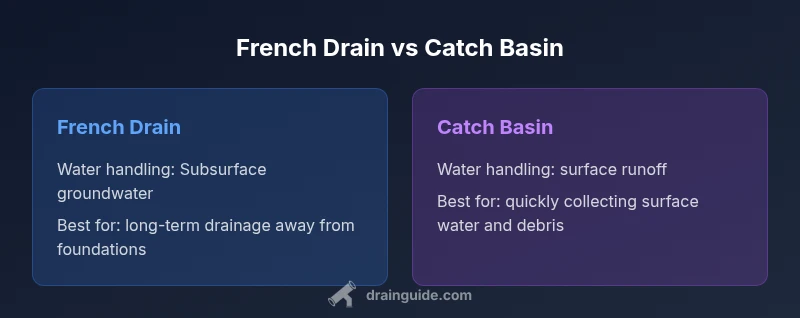
Across common residential drainage projects, the choice between a french drain vs catch basin hinges on where water collects and how you want to channel it away. A french drain is trench-based and uses a perforated pipe to move groundwater away from structures, while a catch basin sits at the surface, capturing runoff and directing it underground to an outlet. Drain Guide's analysis highlights practical trade-offs.
French drain vs catch basin: core differences
According to Drain Guide, the fundamental distinction between a french drain and a catch basin lies in where and how water is captured. A french drain is a buried trench filled with gravel and a perforated pipe that transports groundwater away from structures, often to a storm sewer or dry well. A catch basin sits at the surface, capturing runoff from roofs and pavement, then routing it underground through a dedicated outlet. Understanding this split helps homeowners map water flow across their property and choose the right tool for the problem at hand.
Key takeaway: identify whether your water issue is primarily subsurface or surface before deciding.
Site factors that influence the decision
Drainage outcomes depend on site-specific conditions: soil type, slope, water table, and existing drainage infrastructure. Clay soils slow infiltration and encourage lateral water movement, increasing the value of a buried system like a french drain. Sandy soils drain quickly, so surface runoff management with basins can be effective where grading directs water to a compliant outlet. The presence of roots, utility lines, and proximity to the foundation also matters. A thorough site assessment helps avoid over-engineering or under-sizing either option.
Subsurface drainage: when to use a french drain
French drains are designed for groundwater management, basement and foundation protection, and long-term soil stabilization. They excel when water saturates the root zone, or when the goal is to move water away from vulnerable structures without creating surface pools. Installation involves digging a trench, lining with landscape fabric, laying perforated pipe, and backfilling with gravel. The system relies on a gravity-based outlet; add a cleanout and ensure slope for efficient flow. Regular inspection of the trench and outlet minimizes clogging and performance loss over time.
Surface drainage: when to use a catch basin
Catch basins are optimized for surface runoff from roofs, driveways, and patios. They act as first-line collectors, capturing debris and directing water into a storm line or dry well. Basins are easier to install in push-button fashion, but require periodic cleaning to prevent clogging from leaves, sediment, and mulch. A grate or hood prevents large debris from entering the pipe. Real-world performance improves when basins are placed at critical low spots and connected to a properly graded discharge line.
Installation considerations: planning, permits, and gradients
Both systems require careful planning, and codes may govern trench depth, drainage discharge, and setback distances from foundations and utilities. A french drain needs proper trench width, a smooth inner surface, and consistent slope (typically around 1-2 percent) to keep water moving. Catch basins require a stable base, a secure lid, and a reliable outlet connection. In either case, improper slope, under-cutting, or improper backfill can reduce performance and create new problems like pooling or undermining nearby structures.
Cost and maintenance expectations
Cost implications hinge on yard size, soil, and labor. French drains tend to be higher upfront due to trenching and materials, but offer long-term resilience against groundwater. Catch basins typically cost less to install but can accumulate debris and require ongoing maintenance and periodic liner or grate replacement. Maintenance considerations include seasonal cleaning, sediment removal, screen checks, and periodic inspection of the outlet to ensure continued performance.
Common installation mistakes and how to avoid them
Mistakes include inadequate slope, insufficient gravel backfill, and failure to use filter fabric, which can lead to clogging and reduced flow. Another pitfall is placing the outlet too close to the house or in a location where the discharge re-enters the soil or foundation. For basins, neglecting debris screens or leaving the grate loose can cause frequent blockages. A careful plan and professional installation reduce risk significantly.
Hybrid strategies: combining french drains and catch basins
In many properties, a hybrid approach yields the best results: a french drain captures groundwater near structures, while strategically placed catch basins collect surface runoff and debris from impervious surfaces. The outflow from basins should connect to a designed discharge path that does not compromise soil stability or create nuisance water flows. Hybrid systems require coordination to avoid short-circuiting water and to maintain proper grading.
Local codes, permits, and best practices
Regulatory requirements vary by jurisdiction, especially for discharge to storm sewers or drainage fields. Always check with local building departments and homeowners associations if applicable. Best practices include using durable materials rated for soil and freeze-thaw cycles, implementing cleanouts for easy maintenance, and documenting the system design for future upgrades.
Maintenance checklist and long-term performance tips
A proactive maintenance plan extends system life. For french drains, inspect the trench outlet, test flow during heavy rain events, and remove sediment from the trench or cleanout. For catch basins, clear debris from grate and basin sump, verify the outlet is clear, and monitor for standing water. Consider seasonal inspections, especially after storms or yard work, to preempt clogging and ensure continued efficiency.
Quick-start decision framework for homeowners
Start by mapping water sources across the property: do you see persistent damp patches near the foundation or pooling in low spots? If subsurface moisture dominates, lean toward a french drain; if surface runoff dominates, start with a catch basin or a hybrid approach. Factor budget, local codes, and long-term maintenance into your final plan. A professional evaluation can help validate your assessment.
Real-world scenarios: translating theory into practice
Consider a home with a damp basement and a sloped driveway; grading directs runoff toward the foundation. A french drain installed along the foundation with an outlet to a drainage field can prevent basement moisture, while a catch basin at the driveway intercepts runoff and reduces surface pooling. In this example, both systems work together to protect structural integrity and improve outdoor usability. Always tailor the design to your site conditions and climate.
Comparison
| Feature | French drain | Catch basin |
|---|---|---|
| Water handling | Subsurface groundwater transfer via perforated pipe | Surface runoff and debris collection with direct outlet |
| Primary use | Long-term groundwater management around structures | Surface water management and debris interception |
| Maintenance needs | Lower surface maintenance; periodic trench/outlet checks | Requires regular debris removal and grate maintenance |
| Installation depth | Deep trench with gravel backfill | Shallow basin with surface grate and outlet |
| Debris handling | Less debris intake at surface | Higher debris risk without proper screening |
| Local code sensitivity | Subject to trenching and discharge rules | Subject to surface water discharge regulations |
| Cost range | Moderate to high upfront; long-term durability | Lower upfront; potential higher ongoing maintenance |
Positives
- Efficient groundwater control near foundations and low zones
- Discreet, buried installation minimizes visual impact
- Long-term durability when installed with proper slope and backfill
- Low maintenance after initial setup and inspection
Cons
- Higher upfront cost and more invasive installation
- Requires proper design to avoid blocking outlet or re-saturation
- Maintenance still needed to clear debris at outlets
- Professional installation recommended for best results
French drain systems generally offer stronger long-term groundwater control, while catch basins excel at rapid surface drainage; most properties benefit from a hybrid approach when both water sources are present.
Choose a french drain when subsurface moisture is the primary concern near foundations. Choose a catch basin for surface runoff and debris interception. A combined design often provides the most robust protection.
Got Questions?
What is the main difference between a french drain and a catch basin?
A french drain moves groundwater away underground via a perforated pipe, while a catch basin collects surface runoff at grade and routes it to an outlet. They address different water sources and often serve complementary roles.
French drains handle underground water; catch basins handle surface runoff.
When is a French drain preferred over a catch basin?
When the water problem is below the surface, such as high groundwater or persistent damp areas near foundations, a french drain is typically preferred.
Choose a french drain for underground moisture.
Can I install both in the same area?
Yes. Combining a french drain with a catch basin can address both groundwater and surface runoff. Careful layout ensures efficient drainage without short-circuiting water paths.
Yes, but plan the layout to protect the structure.
What maintenance do these systems require?
Catch basins need regular debris removal and grate checks; french drains require occasional inspection of the trench and outlet to prevent clogs.
Keep basins clean and inspect drains periodically.
Do local codes restrict these installations?
Yes. Check discharge rules, trench depth, setback distances, and permitting requirements with your local authority.
Yes—verify with local codes before installing.
How long does installation take?
Installation duration depends on yard size and soil conditions. A concise project can take a few days, while larger properties may require more time.
It varies by site; plan for several days on larger jobs.
The Essentials
- Assess water source first: subsurface vs surface.
- Choose french drains for groundwater control near foundations.
- Use catch basins for surface runoff and debris capture.
- Hybrid systems can optimize both water types.
- Plan for regular maintenance and local code compliance.