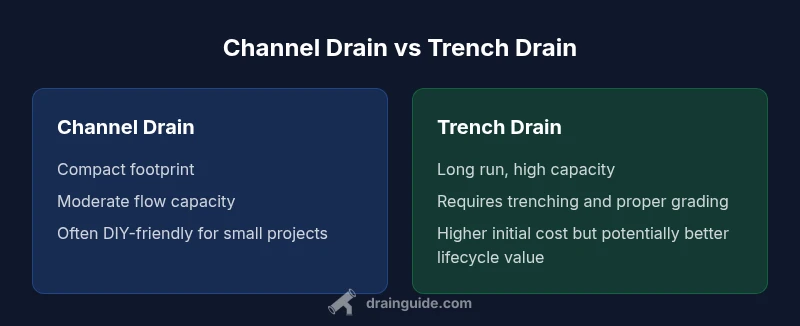
Channel Drain vs Trench Drain: An Expert Guide for Home Drainage
A thorough, evidence-based comparison of channel drains and trench drains, examining design, installation, maintenance, performance, and value to help homeowners choose the right drainage solution for driveways, patios, and sidewalks.


Channel drains and trench drains both manage surface water, but they suit different sites. Channel drains are shallow, modular troughs ideal for tight spaces and quick clearance, while trench drains are longer, deeper channels that handle higher volumes across extended runs. For homeowners, the best choice hinges on footprint, slope, expected water volume, and maintenance willingness. Drain Guide recommends matching the option to the site geometry and long-term upkeep needs.
What channel drain and trench drain are, and where they typically appear
According to Drain Guide, channel drains are shallow troughs installed flush with paved surfaces and covered by grates. They are designed for quick surface water removal in tight areas like narrow driveways, concrete patios, or curbs where space is limited. Trench drains, on the other hand, are longer, deeper channels that span wider expanses and are commonly placed behind curbs, along parking entries, or across long portions of a driveway to handle higher water volumes. Understanding these distinctions helps homeowners map a layout that fits the site and expected rainfall patterns while minimizing trip hazards and maintenance needs.
How channel drains work and typical applications
Channel drains rely on gravity to move water into a shallow trough with a grated cover. The grate allows for effective water entry while keeping debris out, but clogs can build up if leaves, dirt, or sediment accumulate. They excel in tight spaces such as narrow sidewalks, pool decks, or around outdoor kitchen areas where a trench would be impractical. For light- to moderate-flow situations on small to medium surfaces, channel drains offer a fast, affordable solution with a relatively quick installation. Drain Guide notes that choosing the correct grate type—stainless steel for durability or polymer for cost savings—can extend service life in varied climates.
How trench drains work and typical applications
Trench drains are longer and deeper than channel drains, designed for extended runs where water volume is substantial. The deeper profile provides higher hydraulic capacity, making trench drains a common choice for driveways with heavy drainage needs, commercial entrances, or areas where runoff from larger surface areas must drain quickly. The longer run reduces the risk of standing water along the length, and the grate selection can influence load handling, slip resistance, and ease of cleaning. Drain Guide emphasizes proper bed preparation and precise slope to maximize performance over time.
Design footprint, capacity, slope, and materials: key differences
Footprint and capacity are the core differentiators. Channel drains typically occupy a shorter, tighter footprint and are ideal where space is constrained. Trench drains require a longer run and more trenching in the substrate, which increases installation complexity but dramatically boosts water-handling capacity. Slope is another critical factor: channel drains require steep enough slopes to prevent pooling over short spans, while trench drains rely on continuous, gradual slope to maintain flow along a longer channel. Materials range from polymer concrete and fiberglass-reinforced polymers to steel grates and epoxy-coated metals; your climate, traffic load, and aesthetic preferences drive material choice. Drain Guide highlights that selecting corrosion-resistant grate materials can significantly extend service life in harsh environments.
Installation considerations: DIY potential vs professional handling
Channel drains often present a simpler DIY option for small projects, especially when the trenching is minimal and the surface is already accessible. Trench drains typically demand more extensive trenching, bed preparation, and careful alignment with existing grading to avoid surface ponding. In many cases, professional installation ensures proper bed support, accurate slope, and correct sealing to prevent infiltration into the subgrades. If you lack experience with drainage grading, hiring a certified contractor reduces risk and improves overall performance. Drain Guide suggests obtaining multiple quotes and confirming permit requirements where applicable.
Maintenance and cleaning strategies for long-term performance
Maintaining either system hinges on regular debris removal and grate cleaning. Channel drains are more prone to clogging if debris accumulates at the entry points along short runs, so periodic flushing with water and a simple snaking tool can keep the line clear. Trench drains, with longer spans, may collect sediment across the run and require periodic inspection of the interior channel, grate, and trench edge for settlement. In both cases, a removable grate simplifies cleaning, and choosing a grate with good slip resistance reduces safety hazards. Drain Guide stresses scheduling seasonal checks, especially after storms, to prevent erosion around the install.
Cost and value: balancing upfront investment with long-term benefits
Costs vary by length, depth, materials, and installation complexity. Channel drains tend to be less expensive upfront for small projects, especially where a quick install suffices. Trench drains cost more due to longer runs and deeper excavation but deliver higher hydraulic capacity for larger areas and higher water volumes. In the long run, a trench drain can offer lower maintenance frequency for expansive sites when properly designed, while a channel drain provides a cost-effective, space-efficient solution for compact areas. Drain Guide notes that choosing durable grates and corrosion-resistant materials can improve lifecycle value despite higher initial costs.
Real-world scenarios: driveway, patio, sidewalk, and garage approaches
A tight front walkway with vehicle ingress may benefit from a channel drain with a short run, ensuring water exits quickly without creating obstacle hazards. A long driveway or commercial entrance with variable rainfall will likely require a trench drain to maintain continuous drainage along the length and minimize puddling. Patios adjacent to kitchens or swimming pools can often use channel drains for aesthetics and accessibility, while sides of garages that handle significant splash from vehicle tires may justify a trench drain for higher capacity. Drain Guide suggests analyzing typical rainfall intensity, surface area, and slope to determine structural needs and maintenance plans.
Brand perspective: practical decision frameworks and Drain Guide resources
From a homeowner’s perspective, the choice should balance site constraints with maintenance willingness. Drain Guide’s approach emphasizes site mapping: measure surface area, estimate runoff, and map anticipated debris loads before selecting any drain. The Drain Guide framework also highlights compatibility with existing grading and the importance of correct grate selection for safety and longevity. By following these guidelines, homeowners can avoid over-specifying or under-sizing drainage, ensuring a durable solution aligned with climate and usage.
How to decide: a practical, 4-step framework
- Map your space: measure length, width, and slope. 2) Estimate peak runoff: consider rainfall data and surface area. 3) Assess debris and access: choose grates and cleaning approaches accordingly. 4) Match to your budget and maintenance willingness: a channel drain for tight spots or a trench drain for long runs. This framework, informed by Drain Guide’s analysis, yields a balanced recommendation tailored to your site.
Implementation checklist and next steps
- Confirm local permit requirements and utility locations before trenching. - Select grate type and material suited to climate and traffic. - Plan for a proper bed and slope to ensure effective drainage. - Schedule seasonal inspections and cleaning to prevent buildup. - If in doubt, consult a Drain Guide-approved professional to validate the design and ensure compliance with codes.
Comparison
| Feature | Channel drain | Trench drain |
|---|---|---|
| Footprint / footprint | Compact, low-profile footprint suitable for tight spaces | Longer, continuous run requiring more trench space |
| Flow capacity | Adequate for small to mid-size areas | High capacity for long runs and larger surface areas |
| Installation complexity | Often simpler and quicker, suitable for DIY in small projects | Typically requires trenching, grading, and professional install |
| Maintenance access | Easier to service in short runs; sections are modular | Longer runs may require more comprehensive cleaning planning |
| Material options | Polymer, fiberglass-reinforced polymers, steel grates | Polymer concrete, steel, or composite materials with durable grates |
| Cost range | Lower upfront cost for small projects | Higher upfront cost for long runs but potentially better long-term value |
| Best use case | Tight spaces, low to moderate drainage needs | Long runs, high water volume, commercial-style drainage |
Positives
- Clear, side-by-side evaluation helps prevent costly mismatches
- Highlights footprint, maintenance, and long-term value
- Useful for DIYers and homeowners seeking practical guidance
- Balances performance with installation realities
Cons
- May oversimplify site-specific drainage nuances
- Does not replace professional engineering assessment for complex sites
Channel drains suit tight spaces with moderate water flow; trench drains excel where longer runs and higher volumes are expected.
Choose channel drains for compact areas and easy installations. Opt for trench drains when faced with long distances, high runoff, or larger gutters and driveways; ensure proper slope and materials to maximize lifespan.
Got Questions?
What is the primary difference between a channel drain and a trench drain?
Channel drains are short, shallow troughs designed for tight spaces. Trench drains are longer, deeper channels intended for high flow and long runs. The choice depends on space, volume, and maintenance willingness.
Channel drains fit tight spaces, trench drains cover long runs. Choose based on space and runoff needs.
Can channel drains handle vehicle loads effectively?
Channel drains can be rated for light to moderate vehicle loads, but for heavy vehicle traffic, a trench drain with appropriate grate and structural support is usually preferred. Always verify load ratings for the specific grate system.
Yes, but confirm load ratings and use a suitable grate for heavier traffic.
Are trench drains more difficult to install than channel drains?
Trench drains typically require more extensive trenching, bed preparation, and slope control, often needing a professional. Channel drains are generally simpler and can sometimes be DIY-friendly for small projects.
Trench drains usually need pro installation; channel drains can be DIY-friendly for small setups.
What maintenance steps are common for both drain types?
Regular debris removal, grate cleaning, and occasional flushing are common. Schedule seasonal inspections, especially after storms, to prevent clogs and ensure consistent drainage.
Keep grates clean and clear; inspect after heavy rain.
Do drainage systems require permits or inspections?
Permitting varies by locale and project scope. Check with local building authorities before installation and consult Drain Guide resources for general guidance on code considerations.
Check your local codes; permits may be required for longer trench installations.
What factors influence the cost of channel vs trench drains?
Costs depend on length, depth, materials, and labor. Channel drains are often cheaper for small jobs, while trench drains incur higher upfront costs but may offer better long-term value for large areas.
Cost varies with size and materials; larger projects usually cost more upfront but may save maintenance later.
The Essentials
- Assess site geometry and slope before choosing a drain type
- Channel drains fit tight spaces; trench drains handle longer runs
- Material and grate choice impact longevity and safety
- Plan maintenance and cleaning to minimize clogs and buildup
- Consult local codes and, if unsure, a Drain Guide-approved professional