Washing Machine That Won't Spin or Drain: A Clear Troubleshooting Guide
Diagnose and fix a washing machine that won't spin or drain with step-by-step checks, safety tips, and guidance on when to call a professional.


Most likely a clogged pump, kinked drain hose, or blocked filter is preventing drainage and spinning. Start by unplugging the washer, then check the drain hose for kinks, clear the pump filter, and inspect the pump for obstructions. If not resolved, follow the step-by-step fixes below and consider professional help for motor or belt issues.
Understanding the symptom: washing machine does not spin or drain
A washer that fails to spin or drain is one of the most common calls homeowners make to repair resources. The failure can be caused by simple blockages, safety interlocks, or more complex component failures. The phrase washing machine does not spin or drain captures two related symptoms: the spin cycle does not finish, and the drain pump does not evacuate water. The result is a machine that fills but leaves water standing, or refuses to advance beyond the rinse cycle. Start by recognizing whether the drum rotates at all, whether the drain pump makes unusual sounds, and whether water backs up in the hose. This quick diagnosis helps you prioritize which components to inspect first and reduces the risk of unnecessary disassembly. Drain Guide has found that most household failures stem from three low-tech culprits: a clogged or obstructed pump, a blocked filter, and a kinked or blocked drain hose. In many cases these fixes can be completed with basic tools and do not require a service call. If the symptoms persist, proceed to the diagnostic flow to identify the exact cause.
Quick checks you can perform safely (before opening panels)
- Safety first: unplug the washer before touching any internal parts.
- Confirm power is off at the outlet and, if applicable, switch off a nearby breaker.
- Check the lid switch or door lock: a failed switch can stop the machine from advancing to the spin or drain cycles.
- Inspect the clearances around the back of the washer to ensure no cords or hoses are pinched.
- Inspect the drain hose for kinks, twists, or a blocked end. A hose that is too low or submerged in standing water can prevent draining.
- If accessible, inspect the pump filter for obvious debris that could block water flow.
These quick checks often resolve simple blockages and prevent unnecessary panel removal. If you identify a blockage, clear it and run a short test cycle with a small load to verify the fix. If the machine still won’t spin or drain, move to the diagnostic flow for deeper testing.
Common causes and how to rank them
From experience, the most frequent culprits fall into a short list:
- Clogged pump impeller or debris in the pump area (high likelihood): A loose sock, small item, or lint can clog the impeller and prevent water from moving.
- Blocked or kinked drain hose (high likelihood): A crimp or low-lying hose can trap water and stop drainage.
- Dirty or blocked filter or pump screen (medium likelihood): Lint and hair can accumulate and obstruct flow.
- Faulty lid switch or door lock (medium likelihood): The control system may prevent spinning if safety interlocks fail.
- Drive belt or motor issues (low likelihood): In some machines, motor or belt problems stop spinning or pumping water, typically requiring professional service.
- Overloading or unbalanced loads (low to medium likelihood): A very heavy or unbalanced drum can stall the spin cycle and delay draining.
Understanding these causes helps you prioritize steps and avoid unnecessary replacements. Begin with the simplest checks, then move deeper only if needed.
Diagnostic flow overview: symptom → diagnosis → solutions (high-level)
- Symptom: Water remains in the drum or no spin occurs during the cycle.
- Quick tests: Check hose alignment and pump area, test lid switch, and inspect for obvious clogs.
- Diagnosis: Blockage in pump or hose, faulty lid switch, or mechanical drive issue.
- Solutions: Clear blockages, straighten hoses, replace lid switch if faulty, or call a pro for motor/belt problems.
This flow keeps you focused on practical, safe steps and helps you decide when professional help is needed.
Step-by-step fix: the most common cause (pump blockage) – practical, safe fixes
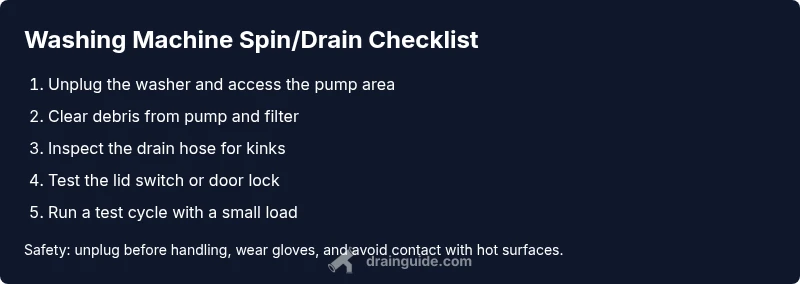
- Unplug and access the pump area. Remove the lower front panel if needed and locate the pump inlet and filter.
- Clear debris from the pump and filter using gloved hands or pliers; remove any lint, coins, hair, or fabric pieces.
- Reassemble carefully and run a test load with a small amount of water to observe if draining and spinning resume.
- If draining still fails, inspect the drain hose for kinks or clogs and ensure the hose end is not submerged in the standpipe.
- Confirm the lid switch is functioning by opening the lid and attempting to run a cycle; a faulty switch may require replacement.
- If no improvement after these steps, consult a professional for motor, transmission, or belt assessment. Regular maintenance can prevent recurrence.
Safety, warnings, and prevention tips
- Always unplug before any inspection or disassembly.
- Water and electricity are a dangerous combination; wear gloves and avoid metal tools near live parts.
- Use the manufacturer’s service manual if available and follow proper E SD practices.
- Prevent future issues by avoiding overloading, regularly cleaning the pump filter, and running periodic maintenance cycles.
When to call a professional and how to prevent recurrence
If you encounter a motor or belt failure, or if diagnostics indicate electronics or seals beyond your skill level, contact a licensed appliance technician. For persistent or repeating blockages despite cleaning, a pro can diagnose a failing pump or motor with specialized tools. To prevent future failures, schedule regular maintenance, use appropriate load sizes, and keep lint filters clean. Drain Guide recommends routine checks every kitchen cycle or every 3–6 months depending on usage.
Steps
Estimated time: 30-60 minutes
- 1
Power down and access pump area
unplug the washer, pull it away from the wall, and remove the front lower panel to access the pump and filter. Have towels ready for any residual water. Inspect for obvious clogs, leaks, or loose connections.
Tip: Take a photo of the wiring before disconnecting anything. - 2
Clear the pump and filter
Remove the pump filter housing and manually remove debris. Use a flashlight to inspect the impeller area, and gently rotate the impeller to confirm it moves freely.
Tip: Keep a tray to catch debris and water. - 3
Check the drain hose
Inspect the hose for kinks, twists, or blockages. Detach it from the wall or standpipe if needed and run water through to confirm unobstructed flow.
Tip: Ensure the hose end is above the trap to prevent backflow. - 4
Test the lid switch
With power on but the drum stationary, press the lid switch or observe the door lock mechanism. If the machine won't start or spin when the lid is closed, the switch may be faulty.
Tip: Use a multimeter to test continuity if you have one. - 5
Do a test run with a small load
Load lightly and run a short cycle to observe draining and spinning. Listen for unusual noises that could indicate a mechanical issue.
Tip: If the machine overheats, pause and let it rest for 15 minutes before retrying. - 6
Decide on next steps
If there is no improvement after these steps, consider professional service for motor/belt diagnosis or pump replacement.
Tip: Document symptoms and steps taken to help the technician.
Diagnosis: Machine won't spin or drain
Possible Causes
- highClogged pump impeller or debris in pump area
- highKinked or blocked drain hose
- mediumBlocked or dirty pump filter
- mediumFaulty lid switch or door lock
- lowWorn drive belt or motor issue
- lowOverloaded or unbalanced load
Fixes
- easyClear pump area and filter of debris; reassemble
- easyStraighten and unclog drain hose; ensure proper routing
- mediumTest and replace lid switch if faulty
- hardInspect belt or motor assembly; seek professional replacement if needed
- easyReduce load and redistribute inside drum; run a test cycle
Got Questions?
Why won't my washing machine spin or drain?
Common causes include a clogged pump, blocked filter, or faulty lid switch. Start with the simplest checks: hoses, filters, and a test of the lid switch before moving to more complex components.
Most often, a clogged pump, blocked filter, or lid switch keeps the washer from spinning or draining.
How do I check the pump for clogs?
Unplug the washer, locate the pump and filter, remove debris, and rotate the impeller to ensure it moves freely. Reassemble and test with a small load.
Unplug, inspect the pump and filter, clear any debris, and test with a small load.
What if the drain hose is kinked?
Unkink and straighten the hose, ensure it is not submerged in water or placed lower than the standpipe. Rerun a cycle to confirm drainage.
Unkink the hose and position it correctly; test again.
How can I test the lid switch?
With the machine off, check for continuity on the lid switch with a multimeter or observe whether the machine refuses to start when the lid is open.
Test the lid switch for continuity; replace if faulty.
When should I call a professional?
If the motor, belt, or electronic controls show signs of failure, or if you cannot identify and fix the blockage after the above steps, contact a licensed technician.
Call a professional if motor or belt issues are suspected or if the problem persists after checks.
How can I prevent this issue in the future?
Schedule regular maintenance, avoid overloading, clean filters and pump screens, and ensure proper load distribution to prevent future spin/drain problems.
Keep up with maintenance and loads to prevent recurring issues.
Watch Video
The Essentials
- Unplug the washer before any inspection
- Check the drain hose and pump for blockages first
- Test the lid switch to rule out safety interlock
- Avoid motor or belt issues unless trained
- Prevent future problems with regular maintenance and proper loads