Why is Battery Draining So Fast on a Laptop? Troubleshooting Guide
Urgent, practical steps to diagnose and fix why your laptop battery drains quickly. Learn quick fixes, monitoring tips, and prevention to extend run time.


Most laptop battery drain comes from ongoing background activity and high screen brightness. Start with quick fixes: reset power settings to balanced, turn off unused peripherals, reduce display brightness, and lower refresh rate. Check for battery-hungry apps, update the OS and drivers, and run a battery report. If the problem persists, consider calibration or battery replacement.
Why is battery draining so fast on a laptop?
If you're asking why is battery draining so fast laptop, you're not alone. The short answer is that a battery's life is a balance between stored capacity and ongoing power draw. As laptops age, their chemical cells lose capacity, and software or hardware may demand more energy. The Drain Guide team emphasizes that most fast-drain scenarios come from a mix of aging battery health and current usage patterns. In practical terms, a healthy laptop still loses charge, but if you notice dramatic drops in a few hours, it's a signal to check both hardware and software. Factors that raise power draw include bright displays, fast processors, active wireless radios, and background tasks that run continuously. You should also consider power settings. In many cases, a few background tweaks plus a quick health check can reclaim meaningful runtime, buying you time before a battery replacement becomes necessary. Remember: addressing battery drain is not just about one fix—it's about a series of small optimizations that cumulatively extend run time.
Here’s how the guide helps homeowners and DIYers: identify the energy-hog components, verify battery health using built-in tools, and implement safe, reversible changes. The tone is practical, not alarmist, and designed to empower you to fix common drain issues without professional help. If your battery has already degraded, you may still improve runtime by tuning usage patterns and avoiding power-hungry peripherals. The goal is to maximize remaining life while you plan a battery replacement.
Common culprits that sap battery life
Common culprits fall into software, display, hardware, and aging categories. Drain Guide analysis shows that background processes and automatic updates can quietly consume watts. Bright displays and high refresh rates dramatically increase draw. Misconfigured power plans keep components awake. External devices like USB-C hubs and external drives can siphon power when plugged in. Battery health declines with age and cycle count, causing shorter runtimes. Finally, wireless radios (Wi‑Fi, Bluetooth) and index/search tasks can keep the CPU busy even when you think you’re idle. By tackling these in order, you can recover a surprising amount of time between charges.
How to measure and monitor battery health
To know where you stand, use built-in tools to measure health and usage. Windows users can generate a battery report with powercfg /batteryreport and review design capacity vs. full charge capacity, plus recent usage. macOS users can open System Report > Power to view cycle count and health. Battery health apps and manufacturer diagnostics can provide a more granular view. Drain Guide recommends running these checks after a full recharge and a few days of normal use to capture typical patterns. If the health metrics show obvious degradation (for example, a large gap between design capacity and current full capacity), plan for maintenance or replacement.
Quick-check checklist before deeper fixes
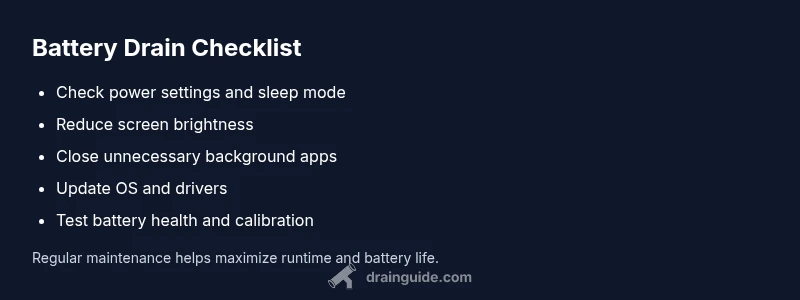
Before diving into deeper fixes, go through this quick checklist. Are you on the latest OS and drivers? Is Sleep/Hibernate configured correctly and not set to keep devices awake? Is screen brightness at a comfortable level? Are you running any nonessential background apps or cloud backups? Are peripherals drawing power while plugged in? Completing these checks often yields immediate improvements and helps scope the root cause.
Diagnostic approach: from symptom to solution
Use a simple symptom-to-diagnosis flow to avoid guesswork. Start with the symptom: rapid drain during normal use. If the screen is bright and you notice battery drop during idle, the culprit is display settings or idle processes. If battery drains quickly even with reduced activity, focus on background services and battery health. If updating software seems to coincide with drain, a recent update or driver might be the cause. In each case, apply targeted fixes and re-test for a full charge cycle. When to call a professional is when the battery shows physical swelling, frequent unexpected shutdowns, or the battery cannot hold charge after calibration.
Step-by-step fixes for the most common cause
- Adjust power plan: Set to balanced or battery saver, then customize display and sleep timings. Tip: set a shorter idle sleep to minimize wake events. 2. Reduce screen brightness and disable high-refresh-rate if not required. Tip: enable dimming when on battery. 3. Close or disable unnecessary background apps and scheduled tasks, particularly updates and indexing. Tip: use Task Manager to review processes. 4. Update OS and drivers, and check for firmware updates for the battery controller. Tip: ensure you have a backup before updating. 5. Run a battery calibration if the health data seems inconsistent. Tip: discharge to 5-10% then fully charge to 100% once. 6. If health is poor, plan a replacement or service. Tip: consult the manufacturer for service options.
Tips, warnings, and safety notes
- Pro tip: calibrate the battery only if health readings seem off after a full charge cycle.
- Warning: use only charger and cables from the manufacturer to avoid damage.
- Note: avoid leaving the laptop plugged in at 100% for extended periods; aim for storage at around 50-80% if unused.
Long-term prevention and battery replacement decisions
Proactively maintaining your battery life means combining healthy software habits with physical care. Regularly review which apps run at startup, keep drivers updated, and use battery saver modes during extended sessions away from a power outlet. If system reports show persistent degradation in capacity or frequent unexpected shutdowns despite corre ct fixes, plan for battery replacement. A well-timed replacement can restore runtime significantly and prevent data loss from sudden power loss. Drain Guide recommends documenting your power usage patterns and noting when changes in performance occur to pinpoint the right moment for a service or replacement.
Steps
Estimated time: 60-90 minutes
- 1
Assess current power settings
Open Power & Sleep settings, select a balanced plan, and note display brightness. Adjust timings for sleep/hibernation to minimize wake events.
Tip: Document the current settings before changing anything. - 2
Limit background activity
Review running apps and services; disable or delay nonessential background processes, especially cloud backups and indexing tasks.
Tip: Use Task Manager or Activity Monitor to identify power hogs. - 3
Tweak display and peripherals
Lower screen brightness and disable high-refresh-rate modes if not needed. Disconnect unnecessary USB devices when on battery.
Tip: Try a quick 10-point brightness test to find a comfortable balance. - 4
Update software and drivers
Update OS, firmware, and drivers, particularly chipset and battery controller firmware.
Tip: Backup important files before major updates. - 5
Calibrate the battery
If health data seems inconsistent, perform a full discharge/charge cycle. Use 5-10% remaining before charging to 100%.
Tip: Do not calibrate frequently; only when readings seem off. - 6
Plan for replacement if needed
If battery health appears degraded, consider a professional replacement or purchase of a new battery.
Tip: Check warranty coverage and official service options.
Diagnosis: Laptop battery drains quickly during normal use
Possible Causes
- highBackground processes and updates consuming power
- highHigh brightness and display settings
- highAging battery with degraded capacity
- mediumMisconfigured power plan or sleep settings
- mediumPower draw from peripherals or external devices
Fixes
- easyReset and optimize power plan to balanced or battery saver
- easyReduce brightness and refresh rate; disable unused peripherals
- easyClose background apps and update OS/drivers
- mediumRun battery health checks and calibration if needed
- hardConsider battery replacement if health is degraded
Got Questions?
Why is my laptop battery draining so fast even when idle?
Idle drain is usually caused by background processes, failed sleep states, or a high brightness setting. Check Task Manager for active processes and ensure the display and sleep settings are optimized. Battery health may also play a role if the battery is aging.
Idle drain is often due to background tasks or brightness. Check running processes and adjust sleep settings.
How can I check my battery health on Windows or macOS?
Windows users should generate a battery report with powercfg /batteryreport and compare design vs. full charge capacity. macOS users can view cycle count and health in System Report > Power. Use manufacturer diagnostics for deeper insights.
Run a battery report on Windows or check Power in macOS to gauge health.
Can screen brightness alone cause rapid battery drain?
Yes. Higher brightness increases power draw substantially, especially on older displays. Reducing brightness and using adaptive brightness can noticeably extend runtime.
Bright screens burn through battery faster; lower brightness helps a lot.
Should I calibrate my laptop battery?
Calibration helps if your battery readings seem off. It is not a substitute for a degraded battery, but a periodic step can improve accuracy of remaining-life estimates.
Calibration helps with accuracy when readings seem off, not a fix for a bad battery.
When should I replace my laptop battery?
Consider replacement when health reports show degraded capacity and runtime remains consistently short despite fixes. Check warranty and service options from the manufacturer.
If battery health is poor and runtime remains short, it’s time to replace.
Do software updates fix battery drain?
Software updates can improve power management and fix bugs that cause excess drain. However, they’re not a guarantee; combine updates with the other fixes described.
Updates can help, but combine with other fixes for best results.
Watch Video
The Essentials
- Adjust power settings to balance performance and longevity
- Limit background activity and monitor app usage
- Lower display brightness to extend runtime
- Keep OS and drivers up to date for optimal power management
- Replace the battery if health is degraded to restore runtime