Active Drain vs Passive Drain: A Practical Comparison for Homeowners
Compare active drains that use pumps to passive gravity drains. Learn which fits your home, installation needs, maintenance, and cost considerations with Drain Guide.


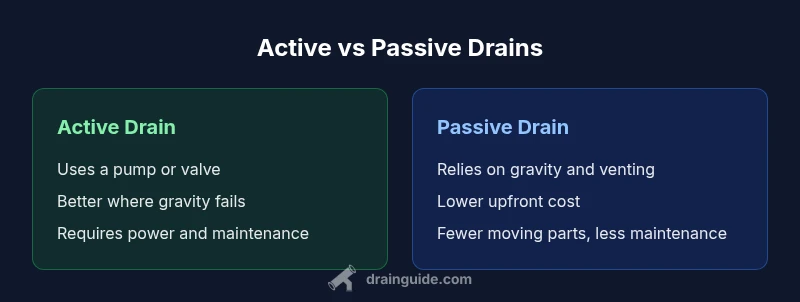
Active drain vs passive drain boils down to water movement: active drains use pumps or mechanical means to move water, granting control and reliability in challenging layouts; passive drains rely on gravity and venting, offering simplicity and lower upfront costs. For most homes, passive drains suffice, but active systems shine in basements, low-slope areas, or where gravity drainage isn’t feasible.
What the terms mean in practical terms
The phrase active drain vs passive drain describes two fundamentally different approaches to moving wastewater from a fixture to the sewer or septic system. An active drain employs a pumping mechanism, valve logic, or other motorized components to move or regulate flow. A passive drain relies on gravity, proper slope, venting, and trapping to carry water away without electrical or moving parts. Drain Guide notes that many homeowners encounter the topic when renovating basements, remodeling kitchens, or retrofitting older homes with drainage challenges. The key distinction is whether water movement is assisted by a device (active) or allowed to flow solely by gravity (passive). The choice affects installation, maintenance, and long-term reliability, so it’s worth analyzing early in the planning phase.
How gravity and pressure shape the answer
Passive drains depend on a consistent slope and correctly vented traps to avoid siphoning and backflow. In contrast, active drains add a pump, check valve, or control system that can override slope limitations and compensate for poor drainage paths. When you compare active drain vs passive drain, you must weigh the reliability of a mechanical system against the simplicity of a gravity-based approach. Drain Guide emphasizes that the right choice aligns with your home’s layout, humidity control needs, and the willingness to manage power-dependent equipment. The keyword active drain vs passive drain appears frequently in professional discussions because it highlights two paths to the same end: clean, reliable wastewater removal.
Key design considerations anyone can evaluate
A successful comparison starts with three questions: Can gravity alone deliver adequate drainage from this fixture or area? Is the space suited to a pump or mechanical device (power, access, and maintenance)? Are there reliability concerns such as frequent outages or backflow risk? In practice, active drains are more forgiving of poor slope or long runs, but they require power, regular maintenance, and backup plans. Passive drains excel where slope and venting conditions are excellent, offering fewer moving parts and lower ongoing costs. Drain Guide suggests cataloging fixtures by their location (e.g., basement laundry, garage floor drain, kitchen sink) to map out which sections would benefit from each approach. This assessment helps homeowners avoid over-engineering a simple gravity drain or under-using a pump system where gravity won’t suffice.
Real-world scenarios to anchor the choice
Imagine a basement bathroom closet with a vertical run and limited floor space. A passive drain may work if you can maintain the slope and venting, but a wet basement with irregular floor levels often benefits from an active drain, like a sump or pump-assisted trap. In a traditional upstairs kitchen, a passive drain is generally adequate when the piping layout remains straight and vented. Drain Guide’s experience shows that mixing both approaches in a single home—passive drains where gravity works best and active systems in problem zones—often yields the most reliable results.
Comparison
| Feature | Active Drain | Passive Drain |
|---|---|---|
| Operation principle | Uses a pump/valve system to move or regulate flow | Rely on gravity and venting without moving parts |
| Best-use scenarios | Basements, long runs, or layouts with poor slope or low water pressure | Standard floors with good slope and venting |
| Installation complexity | Medium to high due to wiring, controls, and pump placement | Low to medium; simpler piping and venting suffices |
| Maintenance frequency | Regular pump servicing, battery checks, and potential seal replacements | Periodic trap/vent checks and general cleaning |
| Reliability in power outages | Dependent on power; backup power improves reliability | Unaffected by power outages (no pumps) |
| Water flow control | Automatic or manual pump-based control | Gravity-driven flow with fixed slope and venting |
| Best for (home types) | Areas with space for equipment or challenging gravity paths | Homes with adequate slope and venting, standard layouts |
| Cost range (general) | Moderate to high upfront; ongoing maintenance costs | Low to moderate upfront; minimal ongoing costs |
Positives
- Increased drainage reliability in challenging layouts
- Reduces standing water and backflow risk in basements
- Can be retrofitted where gravity drainage is insufficient
- Offers better control over flow in variable water usage scenarios
- May enable pump-backup backup options during outages
Cons
- Higher upfront costs and ongoing maintenance
- Requires electrical supply and routine service appointments
- More complex installation and potential points of failure
- Backups or failures can cause downtime if power or components fail
Passive drains are the default choice for most homes; active drains are best for problem areas where gravity alone won’t suffice
Choose passive drainage for standard layouts with good slope and venting. Opt for active drainage in basements, long runs, or spaces where gravity drainage is impractical, ensuring power backup and maintenance plans are in place.
Got Questions?
What is the main difference between an active drain and a passive drain?
An active drain uses a pump or mechanical device to move water, enabling control in difficult layouts. A passive drain relies on gravity and venting to move water without any moving parts. The choice depends on layout, slope, and maintenance willingness.
Active drains use pumps to move water; passive drains use gravity. The best choice depends on your space and maintenance willingness.
Can I convert a passive drain to an active drain later?
Yes, but it typically requires significant planning: add a pump pit, wiring, controls, and possibly piping rearrangements. A professional assessment helps avoid backflow and code issues.
You can convert later, but you’ll likely overhaul the drainage path and add electrical components.
What maintenance does an active drain require?
Regular inspection of pumps, backflow valves, traps, and power backups is essential. Listen for unusual noises and check that alarms or sensors function as intended.
Keep the pump and backflow devices in good shape with routine checks.
Are there situations where passive drains fail but active drains succeed?
Yes. In basements with high water tables, poor slopes, or long horizontal runs, an active drain may prevent flooding where passive systems struggle.
Active drains can handle tricky layouts where gravity falls short.
Do active drains save water or energy?
Active drains primarily save time and reduce flood risk rather than saving water. They may use energy, so efficiency and backup options matter.
They don’t inherently save water; they help move water reliably when gravity isn’t enough.
The Essentials
- Evaluate slope and venting before choosing drainage type
- Active drains add reliability in tough layouts but need power and maintenance
- Passive drains work well in clean, gravity-friendly homes with lower upkeep
- Consider a hybrid approach: passive where possible, active where needed
- Plan for power backups in active systems to prevent downtime