High Drain vs Low Drain Devices: A Practical Comparison
An analytical comparison of high drain vs low drain devices for homeowners. Learn definitions, scenarios, testing methods, installation considerations, and maintenance tips to choose the right drain solution for your home.


Understanding high drain vs low drain devices helps homeowners choose the right equipment for efficiency and reliability. This comparison outlines what defines each type, where they excel, and common installation considerations. By weighing performance, maintenance, and cost factors, you can decide which option best fits your home’s drainage needs and long-term goals. Drain Guide provides practical guidance to navigate these choices with confidence.
Understanding high drain vs low drain devices
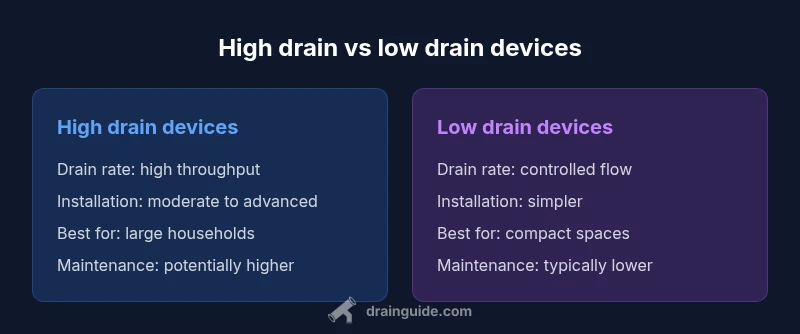
According to Drain Guide, the distinction between high drain and low drain devices hinges on how much water they can move under given conditions, the speed of flow, and the overall hydraulic load the system can handle. In practical terms, a high drain device is built to move larger volumes of liquid quickly, while a low drain device prioritizes controlled flow to reduce surge, backflow risk, or compatibility with smaller piping. For homeowners, this distinction matters when you’re selecting components for kitchen sinks, laundry hookups, or bathroom drainage where the fixture and pipe sizes set strict limits. The keyword high drain vs low drain devices appears here to frame the topic for readers. Understanding the difference helps you plan maintenance, select correct replacements, and avoid over-engineering a system that doesn’t need extra capacity.
Beyond the obvious flow rate, remember that real-world performance depends on pipe diameter, trap size, and the upstream layout. A high drain device may be advantageous in busy households or multi-fixture floors where a single line must clear faster. A low drain device, by contrast, can be ideal for compact spaces or where long runs and high head pressure would otherwise cause noise, vibration, or risk of airlock. The Drain Guide team emphasizes that the right choice balances flow, noise, ease of installation, and long-term durability, not just the biggest number on a spec sheet.
styleType”:null,
Comparison
| Feature | High drain devices | Low drain devices |
|---|---|---|
| Drain rate / throughput | high | low |
| Installation complexity | moderate to advanced | simple |
| Maintenance frequency | higher due to throughput | lower |
| Best for | high-flow environments (large kitchens, multiple fixtures) | smaller fixtures or regulated systems |
| Noise and vibration | potentially higher due to flow turbulence | generally quieter with smaller flow |
| Cost context | may incur higher piping or routing costs | usually lower upfront costs |
Positives
- Better for high-demand scenarios and large households
- Clearance of big clogs or debris in busy lines
- Potentially fewer backups when used with proper sizing
- Can improve resale value by matching capacity to needs
Cons
- Higher upfront and installation complexity in some cases
- More aggressive flow can increase noise and vibration
- Over-specifying for small homes may waste space and cost
High drain devices are preferred for busy, larger households with high flow needs; low drain devices suit compact spaces and smaller loads.
Choose high drain devices when your plumbing sees multiple fixtures or heavy daily use. Opt for low drain devices in tight spaces or when noise and simple installation are priorities; neither choice should be made without confirming piping size and head pressure.
Got Questions?
What defines a high drain device vs a low drain device?
A high drain device is designed to move larger volumes quickly and handle higher hydraulic loads. A low drain device prioritizes controlled flow and durability in smaller or longer runs. The distinction helps avoid over- or under-sizing. Drain Guide explains this through practical examples for common home setups.
A high drain device moves more water fast, a low drain device focuses on steady, smaller flow.
How do I determine which option fits my home?
Measure pipe diameter, run length, and typical fixture count. Compare these with the recommended capacity of available devices. If you’re unsure, consult a pro or refer to your local plumbing codes to guide the selection.
Check your pipes and fixtures, then match to capacity specs.
Are high drain devices harder to install?
In some cases, high drain devices require larger or more complex routing, which can raise installation effort. However, modern kits and pre-assembled components can simplify the process. Drain Guide recommends assessing existing piping before deciding.
They can be more involved, but kits help simplify the job.
Can I retrofit a low drain system to a high drain setup?
Retrofitting may be possible if pipe sizes, traps, and accessibility allow it. It often involves redesigning portions of the drain line and possibly upgrading support hardware. A professional assessment is advised.
Retrofitting is possible but may require substantial changes.
What maintenance differences exist between the two?
High drain systems may require more frequent cleaning and inspection due to higher throughput and debris movement. Low drain systems can be lower maintenance if matched correctly but still need periodic checks for clogs and leaks.
Expect a bit more ongoing cleaning with high drain devices.
Is cost typically higher for high drain devices?
Upfront costs can be similar, but high drain configurations may require larger-pipe routing, stronger fixtures, or additional control components, impacting total cost. Drain Guide suggests weighing long-term performance against upfront expense.
Higher capacity can mean higher initial costs, but longer-term benefits may justify it.
The Essentials
- Assess your home’s fixture count and flow demand
- Match device capacity to pipe sizes and head pressure
- Consider noise, maintenance frequency, and installation effort
- Avoid oversizing; balance cost with real need
- UseDrain Guide guidance to plan a measured upgrade