Gravity Drain vs Drain Pump: A Practical Comparison for Homeowners
Compare gravity drains and drain pumps for home plumbing. Learn how each works, where they shine, costs, maintenance, and practical tips for homeowners from Drain Guide.


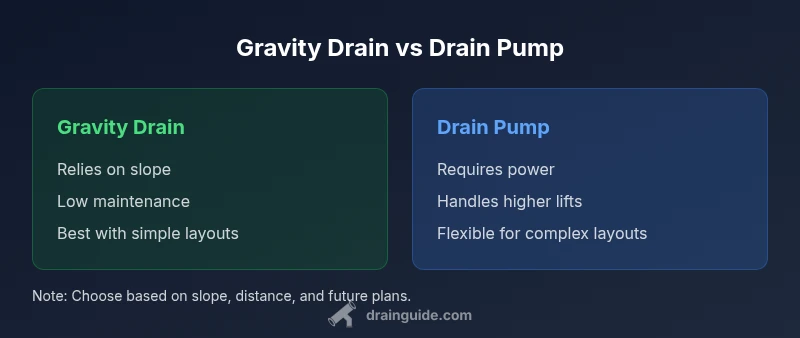
Gravity drain vs drain pump: In essence, gravity drains rely on slope and gravity to move wastewater, while a drain pump actively pushes liquids to higher or distant outlets. Gravity drains are simple, low-cost, and quiet but limited by layout and head height. A drain pump adds versatility, enabling higher lifts and non-ideal slopes, at the cost of power needs and maintenance.
gravity drain vs drain pump: Defining the concepts
Gravity drain is a passive drainage approach that depends on a consistent downward slope to move wastewater from sinks, showers, and appliances toward the building's main drain. The principle is simple: gravity does the work, so there are few moving parts and no electrical components to fail. In typical homes, gravity drainage works best when the pipe runs are short, the slope is gentle but continuous, and the system is properly vented to prevent siphon or backflow. For many DIY projects, a gravity-based layout offers straightforward installation—especially in basements or crawl spaces where stairs or equipment access is limited. However, its effectiveness hinges on achieving the right head pressure along the path. If the vertical lift is too high, or if long horizontal runs become too flat, wastewater may struggle to reach the main line, leading to slow drainage or standing water. Drain Guide emphasizes planning the route, avoiding sharp bends, and confirming venting before committing to a gravity-only design.
How a drain pump works and typical use cases
Drain pumps are active devices that move wastewater using an impeller or diaphragm motor. They are installed at the lowest point of a drainage run, or in a basin, sump, or toilet where gravity alone cannot guarantee flow. The pump is wired to a circuit and often includes a float switch to start and stop as needed, a check valve to prevent backflow, and a discharge outlet. Pumps are useful when you need to lift wastewater to a higher outlet, push it through stairs or up to an upper floor, or overcome flattened slopes. They are common in basement bathrooms, laundry areas, and crawl spaces with limited upward drain potential. When installed correctly, pumps can provide consistent flow even when the natural grade is insufficient. But they introduce ongoing energy use, potential noise, and maintenance needs—such as inspecting impellers, seals, and the power supply. The Drain Guide team notes that proper sizing and a reliable power source are critical to avoid nuisance trips or clogs.
Key differences at a glance
- Layout dependency: Gravity drains require a continuous downward slope; pumps provide active movement regardless of slope.
- Lifts and distances: Gravity works best for short, low-head runs; pumps handle higher lifts and longer distances.
- Noise and reliability: Gravity runs quietly with minimal wear; pumps can generate noise and have moving parts subject to wear.
- Maintenance: Gravity installations demand little ongoing maintenance; pumps require periodic inspection of impellers, seals, and outlets.
- Cost and flexibility: Gravity is typically cheaper upfront and easier to install; pumps add flexibility but come with ongoing energy and component costs.
- Best use scenarios: Gravity for simple, fixed layouts; pumps for complex layouts or poor slopes that require lifting.
Performance factors: lift, flow, and head height
Performance in gravity versus pump systems hinges on three concepts. Lift or head height describes how high the wastewater must travel; gravity depends on natural downward energy, so high head height reduces flow. For pumps, head height is addressed by the motor providing upward or lateral push, enabling flows even when the route is challenging. Flow rate depends on pipe size, fittings, and the viscosity of waste; gravity flows can slow if the pipe becomes clogged or narrowed, whereas pumps maintain push until the outlet is reached. Friction losses along the run reduce efficiency in both systems, but pumps can compensate with adjustable flow control and monitoring. In practice, the choice depends on your building geometry, venting, and future renovations; Drain Guide recommends mapping the exact route and simulating how each option would behave under typical usage.
Cost, installation, and maintenance considerations
Cost is a major factor in choosing between gravity drains and drain pumps. Gravity-based drainage typically requires fewer parts, simpler installation, and no power connection during operation, which translates into a lower upfront commitment. Pumps add components, seals, wiring, and electrical protection, which increases material and labor costs, and require a reliable power source and periodic maintenance. Installation considerations go beyond the price tag: gravity systems demand careful planning of slope, venting, and trap placement to prevent odors and backflow. Pumps, on the other hand, demand secure mounting, waterproof connections, and safe discharge paths that can handle repeated cycling. Maintenance for gravity drains is minimal—mostly routine inspection of traps and vents—while pump systems require periodic checks of impellers, seals, floats, and electrical circuits. Drain Guide highlights the importance of choosing a solution that aligns with your current space and future plans.
Real-world scenarios: kitchen, bathroom, laundry
In kitchens, gravity drainage is common when the sink and disposal drain to a nearby main line with a clear slope. Bathrooms in older homes sometimes rely on gravity for sinks and showers; modern renovations may introduce a pump if the floor plan requires lifting waste to the main line or if there is insufficient natural grade. Laundry areas can benefit from pumps when the washer location is lower than the discharge point or when the basement layout prevents a clean downhill run. In all cases, ensure traps, vents, and backflow prevention are correctly installed. Drain Guide stresses evaluating the entire drainage path, including the basement or crawl space, before deciding on gravity or pump-based solutions. Consider future renovations such as new fixtures or reconfigured utilities to avoid expensive retrofits later.
Choosing the right approach: decision guide
Begin with a schematic of the space and an honest assessment of slope, distance, and potential future changes. If the route offers a steady downward gradient with a manageable head height and venting, gravity drainage may be the simplest and most economical choice. If the path requires lifting wastewater to a higher outlet, or if the layout cannot rely on gravity due to distance, a pump system becomes more attractive. Consider noise tolerance, energy use, and maintenance willingness, along with local building codes and venting requirements. For homeowners planning a kitchen or laundry remodel, running a side-by-side evaluation with a plumber or Drain Guide advisor can prevent costly mistakes. In the end, choose the option that delivers reliable drainage without unexpected outages or backups in your specific space.
Safety and code considerations
Regardless of the approach, safety and code compliance matter. Ensure all electrical work associated with a pump is performed to local codes and includes GFCI protection where required. Venting strategies must prevent siphoning and sewer gas entry, and traps should be properly sealed and maintained to avoid odors. Backflow prevention devices should be installed where required by code, and access to serviceable components should be preserved for future maintenance. Drain Guide notes that local regulations can influence the choice between gravity and pump strategies, so review your municipality’s plumbing code and seek professional input when in doubt.
Practical tips and common pitfalls
Plan ahead by measuring the longest run, vertical lift, and the path of the discharge. Double-check vent placement and trap integrity before finalizing a design. Avoid abrupt bends and ensure adequate drainage capacity for future fixtures. Common mistakes include underestimating head height, neglecting venting, and selecting a pump without considering electrical supply and discharge routing. If you are unsure, start with the simplest gravity-based plan that meets current needs and leave space for upgrades if the building evolves. Drain Guide reminds readers that a well-designed system is safer, quieter, and less prone to costly backflow or clogs.
Comparison
| Feature | Gravity drain | Drain pump |
|---|---|---|
| Ideal lift / head height | Low head height (short, downhill run) | High lift potential (can push to higher outlets) |
| Flow characteristics | Passive flow governed by slope | Active flow with pump-driven movement |
| Installation complexity | Typically simpler setup | More components and electrical work |
| Power requirement | No power needed for operation | Requires reliable power supply |
| Maintenance needs | Minimal maintenance | Regular checks on impellers, seals, and switches |
| Best use case | Simple layouts with clear slope | Lifts and complex layouts with poor slope |
| Cost considerations | Lower upfront cost | Higher upfront and ongoing costs |
| Outage resilience | Unchanged in power outages | Dependent on power availability |
Positives
- Low upfront cost and simple installation
- No electrical operation during normal use
- Quiet with no moving parts
- Fewer parts mean fewer failures
Cons
- Limited by slope and head height
- Not suitable for long runs or high lifts
- Less flexible if layouts change
- Potential odor risk if traps/venting is missed
Pumps are better for flexibility and higher lifts; gravity wins for simplicity and cost in suitable layouts
If your space has a gentle slope and short drainage path, gravity is typically the most economical choice. If you need to lift wastewater or work around poor slope, a pump offers reliability and flexibility, at the expense of power and maintenance.
Got Questions?
What is gravity drain and when should I use it?
Gravity drains rely on a continuous downward slope to move wastewater toward the main line. They work best in simple layouts with a clear grade and proper venting. Use gravity when your path can stay downhill from fixtures to the exit.
Gravity drains move wastewater with slope, best for simple, downhill paths.
Can gravity drain lift high or handle long runs?
Gravity drainage is limited by how much vertical rise is available and by the slope of the route. For long runs or high lifts, a pump may be required to ensure reliable flow.
Gravity struggles with high lifts; pumps help with longer runs.
Do drain pumps require power and maintenance?
Drain pumps require a power supply and regular maintenance, including checking moving parts and electrical connections. Proper sizing reduces nuisance trips and clogs.
Yes, pumps need power and occasional maintenance.
Can I retrofit a gravity setup with a pump later?
Retrofitting from gravity to a pump is possible but adds complexity. It typically involves electrical work, mounting, and verifying discharge routes and venting.
You can retrofit, but plan for electrical and discharge changes.
Which option is better for a basement bathroom?
Basement bathrooms often require a pump if gravity alone cannot reach the main line. If a clear downhill path exists, gravity could still work with careful design.
Basement baths often need a pump for elevation or distance.
What are common installation mistakes?
Common mistakes include underestimating head height, neglecting venting, and choosing a pump without checking discharge routing. Correct planning reduces backflow and clogs.
Plan ahead to avoid common installation mistakes.
The Essentials
- Prioritize slope and distance first
- Choose gravity for simple, fixed layouts
- Choose a pump for higher lifts and flexible layouts
- Plan venting and backflow prevention early
- Consult Drain Guide for site-specific guidance