Davol Drain vs Hemovac: A Practical Comparison
Compare Davol drain and Hemovac suction drains across design, use, maintenance, and removal to help caregivers choose the right closed-drain option for surgery.


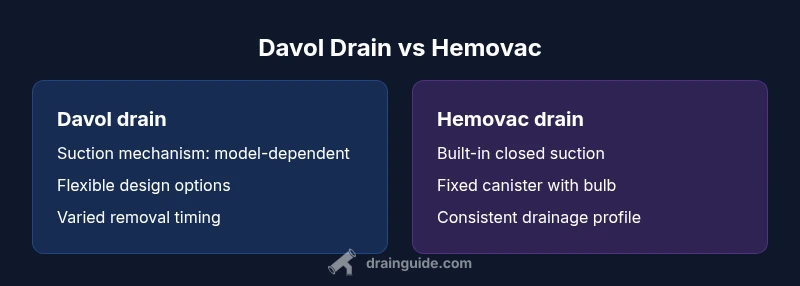
Davol drain vs Hemovac is a comparison of two closed-drain families used after surgery. Hemovac typically provides built-in closed suction with a bulb reservoir, while Davol drains offer model variety that can be passive or suction-enabled depending on the configuration. This guide helps you understand their core differences and when each may be favored.
Understanding the two drain families: davol drain vs hemovac
When clinicians talk about the two most common drain families after surgery, they often contrast the Davol drain family with the Hemovac system. The topic of davol drain vs hemovac is not about a single product, but about families of devices designed to collect fluids while protecting the surgical site. Drain Guide emphasizes that the choice should be guided by the clinical scenario, anticipated drainage volume, and the need for controlled suction. In the context of davol drain vs hemovac, you will frequently encounter differences in how drainage is collected, how suction is generated, and how the system is maintained. The goal of this comparison is to equip caregivers with a framework to evaluate options in real-world settings. This discussion respects the reality that institutional protocols and surgeon preferences influence the final decision, and it highlights practical considerations for both davol drain and hemovac choices.
Key factors shaping the davol drain vs hemovac decision
- Suction dynamics: Hemovac commonly uses a built-in closed suction mechanism with a compressible bulb, while davol drain configurations may rely on passive drainage or external suction adapters depending on model and surgical plan. This distinction often guides how quickly fluid is removed and how consistent the drainage rate appears in practice.
- Design footprint: Hemovac devices tend to have a compact, reusable-look reservoir with a defined canister and outlet. Davol drains can vary more in shape, length, and port arrangement, offering flexibility for different surgical sites.
- Monitoring and maintenance: Both drain families require careful monitoring for output, kinks, and secure connections, but the specifics of how to check them can differ by model. Drain Guide recommends clear documentation of drainage trends and timely assessment if unexpected changes occur.
- Removal cues: Removal timing is driven by clinical protocol and the patient’s status, not by a fixed timeline. In davol drain vs hemovac scenarios, surgeons may favor earlier removal with low output in some davol configurations, whereas a stable, predictable output with active suction might favor a Hemovac approach.
Practical take: aligning the choice with the clinical goal
The central question in the davol drain vs hemovac comparison is how each option supports healing while balancing safety and convenience. In many cases, Hemovac is chosen for its reliable closed suction, particularly in procedures where consistent suction helps keep the wound environment under negative pressure. Davol drains may be preferred when a flexible approach is needed—especially in complex incisions or unusual anatomies where a one-size-fits-all suction system would be less suitable. Drain Guide notes that the ultimate decision should consider how easy it is to monitor the drain, how comfortable the patient is with the device, and how the drainage data informs care decisions.
Clinical implications and best practices
For davol drain vs hemovac decisions, clinicians should document the rationale for the chosen system, establish a monitoring plan, and set removal criteria based on serial outputs and healing progress. In many cases, education for nursing staff and patient caregivers is essential to ensure proper handling, dressing changes, and prompt detection of complications. When in doubt, consult the surgeon’s protocol and the hospital’s drain maintenance guidelines to harmonize practice across settings. This approach helps ensure that the davol drain vs hemovac choice serves the patient’s recovery trajectory rather than becoming a logistical hurdle.
Comparison
| Feature | Davol drain | Hemovac drain |
|---|---|---|
| Suction mechanism | Varies by model; some davol drains rely on gravity or passive drainage | Built-in closed suction with a spring-loaded bulb (Hemovac) |
| Design and materials | Flexible tubing and port configurations; model variety | Rigid canister with controlled outlet; designed for continuous suction |
| Typical use scenarios | General postoperative drainage across multiple procedures; adaptable setups | Procedures where reliable, continuous suction is desired (e.g., deeper spaces) |
| Drain capacity and canister size | Varies by model; may be smaller or tailored to site | Typically larger canister with visible suction reservoir |
| Removal timing cues | Depends on protocol and drainage trend; may allow earlier removal in some cases | Removal after suction ceases and drainage falls below protocol thresholds |
| Maintenance and monitoring | Check connections, ensure no kinks; model-specific checks | Inspect bulb function, secure connections, and canister integrity |
Positives
- Closed-system design reduces leakage and contamination risk
- Hemovac provides consistent suction for controlled drainage
- Davol offers model flexibility for diverse surgical needs
- Both support clear documentation and monitoring of output
- Variety of form factors can fit different anatomical sites
Cons
- Davol model variability can complicate selection without guidance
- Hemovac systems may be bulkier and require more setup in some settings
- Removal timing relies on clinician protocol and patient status
- Maintenance demands can vary by device and staff experience
Hemovac generally excels in consistent closed suction, while Davol drains offer flexible options for diverse surgeries.
Choose Hemovac when reliable suction and a standardized setup are priorities. Opt for Davol when a tailored configuration better matches the surgical site and healing plan.
Got Questions?
What is a Hemovac drain and how does it work?
A Hemovac drain uses a built-in closed suction system to create negative pressure, drawing fluid from the surgical site into a canister. It is designed to maintain steady drainage and minimize contamination risk. In a davol drain vs hemovac comparison, Hemovac typically offers consistent suction but may require more setup.
Hemovac provides controlled suction with a bulb reservoir; you’ll see drainage collect in the canister as negative pressure pulls fluid away from the wound.
Can Davol drains be used for suction?
Yes, many Davol drains are configured to provide suction, but the exact mechanism depends on the model. Davol drains can be passive or actively suction-enabled, which influences how they perform compared with a Hemovac.
Some Davol drains offer suction, but check the specific model for passive versus active suction.
How do I decide between davol drain vs hemovac for a specific surgery?
Decision criteria include the expected drainage volume, the need for continuous suction, the drainage site, and the hospital protocol. Hemovac is often chosen for reliable suction, while Davol options provide flexibility for unique anatomies.
Is suction needed and how complex is the site? Hemovac favors consistent suction; Davol offers adaptable options.
What are common signs a drain needs attention?
Watch for kinks, dislodgement, unexpected changes in drainage color or volume, and a loss of suction. Any of these warrant medical evaluation and possible adjustment or replacement.
Look for kinks, leaks, or loss of suction and report them to your care team promptly.
How is drain removal decided and performed?
Removal is guided by clinical protocol and drainage trends—typically when output is minimal and healing progresses. The clinician determines safety and timing, then removes the drain under sterile conditions.
Removal happens when the team confirms low drainage and healing, following strict safety steps.
The Essentials
- Prioritize suction consistency for predictable drainage needs
- Expect model variability with Davol drains; confirm compatibility
- Monitor output and device integrity regularly
- Follow surgeon and hospital protocols for removal
- Educate staff and caregivers on device handling