Hemovac Drain vs JP Drain: An Analytical Guide
This objective guide compares Hemovac and JP drains, outlining how they work, when to use them, care tips, and factors that influence choosing one drain type over the other.


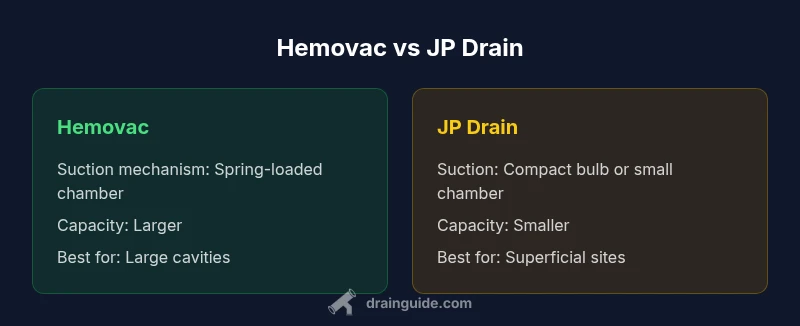
Both Hemovac and JP drains are closed suction devices used to remove postoperative fluids. For small, superficial spaces, JP drains are often preferred due to their compact size and simpler care. Hemovac drains offer higher suction and larger capacity, making them better for large cavities or high-drain situations. The choice depends on surgical site, expected output, and doctor preference.
Understanding the two drain families: hemovac drain vs jp drain
The hemovac drain vs jp drain are common closed suction systems used after many surgical procedures. They are designed to remove blood, serum, and other fluids to reduce infection risk and promote healing. For readers of Drain Guide, understanding these devices helps you engage in informed conversations with your surgical team. In the context of hemovac drain vs jp drain, clinicians weigh the surgical site, expected drainage volume, patient comfort, and surgeon preference. Drain Guide emphasizes that there is no one-size-fits-all solution; the choice hinges on the specifics of the operation and patient factors.
In many procedures, practitioners favor a JP drain for smaller spaces due to its compact form and ease of care, while a Hemovac offers a larger capacity and stronger suction for larger cavities or high-drain scenarios. The landscape is shaped by clinical protocols, hospital equipment inventories, and surgeon familiarity with each system.
According to Drain Guide Analysis, the decision often rests on cavity size and expected drainage rate. This analysis highlights the practical trade-offs between a small, quiet bulb-style drain and a larger, spring-loaded reservoir. Both systems are designed to be closed and portable, minimizing external contamination and helping nurses monitor output over the critical postoperative days.
How the Hemovac drain works: suction, capacity, and placement
Hemovac drains use a closed, spring-loaded reservoir that actively creates suction as it expands to accommodate fluid. When the chamber expands, it maintains negative pressure to pull fluids from the wound cavity through the tubing. The device typically has a larger internal capacity than many alternatives, which makes it suitable for high-drain surgeries. Because of its size and the need to position the reservoir, Hemovac tubing is often placed in deeper cavities (e.g., abdomen, orthopedic sites). This setup allows for continuous drainage without frequent re-collection, but it also requires careful securement and monitoring to prevent kinking or dislodgement. Routine nursing duties include checking the expansion of the canister, ensuring the connections are tight, and recording output to guide medical decisions.
How the JP drain works: compact suction and site versatility
The JP drain is a closed suction system that is commonly attached to a small bulb or compact chamber. Suction is created by squeezing and releasing the bulb, which pulls air out of the chamber and creates negative pressure in the tubing. The JP drain is typically smaller and lighter than a Hemovac, making it more comfortable for patients with smaller surgical spaces. Its tubing is usually flexible and easier to position around superficial sites, such as breast surgery or thyroid procedures. Because the unit is smaller, clinicians may need to monitor drainage more frequently and empty or reset the bulb as needed. The JP drain is often favored when mobility and outpatient management are priorities.
Typical use cases and site considerations: choosing the right fit
Hemovac drains are frequently chosen for larger cavities or surgeries with substantial tissue disruption, such as abdominal or orthopedic procedures. The larger capacity can accommodate higher drainage volumes over several days, reducing the need for frequent changes. JP drains are commonly selected for smaller, more superficial spaces, including breast reconstructions and thyroid or neck procedures, where a lighter, less bulky device improves patient comfort.
From a patient education perspective, it’s important to understand how your specific drain will be managed after discharge. Drain output, dressings, and activity restrictions will differ between Hemovac and JP drains. Drain Guide notes that, in practice, the decision is a collaboration among the surgical team, nursing staff, and the patient’s care plan. Clinicians weigh the expected drainage rate, wound location, and the patient’s ability to participate in care tasks when making a recommendation.
Design and maintenance differences: size, durability, and care routines
Hemovac devices are larger and heavier, with a clear reporting path for nurse-led monitoring of chamber expansion and secure connections. They tend to require more space around the patient and more deliberate handling during dressing changes or movement. JP drains are notably lighter and more portable, often perceived as easier for the patient to manage during daily life. However, the JP’s smaller capacity means higher drainage volumes may necessitate more frequent emptying or bulb resets. Both systems demand strict aseptic technique, careful securing of tubing, and clear labeling to prevent accidental dislodgement or contamination. Regular checks of the drain site, skin integrity, and filtration of any clots are essential for preventing complications.
Safety, risks, and complication management: staying alert
A primary safety objective with any closed suction drain is to minimize infection risk. Both Hemovac and JP drains reduce external contamination by keeping drainage inside a sealed system. Complications can include blockage, dislodgement, incorrect suction, and skin irritation from the dressing or tubing. Signs of concern include sudden increases in drainage with foul odor, new redness around the insertion site, fever, or localized warmth. If any of these occur, contact the healthcare team promptly. It’s critical not to manipulate the drain beyond the prescribed steps, especially if the patient is recovering at home. The surgeon will provide explicit guidance on when to seek urgent care and what information to report (output volume, color, and any changes in sensation).Drain Guide emphasizes clear communication with your care team to tailor monitoring and activity recommendations to the drain type in use.
Care and troubleshooting at home: practical steps you can take
Home care for a drain requires adherence to wound care basics and drain-specific instructions. Keep the dressing clean and dry, and avoid pulling or bending the tubing. Record daily output in a patient log, noting color, volume, and any changes in viscosity. If the drain bulb is not maintaining suction, do not force adjustments; consult your clinician for guidance. Determine what activities are permitted and which movements to avoid to protect the drain and site. Remember that proper securing of cords or tubing helps prevent accidental dislodgement during routine tasks. By following your clinician’s specific instructions, you can reduce the risk of complications and support a smoother recovery.
Cost, availability, and patient experience considerations
Cost and availability of Hemovac vs JP drains vary by hospital, region, and supplier contracts. In general, JP drains are less expensive and more widely stocked, which can influence initial device selection, especially in budget-conscious settings or outpatient programs. Hemovac devices tend to be more expensive due to larger capacity and specialized components, but they may reduce the need for early drain removal in high-drain scenarios. Patients often report a noticeable difference in bulk and comfort, with JP drains offering greater discretion under clothing. Recovery experiences differ by site and surgeon preference, as well as the patient’s activity level and support system at home.
Decision factors to help you talk with your clinician
When deciding between a Hemovac drain and a JP drain, consider the surgical site, expected drainage rate, patient comfort, mobility requirements, and discharge plan. A surgeon will weigh the space available for the drain, the likelihood of rapid fluid accumulation, and the patient’s ability to manage a more extensive device. Discuss the anticipated drain duration, monitoring schedule, and signs of potential problems to create a practical, action-oriented care plan. If you are a homeowner or caregiver, ask for written instructions and a contact path for questions that arise after discharge. Drain Guide highlights that collaboration with the surgical team leads to safer, more predictable recovery outcomes.
What patients should expect in hospital and after discharge
In the hospital, expect routine surveillance of the drain site, regular output measurements, dressing changes, and clear guidance on activities, bathing, and movements that are allowed with the drain in place. After discharge, the plan will depend on the drain type and the recovery trajectory. Some patients may resume normal activities sooner with JP drains, while others with Hemovac devices may require a longer period of restricted movement or additional home health visits. Follow-up appointments will assess healing progress, determine whether drainage is trending down, and decide when drain removal is appropriate. Adhering to activity restrictions, wound care protocols, and medication regimens will help minimize complications while ensuring a smooth transition from hospital to home. The Drain Guide team recommends documenting any concerns and maintaining open communication with your healthcare team to tailor the care plan to your specific situation.
Authority sources and best-practices references
For readers seeking evidence-based guidance, consult reputable sources and professional organizations. Key references include: • https://www.cdc.gov • https://www.nih.gov • https://www.ncbi.nlm.nih.gov. These resources provide general principles of wound drainage, infection prevention, and postoperative care that support clinicians and patients in making informed decisions about drainage strategies. Drain Guide also relies on clinical guidelines and expert consensus from these sources to inform recommendations and best practices.
Comparison
| Feature | Hemovac | JP drain |
|---|---|---|
| Suction mechanism | Integrated mechanical spring-loaded chamber for continuous suction | External bulb or compact suction device |
| Capacity | Larger capacity for high-volume drainage | Smaller, compact capacity for moderate to low drainage |
| Typical placement | Deeper or larger spaces (abdomen, pelvis, orthopedic sites) | Superficial or breast/neck procedures |
| Care and maintenance | Requires monitoring of chamber expansion and secure connections | Easier to empty and manage; may require bulb resets |
| Patient comfort and mobility | Bulkier and may limit movement | More comfortable and easier to wear under clothing |
| Cost/availability | Often higher cost; specialized equipment | Typically less costly and widely stocked |
Positives
- Closed-suction design reduces infection risk
- Hemovac offers larger capacity for high-drain surgeries
- JP drain is compact and easier to manage for superficial sites
- Clear nursing protocols exist for both devices
Cons
- Hemovac can be bulky and heavier to manage
- JP drains may require more frequent emptying with high output
- Device choice may depend on surgeon preference and hospital policy
- Discharge planning may require additional caregiver training
No single choice is universally best; match the drain type to the surgical site and expected drainage.
JP drains suit small, superficial spaces with moderate output; Hemovac excels for larger cavities and higher drainage. Clinician input remains crucial for final selection.
Got Questions?
What is the key difference between Hemovac drain and JP drain?
Hemovac uses a spring-loaded chamber to provide higher suction and larger capacity; JP drains use a compact bulb or small chamber. Both are closed suction systems designed to remove postoperative fluids. The choice depends on surgical site and expected drainage.
Hemovac has more capacity and stronger suction; JP drains are smaller and easier to manage. The choice depends on the surgery.
When should a JP drain be chosen over a Hemovac drain?
JP drains are typically favored for small, superficial spaces where modest drainage is expected and comfort is a priority. They’re easier to position and monitor in outpatient settings.
For small, superficial spaces, a JP drain is usually preferred because it's lighter and easier to manage.
Are JP drains more comfortable for patients than Hemovac drains?
In many cases, JP drains feel less bulky and are easier to conceal under clothing, contributing to patient comfort. Hemovac devices are larger and may restrict movement.
JP drains tend to be more comfortable because they are smaller and lighter.
Can a patient remove a drain at home?
Drain removal should always be performed by a trained clinician in a clinical setting. Improper removal can cause tissue damage or infection.
Don't try to remove a drain yourself; seek medical care.
What signs indicate infection or complication with a drain?
Watch for increasing redness, warmth, fever, unusual drainage, or foul odor. Report these signs promptly to your healthcare team.
If you notice redness, fever, or foul drainage, contact your clinician right away.
How does suction work in Hemovac and JP drains?
Hemovac uses a spring-loaded chamber to generate continuous suction; JP drains rely on a bulb or built-in mechanism to create negative pressure. Both require regular monitoring and proper securing of connections.
Hemovac uses a spring chamber; JP uses a bulb—both pull fluids out of the wound.
The Essentials
- Assess cavity size and expected drainage early.
- Choose JP drain for compact, low-to-moderate output.
- Choose Hemovac for high-volume drainage and larger spaces.
- Monitor for blockage, infection, and skin irritation.
- Discuss drain type with your surgeon to align with care plan.