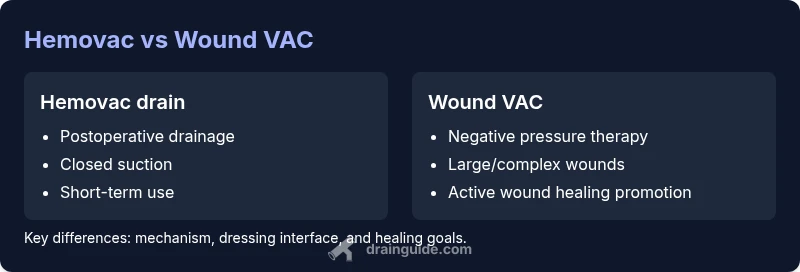
Hemovac Drain vs Wound VAC: Side-by-Side Comparison
Compare Hemovac drains and wound VAC therapies: indications, mechanisms, care, and decision factors to choose the right drainage approach for postoperative wounds.


Hemovac drain and wound VAC are two distinct approaches for managing wounds after surgery. The hemovac drain vs wound vac framing helps clinicians decide whether simple drainage or active wound therapy best supports healing. For straightforward, low-exudate wounds, a Hemovac may suffice; for larger or complex wounds, VAC therapy is often favored to promote closure and granulation.
Understanding hemovac drain vs wound vac in clinical practice
In surgical and wound care settings, the choice between a hemovac drain and a wound VAC (negative pressure wound therapy) is not a one-size-fits-all decision. The hemovac drain vs wound vac framing helps clinicians map out drainage strategies, healing goals, and patient comfort. According to Drain Guide, the key question is: what wound characteristics and exudate levels dictate the appropriate option? For many patients, this comes down to wound size, depth, tissue viability, and whether rapid fluid removal or active wound-edge management is required. In short, hemovac drainage is often favored for straightforward postoperative drainage, while wound VAC therapy is chosen for complex wounds with substantial tissue loss, tunneling, or delayed healing. This analytical guide compares the two approaches, highlighting practical considerations for clinicians and caregivers.
How a hemovac drain works and typical setup
A hemovac is a closed suction drain that uses negative pressure to draw fluid away from a surgical site into a collapsible reservoir. The device is connected to a sterile tubing system anchored near the incision, and suction can be adjusted or turned off as needed. Hemovac drains are commonly placed at the end of a procedure and are typically removed once drainage decreases to a negligible rate. Key practical points include ensuring the collection canister remains upright, monitoring for kinks in the tubing, and keeping the exit site clean to reduce infection risk. For postoperative patients, the ability to quantify drainage helps clinicians track healing progress and make decisions about wound care, antibiotic use, and potential re-operation if a drain becomes obstructed or dislodged.
How a wound VAC works and dressing interfaces
A wound VAC applies controlled negative pressure to a wound via a foam dressing sandwiched between the wound bed and an airtight drape. The suction is delivered through tubing to a canister, removing exudate, reducing edema, and encouraging granulation tissue formation. Dressing changes are scheduled per protocol and depend on wound type, exudate level, and infection risk. VAC therapy is particularly advantageous for large wounds, tunneling, or areas with irregular contours where standard dressings struggle to maintain a seal. Observing aseptic technique during dressing changes minimizes contamination and helps maintain the vacuum's effectiveness. While VAC can accelerate healing in certain wounds, it requires careful patient selection and ongoing evaluation for signs of necrosis, necrotic tissue, or inadequate perfusion.
Clinical indications: when to choose VAC vs Hemovac
The decision to use a hemovac drain or a wound VAC is guided by wound characteristics and healing goals. For clean surgical incisions with moderate exudate after routine procedures, a hemovac drain can prevent fluid collections and reduce tissue tension. In contrast, VAC therapy is favored for larger wounds with substantial exudate, devitalized tissue, or delayed healing where maintaining a moist, controlled wound environment is critical. The choice also depends on patient factors such as mobility, pain tolerance, and access to healthcare facilities. Drain Guide notes that VAC therapy is commonly integrated into multidisciplinary wound care programs for complex wounds, while hemovac drains remain a workhorse for acute postoperative drainage. Clinicians balance cost, device availability, and goals like infection control and rapid closure when selecting a strategy.
Comparative performance and healing considerations
Evidence comparing hemovac drains and VAC therapy emphasizes different strengths. VAC therapy can promote granulation tissue, reduce edema, and help draw edges together in suitable wounds; however, it is not universally appropriate and may be less effective for very shallow wounds or wounds with exposed vessels. Hemovac drains provide reliable fluid removal and can help prevent seromas and hematomas after surgery, but they do not directly deliver wound-edge therapy. In practice, many patients require a staged approach: initial drainage with a Hemovac to control exudate, followed by VAC therapy if the wound conditions warrant enhanced healing promotion. Clinicians should monitor indicators such as exudate quality, color, and wound bed appearance to determine when to escalate or de-escalate therapy.
Design, usage, and maintenance differences
Hemovac devices emphasize portability and a simple suction mechanism. The canister is emptied, and suction is reestablished as needed, with attention to kinks and the integrity of the tubing. VAC systems revolve around a dressing interface that maintains an airtight seal, periodic dressing changes, and monitoring of negative pressure levels. Maintenance for VAC requires more frequent dressing manipulation and training to avoid compromising the seal. Infection control is central to both approaches, but VAC dressings add an extra layer of interface between the wound and the environment. Patient and caregiver education should cover device handling, recognizing alarms, and when to seek urgent care.
Cost considerations and resource use
Cost considerations for hemovac drains and VAC therapy vary by setting and region. A Hemovac unit may incur lower upfront device costs and fewer specialized supplies, making it attractive for simple postoperative drainage. VAC therapy, while potentially more expensive upfront due to dressings and equipment, may offer benefits in complex wounds that shorten healing time and reduce hospital stay in the right context. Reimbursement policies and the availability of trained staff influence the decision as much as clinical factors. Hospitals may negotiate bulk supply agreements to reduce per-use costs, while outpatient clinics must consider patient travel and dressing supply availability when planning home therapy.
Patient experience and safety considerations
Patient experience is shaped by pain, mobility, and comfort of the wound care process. Hemovac drains can limit movement due to tubing, and the sound of suction may be bothersome for some patients, especially in the early postoperative period. VAC therapy often requires more frequent dressing changes, and some patients report discomfort from the dressing or from edema around the wound edges. Both therapies aim to reduce infection risk by maintaining a controlled wound environment, but strict asepsis during dressing changes is essential for VAC. Clinicians should educate patients and families about signs of leakage, tube kinking, or reduced suction, and provide clear instructions for seeking help if there is fever, new drainage color, or increased pain.
Decision framework and practical steps to decide
To choose between a hemovac drain and a wound VAC, start with a structured assessment: evaluate wound size, depth, exudate level, and tissue viability; assess patient mobility and home support; review available staff and supply chains. Develop a plan that may involve an initial drain to control drainage, followed by VAC if the wound demonstrates favorable progress. Documentation should capture drainage volume trends, wound bed evaluation, and response to therapy. Involve the patient in the decision by explaining expectations, potential discomfort, and the approximate duration of therapy. Reassess regularly and adjust the plan based on evolving wound characteristics and patient goals. For clinicians and caregivers, use the framework to minimize unnecessary device changes and optimize healing outcomes.
Comparison
| Feature | Hemovac drain | Wound VAC |
|---|---|---|
| Indications | Postoperative drainage, small to moderate wounds | Complex wounds or large surface area, ongoing exudate care |
| Mechanism | Closed suction reservoir that collects drainage | Negative pressure dressing that promotes wound edge healing |
| Dressings/Interface | Canister-based drainage with collection bag | Foam dressing interfacing with wound and tubing |
| Typical duration | Short-term drainage after surgery | Longer-term therapy as wounds heal |
| Cost considerations | Lower upfront cost in simple cases | Higher ongoing supply costs for VAC |
| Maintenance | Monitor suction and empty canister | Regular dressing changes and pressure checks |
| Best For | Straightforward postoperative drainage | Large, complex wounds requiring active wound therapy |
Positives
- Hemovac provides reliable, straightforward postoperative drainage with minimal setup
- Wound VAC can promote faster healing for large or complex wounds
- Both create closed systems that reduce external contamination risk
- Hospital and outpatient settings commonly support either option when clinically appropriate
- Clear protocols exist for monitoring and escalation when wounds evolve
Cons
- VAC is not suitable for every wound and requires careful selection and training
- Hemovac does not deliver active wound-edge therapy and may prolong healing in complex wounds
- VAC dressings can be more labor-intensive and costly over time
- Both devices require diligent care to avoid blockage, seal failure, or infection
VAC is generally better for large or complex wounds; Hemovac is preferred for straightforward postoperative drainage.
Choose VAC when the wound is large, has significant exudate, or needs edge contact therapy. Choose Hemovac for simple drainage after surgery with lower setup complexity.
Got Questions?
What is the main difference between a Hemovac drain and a wound VAC?
Hemovac drains remove postoperative fluid to prevent collections, while a wound VAC applies controlled negative pressure to promote healing in larger wounds. They serve different purposes and are often used in a staged or combined approach.
Hemovac removes drainage; VAC applies suction to the wound to encourage healing.
When is Hemovac preferred over VAC?
Hemovac is preferred for straightforward postoperative drainage with limited exudate. VAC is chosen when the wound is large, complex, or shows delayed healing where active wound therapy can help.
Use Hemovac for simple drainage; VAC for complex wounds needing therapy.
Can VAC therapy be used for any wound?
VAC therapy is versatile but not universal. It is avoided in wounds with exposed vessels, necrotic tissue without debridement, or active infection without appropriate management.
VAC isn’t for every wound—some require different approaches.
What are common complications with Hemovac drains?
Common concerns include occlusion, dislodgement, skin irritation at the entry site, and infection risk if site care is inadequate. Regular checks help prevent issues.
Blockage or dislodgement are possible with Hemovac if not monitored.
What are common complications with VAC therapy?
VAC can cause skin maceration at the dressing edge, bleeding, or seal failure if the dressing is not applied properly. Monitoring and correct pressure settings reduce risk.
Watch for skin irritation and seal leaks with VAC.
How should I care for these devices at home?
Follow clinician instructions for dressing changes, monitor for signs of infection, document drainage and wound appearance, and contact a clinician if suction changes or leakage occur.
Follow your clinician's home-care steps and seek help if anything changes.
The Essentials
- Match device choice to wound complexity and healing goals
- VAC suits large or complex wounds; Hemovac fits simple postoperative drainage
- Assess exudate, wound bed, and patient capacity for care
- Monitor for complications and adjust therapy as wounds evolve