ipad battery drain fast: practical troubleshooting guide
Quickly diagnose why your iPad battery drain fast and apply practical fixes. This step-by-step guide from Drain Guide covers software tweaks, usage habits, and when to seek professional help to restore longer battery life.


The most common reason an ipad battery drain fast is background activity and overly bright display settings, especially on older models. Start with this quick fix: lower brightness or enable Auto-Brightness, turn off Background App Refresh, enable Low Power Mode, and set Auto-Lock to 2 minutes. Then check for iPadOS updates and restart if needed. If drain persists, consider a battery health check.
Why iPad battery drains fast
The iPad battery can seem to disappear quickly for several reasons. According to Drain Guide, aging hardware, software updates, and heavy daily use combine to shorten run time. The most common culprits are background activity, high screen brightness, and frequent charging interruptions. Background tasks like mail fetch, location services, and push notifications keep processors alive and draw power even when you aren’t actively using the device. Older iPads are more susceptible because their lithium-ion cells wear with time, reducing capacity. In practice, you may notice that even after a full charge, the device runs low within a few hours of light use. That’s not a bug; it’s a symptom of how the device balances performance, battery health, and thermal conditions. The Drain Guide team emphasizes that diagnosing the issue starts with simple checks and gradual elimination, not sweeping changes. Start by noting when the drain happens (idle vs. active use) and compare it against normal usage patterns for your model. If you’ve recently installed new apps or updated iPadOS, those changes can temporarily increase drain. With patience, most cases improve without hardware replacement.
Common culprits explained
Background activity is the top offender. Apps continuously refreshing in the background—fetching mail, updating social feeds, or syncing data—pull energy even when you’re not using them. Reduce this by turning off Background App Refresh for nonessential apps and limiting location services to only what you truly need. Display brightness is another major factor; keeping the screen at full brightness or relying on Auto-Brightness in bright environments can dramatically shorten run time. When the brightness is high, the backlight consumes power relentlessly. Location services, push notifications, and frequent app updates also drain battery, especially if many apps are configured to notify you constantly. Finally, aging hardware matters. As batteries age, they lose capacity and efficiency, causing faster drain despite light usage. Drain Guide recommends approaching the problem with a layered fix: start with quick software tweaks, then reassess battery health and behavior over a few days.
Quick checks you can do now
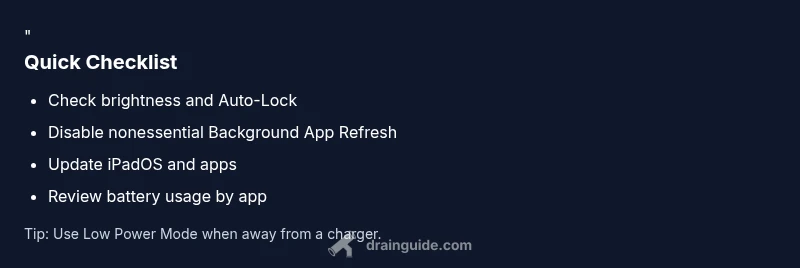
- Lower screen brightness to a comfortable level or enable Auto-Brightness. Set Auto-Lock to 2 minutes to minimize idle screen time.
- Turn off Background App Refresh for apps you don’t need updating in real time.
- Review Location Services and disable for nonessential apps; consider using a “While Using” setting where possible.
- Check which apps run in the background and close those that aren’t needed. Disable push notifications for rarely used apps.
- Ensure you’re running the latest iPadOS and app updates; developers optimize resources in newer releases.
- Avoid using power-intensive features in hot or cold environments; heat accelerates battery wear and reduces efficiency.
- Do a soft restart after updates or changes to clear temporary cache and reset processes that may be stuck.
- If the device still drains quickly, consider a battery health assessment by a professional.
How to optimize for long-term battery life on iPad
Long-term battery health on iPad is built through disciplined settings and proactive maintenance. Start by enabling Low Power Mode during long trips or when you’re away from a charger; this reduces device wake-ups and background activity. Use Auto-Lock to a short interval to prevent the screen from staying on unnecessarily. Regularly update iPadOS and apps, as developers optimize battery usage in new releases. Limit Background App Refresh and Location Services for nonessential apps, and review battery usage per app in Settings to identify killers like games or navigation apps that stay active in the background. Avoid heat exposure, keep the device out of direct sunlight, and remove heavy cases while charging if they trap heat. Finally, protect against “battery aging” by replacing the battery when the health declines substantially; consult Apple or an authorized service provider for a precise battery assessment.
Hardware health and replacement considerations
Battery health matters more as devices age. If you notice rapid drain that persists after all software tweaks, the issue could be an aging or faulty cell. In that case, the most reliable remedy is a battery health assessment and potential replacement through Apple or an authorized service provider. Most iPads with degraded batteries experience notably shorter run times even after full charging. Before replacing, confirm there are no lingering software issues and that the device isn’t thermally throttling due to heat. A professional check can confirm whether battery replacement is cost-effective compared with device life remaining.
Note: If you’re outside the standard warranty window, compare the cost of a battery replacement against the value of upgrading to a newer model. Drain Guide recommends making an informed decision based on usage patterns, device age, and the expected lifespan of the replacement.
Troubleshooting flow you can follow
When you notice rapid drain, follow a diagnostic flow to isolate causes. Start with a quick software check (OS and app updates), then evaluate settings that affect power: brightness, auto-lock, background activity, and notifications. If drain persists, re-check after a restart. If software tweaks don’t help, inspect battery health and consider a professional replacement if capacity is substantially reduced. Finally, adopt preventive habits to minimize recurrence: keep software updated, monitor battery usage by app, and avoid heat and rapid charging cycles that stress the battery.
Prevention and maintenance habits
Develop a routine to preserve battery health: install updates promptly, enable Low Power Mode during heavy use, and keep brightness at sensible levels. Check battery usage by app weekly to catch energy hogs early. When charging, use reliable adapters and avoid exposing the iPad to heat sources. Store the device with a moderate charge if you won’t use it for long periods. Regular soft restarts can also prevent software drift that impacts power efficiency. By combining mindful usage with routine maintenance, you’ll extend both daily life and overall health of the battery.
Steps
Estimated time: 30-45 minutes
- 1
Identify symptoms and baseline
Document when drain occurs, how long a full charge lasts, and which apps are active. This establishes a baseline to measure improvements after fixes.
Tip: Keep a simple log for 2–3 days to observe patterns. - 2
Update software
Install the latest iPadOS and app updates. Updates often fix power leaks and optimize resource usage by apps.
Tip: Connect to a reliable Wi-Fi network and keep the device charged during updates. - 3
Adjust display and background activity
Lower brightness, enable Auto-Lock, and disable Background App Refresh for nonessential apps.
Tip: Use Settings > Battery to identify energy-heavy apps and tweak them. - 4
Test with a restart
Perform a soft restart to clear temporary processes that can drain power unusually.
Tip: If you notice unusual heat, let the device cool before testing again. - 5
Check battery health
Review Battery Health information in Settings (or via Apple diagnostics) to assess replacements.
Tip: If health is poor, schedule a professional check rather than attempting DIY fixes. - 6
Consider battery replacement
If capacity and run time remain poor after software fixes, replacement may be the most cost-effective path.
Tip: Factor device age and potential resale value when deciding.
Diagnosis: iPad battery drains quickly even after full charge
Possible Causes
- highBackground app activity and push updates
- highHigh screen brightness or long Auto-Lock delay
- mediumOutdated iPadOS or buggy apps
- mediumAging battery reducing capacity
- lowCharging issues causing inaccurate battery readings
Fixes
- easyClose unused apps and disable unnecessary background refresh
- easyReduce brightness and set Auto-Lock to a shorter interval
- easyUpdate iPadOS and apps, then restart the device
- mediumReset all settings if issues persist (data remains, but preferences reset)
- hardIf battery health is degraded, arrange a replacement via Apple or an authorized service provider
Got Questions?
Why does my iPad battery drain faster after updating to the latest iPadOS?
Updates can introduce new background tasks and features that temporarily increase power use. After updating, monitor battery usage and disable any nonessential background activity or features if needed.
Updates can cause extra background activity. Check which apps are consuming energy and adjust their refresh settings.
Does Low Power Mode help iPad battery drain?
Yes. Low Power Mode reduces background activity and fetch frequency, helping extend run time when you’re away from a charger.
Low Power Mode can help extend battery life by limiting background activity.
Can background app refresh cause battery drain on iPad?
Yes. Background refresh keeps apps updating in the background, which uses energy. Turn off refresh for nonessential apps to save power.
Background refresh can drain battery; disable it for apps you don’t need updating constantly.
Should I replace the battery if the iPad is old?
If the battery health is reduced and the device runs out quickly despite tweaks, a professional replacement is worth considering.
If battery health is poor, a replacement may be the best option.
How can I check battery usage by app on iPad?
Go to Settings > Battery to see energy usage by app. Use this to tailor background settings and disable power hogs.
Settings > Battery shows which apps use the most power.
Watch Video
The Essentials
- Start with software tweaks, not hardware changes
- Identify energy hogs via Settings > Battery
- Update OS and apps regularly to fix leaks
- Replace battery if health is poor and device age justifies it
- Adopt preventive habits to sustain battery life