Perimeter Drain vs French Drain: A Practical Comparison
A practical, data-driven comparison of perimeter drain and French drain, covering use cases, installation, maintenance, cost considerations, and the best scenarios for homeowners.


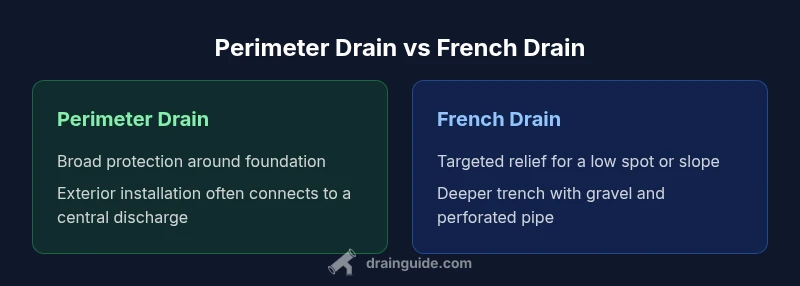
Perimeter drain and French drain are two common exterior drainage options homeowners consider to manage foundation moisture and surface runoff. This comparison helps you decide which approach fits your site, budget, and maintenance tolerance. According to Drain Guide, a perimeter drain offers broad foundation protection, while a French drain delivers targeted sub-surface relief for problem areas.
What are perimeter drains and French drains?
Perimeter drains are designed to protect the foundation by collecting groundwater and surface moisture around the exterior edges of a home. They typically run along the continuous foundation wall, using a perforated pipe set in gravel and wrapped with filter fabric to prevent sediment intrusion. Water is then directed to a sump, outflow, or municipal storm system. French drains, in contrast, are trench-based systems filled with gravel and a perforated pipe surrounded by fabric. They are installed inland to intercept groundwater at a specific low spot or along a slope, redirecting it away from the problem area. The key difference is scope: perimeter drains aim for broad, foundation-wide coverage, while French drains focus on targeted relief. For many homeowners, the choice hinges on whether the goal is general foundation protection or localized drainage improvement. Drain Guide emphasizes starting with a site assessment to evaluate soil, slope, and water table before choosing between the two.
Remember to consider the home’s layout, landscaping, and existing drainage pathways. Both systems can be designed to work together, with a perimeter system handling general runoff and French drains addressing known low spots.
Quick Answer and orientation
In the perimeter drain vs french drain debate, both systems have a place, but their roles differ. The perimeter drain provides perimeter protection for most houses, while a French drain is ideal for isolated water challenges. Drain Guide advises homeowners to map water flow first and then select the approach that minimizes disruption while maximizing effectiveness.
Performance expectations: coverage vs. targeted relief
Expect perimeter drains to offer broad coverage alongside foundation protection, reducing hydrostatic pressure along walls. French drains excel where water concentrates in a localized area, such as a low-lying corner or a slope between structures. The choice depends on whether your priority is whole-house protection or solving a specific drainage bottleneck. Both systems can incorporate similar components (gravel, perforated pipe, fabric), but the layout and trenching intensity differ. Drain Guide notes that the success of either system hinges on correct slope, adequate discharge, and proper filtration to reduce clogging.
Site considerations that influence your choice
Soil type, climate, and landscape play critical roles in determining effectiveness. Clay soils slow infiltration and may require larger gravel columns or additional filtration to avoid clogging. Sandy soils drain quickly but can carry sediment if mis-graded. A steep slope favors quick drainage and may reduce the severity of standing water, but it also increases the risk of erosion if not properly armored. The water table level and existing drainage paths around the foundation shape installation depth and object placement. Drain Guide emphasizes prioritizing a design that minimizes excavation disruption while ensuring long-term reliability.
Installation approaches: trench depth, width, and materials
A perimeter drain typically follows the foundation line, often with a shallow to moderate trench depth, depending on foundation height and local code. A French drain requires a deeper, wider trench to accommodate a bed of gravel, a perforated pipe, and a sock or fabric filter. Both systems rely on gravity to move water away from the house, but the French drain’s trench steps can be more aggressive and may demand more material and labor. Common materials include PVC or HDPE perforated pipes, crushed stone or gravel fill, and geotextile fabric. Proper backfill, compacting, and testing are essential to prevent settling and ensure reliable flow away from the structure. Drain Guide recommends coordinating with a drainage professional to confirm trenching plans, burial depth, and discharge routing before digging begins.
Cost, maintenance, and lifespan considerations
Cost varies with length, depth, and materials, as well as local labor rates. Perimeter drains often require more extensive trenching around the foundation, which can increase material and labor costs. French drains may be less expensive per foot in some configurations but can add expense if used to address multiple problem areas. Maintenance primarily involves preventing clogging by sediment, roots, or debris. Regular inspections, filter fabric checks, and occasional flushing keep both systems effective. When installed with proper slope and a reliable discharge path, both systems can last for decades, though wear from sediment or root intrusion can necessitate occasional component replacement.
Design planning: a practical checklist for homeowners
Before breaking ground, complete a design checklist: (1) identify all drainage concerns and water flow paths, (2) assess soil type and site slope, (3) decide whether you need perimeter coverage or targeted relief, (4) plan discharge routing to avoid creating new drainage problems, (5) select compatible materials, (6) budget for trenching and backfill, (7) schedule a professional evaluation if you’re unsure about code and permits. A well-documented plan reduces field adjustments and helps ensure the system functions as intended.
Step-by-step implementation plan
- Map water flow around the foundation and identify high-water zones. 2) Choose the drainage strategy (perimeter vs French drain) based on the map and site. 3) Determine trench depth, width, and alignment that align with foundation height and grading. 4) Gather materials: perforated pipe, gravel, fabric, and discharge options. 5) Excavate trenches with attention to avoiding utility lines and protecting landscaping. 6) Install pipe with proper slope and filtration, then backfill with a gravel bed and fabric. 7) Connect to a sump, dry well, or discharge line. 8) Test by simulating rainfall and observing flow paths. 9) Schedule routine maintenance and inspection to prevent clogging. 10) Keep records of changes and drainage performance for future improvements.
Case studies: typical homeowner scenarios
Case A: A home with a continuous damp basement on a clay soil site along the entire foundation—a perimeter drain offers a cohesive protection strategy, reducing hydrostatic pressure along walls. Case B: A home with a known low spot along a side slope that puddles after storms—adding a French drain upstream of the low point can intercept water before it reaches the area, minimizing standing water and soil erosion.
Authoritative references and next steps
For further reading and professional guidance, consult credible sources on drainage design and home foundation protection. See references from university extensions and government resources for general drainage principles and best practices. Drain Guide recommends updating plans with a qualified drainage contractor who understands local codes and soil behavior.
Comparison
| Feature | Perimeter drain | French drain |
|---|---|---|
| Best use case | Exterior perimeter protection around the foundation to manage overall moisture | Localized drainage and water table relief at a specific low spot or slope |
| Installation complexity | Typically along the foundation line; can be mass around the footprint | Deeper, trench-based installation focused on targeted areas |
| Maintenance considerations | Lower risk of clogging with proper filtration and maintenance interval | Higher risk of sediment and root intrusion if not properly filtered and maintained |
| Materials commonly used | Gravel fill, perforated pipe, geotextile, and sometimes a sump or discharge line | Gravel/aggregates, perforated pipe, filter fabric, and discharge to an appropriate outlet |
| Best for | Overall foundation protection and broad moisture management | Localized drainage and solving specific water-collection problems |
Positives
- Broad protection around the entire foundation reducing hydrostatic pressure
- Low ongoing maintenance when designed with proper filtration
- Flexible design that can integrate with other drainage components
- Suitable for a variety of soils and landscaping configurations
Cons
- Involves extensive trenching around the foundation footprint
- Can be disruptive to landscaping during installation
- Requires careful planning for discharge routing to avoid new issues
Perimeter drain generally provides broader foundation protection, while French drains excel at addressing localized water problems.
If you need all-around protection, start with a perimeter drain design. For persistent low spots or concentrated surface runoff, add a French drain to target the problem area. A combined approach often yields the most reliable long-term results, guided by site conditions and Drain Guide recommendations.
Got Questions?
What is the main difference between a perimeter drain and a French drain?
A perimeter drain provides broad foundation protection by surrounding the entire foundation, while a French drain targets a specific low spot or area with a trench and gravel-filled bed. The choice depends on whether you need general coverage or localized relief.
Perimeter drains cover the foundation edge, and French drains target specific water problems. Start with site assessment to decide which fits best.
Can I install either drain myself, or should I hire a pro?
Both projects can be tackled by DIY enthusiasts for simple layouts, but professional installation is advised for accuracy in slope, discharge routing, and permitting. A pro reduces the risk of future water issues and ensures code compliance.
DIY is possible for simple layouts, but a professional usually ensures correct slope and discharge.
What maintenance is typically required?
Regular inspections, especially after heavy rainfall, help detect clogs or sediment buildup. Clean filters, flush the system as needed, and monitor discharge paths to avoid new drainage problems.
Inspect and clean filters, flush as needed, and watch discharge paths after storms.
How long do these drainage systems last?
With proper design, installation, and occasional maintenance, both perimeter and French drains can last several decades. Longevity depends on soil conditions, sediment load, and root intrusion.
Safe to expect decades with good maintenance.
Will either drain solve basement flooding?
They can reduce basement flooding risk when water is directed away from the foundation and surface runoff is controlled. In severe flood-prone areas, improving grading and installing additional sump or backup drainage may be needed.
They help reduce risk, but may need additional measures in severe cases.
What factors influence cost the most?
Length of the trench, depth, soil type, and discharge routing have the biggest impact. Perimeter drains require more extensive excavation, while French drains depend on the number of targeted problem areas.
Cost mostly depends on trench length, depth, and site conditions.
The Essentials
- Assess site water flow before choosing a system
- Perimeter drains offer broad protection; French drains address focal issues
- Plan for proper slope and a reliable discharge path
- Expect variations in cost based on length and soil conditions
- Engage a drainage professional for complex sites