How Big Is a Septic Drain Field? Sizing, Standards, and Practical Guidelines
Discover typical septic drain field sizing, factors that influence size, and practical guidelines for homeowners. Learn how professionals estimate area and setbacks.


Typically, the size of a septic drain field depends on soil permeability and daily wastewater flow, plus local code requirements. In residential designs, fields often measure several hundred to around a thousand square feet per bedroom-equivalent. Exact sizing must come from site-specific soil tests and jurisdictional rules. For a precise estimate, consult a licensed septic designer.
Understanding Drain Field Sizing
For homeowners asking how big is a septic drain field, sizing means estimating how much surface area is needed to treat and dispose of effluent safely. The drain field relies on soil in the unsaturated zone to filter and evaporate water, so the ability of the soil to absorb liquids is a primary driver of size. There is no universal number that fits all properties; instead, sizing depends on site data, including soil type, groundwater depth, and local regulations. This section lays out the core concept: size is a function of load and soil capacity, not of house square footage alone, and must be validated by field testing and jurisdictional requirements.
Key Factors Affecting Size
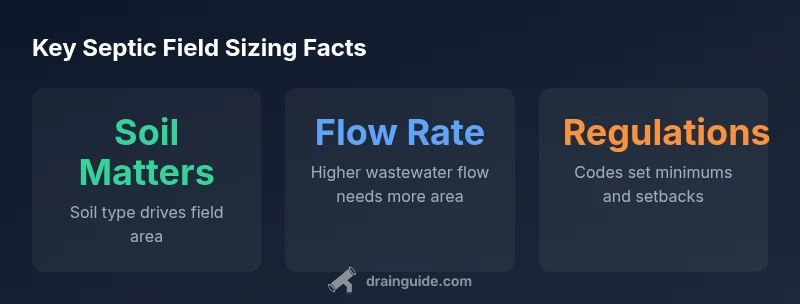
Several core factors determine the drain field footprint. Soil permeability is typically the biggest influence: sandy soils drain quickly and may require less area, while tight clays demand more space to achieve the same treatment. Daily wastewater flow, driven by the number of occupants and water-using appliances, sets the baseline load. Local health codes establish minimum setbacks from wells, property lines, and surface water that can constrain the usable area. Climate and seasonal moisture, slope, and groundwater depth also shape what is feasible. Finally, future changes, such as a larger family or additions, can push designers to plan for expansion.
Sizing Methods: Perc Tests to Design Calculations
Designers use soil tests and flow estimates to calculate field area. A perc test measures how fast soil absorbs water, feeding a standard formula that converts wastewater load into an absorption area. If perc results are slow, the calculated area expands; if fast, the area may be smaller. Some sites require soil borings or hydrological assessments, and advanced modeling for complex soils. Regardless of method, the result should meet safety standards while respecting land availability.
Site and Code Considerations
Site constraints, not just soil, drive feasible field size. Setbacks protect water sources and property, and they vary by jurisdiction. Some areas mandate specific trench designs or mound systems for poor soils or high water tables. Local permitting processes determine documentation, inspections, and timelines. Early communication with the health department, utility company, and any relevant planning boards reduces surprises and costly rework. Keep records of soil tests and design calculations for future maintenance or upgrades.
What Pros Do: Design Process and Best Practices
Professional sizing marries science with local policy. After a site evaluation and soil testing, designers translate wastewater design flow into an absorption area expressed as square footage per bedroom-equivalent. They select trench or mound configurations based on soil type, layout, and access for maintenance. The final plan includes pipe layout, cover, and an explanation of how the field will be monitored. Documentation for permit submission is a critical final step.
Maintenance, Red Flags, and Reassessment
An under- or oversized field can lead to system failure or unnecessary cost. Look for signs such as damp ground, persistent odors, or slow drainage in sinks and toilets. Regular septic pumping helps prevent solids buildup that can clog absorption areas, but it cannot compensate for a mis sized field. If you notice problems, contact a licensed septic designer promptly; retrofitting or expanding an existing field is more challenging on constrained lots. Reassessment is common if the home changes, such as more bedrooms or different water-use patterns.
Key considerations for septic drain-field sizing
| Aspect | Guideline | Notes |
|---|---|---|
| Soil Type | Percolation rate affects size | Clay soils require larger areas |
| Household Size | Higher flow increases area | Consider future expansion |
| Code Requirements | Setbacks vary by jurisdiction | Check with local health department |
| Typical Range | Few hundred to 1,000+ sq ft per bedroom-equivalent | Site-specific sizing |
| Site Constraints | Regulatory and physical limits | May require mound/trench designs |
Got Questions?
What factors determine the size of a septic drain field?
Size is driven by soil percolation, daily wastewater flow, and local regulations; site tests are essential.
It's driven by soil tests, daily flow, and local rules.
How do professionals measure the required drain-field area?
They use soil tests (perc tests), design flow calculations, and regulatory guidance to calculate area.
They test the soil and use design flow to calculate area.
Can a drain field be larger than needed?
Yes, but oversized fields waste space and money; many jurisdictions accept larger than minimum if the design meets the criteria.
Yes, but larger fields are usually not ideal or necessary.
What is a bedroom-equivalent?
A unit used to estimate wastewater load based on bedrooms in the home.
It's the standard unit for estimating wastewater load.
Are perc tests required everywhere?
Most jurisdictions require some soil investigation; exact requirements vary by area.
Most places require soil testing; rules vary by area.
How long does the sizing process take?
Depends on site complexity and permit approvals; typical sizing can take days to weeks.
It can take days to weeks.
“Accurate septic field sizing requires aligning soil science with local regulations; skipping soil testing can lead to undersized or oversized systems.”
The Essentials
- Sizing is site-specific, not fixed
- Rely on soil tests for accuracy
- Consult a licensed designer early
- Local codes determine minimum setbacks