Curtain Drain vs French Drain: A Practical Side-by-Side
A detailed, unbiased analysis of curtain drain vs French drain, including purpose, construction, installation, and best-use scenarios for homeowners and DIYers.


When comparing curtain drain vs french drain, both are perimeter drainage options, yet they serve different purposes and have distinct construction. Curtain drains intercept groundwater near foundations to reduce hydrostatic pressure, while French drains channel groundwater or surface water through a gravel bed and perforated pipe to redirect it away from the home or yard. The choice often hinges on foundation protection versus landscape drainage needs.
What curtain drain vs French drain mean in practical terms
According to Drain Guide, curtain drain vs French drain are both perimeter drainage options used around foundations and landscapes. Curtain drains intercept groundwater near walls to reduce hydrostatic pressure on basements, while French drains channel groundwater or surface water through a gravel bed and perforated pipe to redirect it away from the home or yard. The terminology is regionally variable, and some contractors may use the terms interchangeably. Yet the practical difference matters when you plan a restoration, a new build, or a landscape project. A curtain drain is traditionally placed along the foundation line to keep water from pressing against the wall and seeping inward, whereas a French drain is a more versatile trench that collects subsurface water and drains it laterally to an outlet. When you start planning, assess where water collects, how much water needs to be redirected, and what you want the drainage system to protect: the foundation, the landscape, or both. In all cases, the goal is to lower the groundwater pressure and improve dryness around the structure. Drain Guide's analyses emphasize tailoring the system to site-specific moisture patterns and local soil conditions.
Primary differences in purpose and scope
The curtain drain and the French drain are both designed to manage water but serve different primary purposes. Curtain drains are typically installed along a building’s perimeter to intercept groundwater that would otherwise pool against foundation walls or infiltrate basements. They focus on foundation protection and moisture control at the critical interface between soil and concrete. French drains, by contrast, are multi-purpose drainage tools used in yards, commercial landscapes, driveways, or around basements; they collect subsurface water and move it away to a suitable outlet. In practice, a curtain drain’s effectiveness hinges on getting water away from the footing and under an interior moisture barrier, while a French drain emphasizes flexibility and broader geographic drainage. When evaluating your project, map the water source, whether groundwater or surface runoff, and identify the outlet you’ll use — a storm sewer, a dry well, or a natural slope. Drain Guide recommends starting with a site assessment that includes soil type, groundwater depth, and the expected water volume; then select the system that aligns with those findings.
Construction and materials: what sits inside the trench
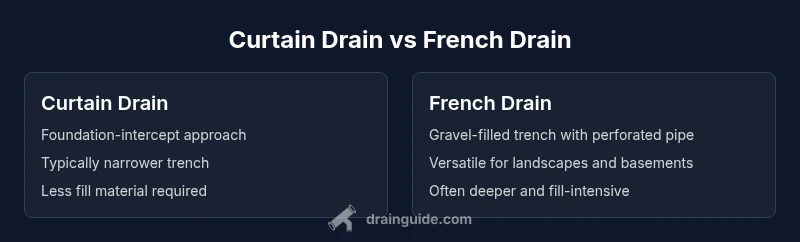
Curtain drains generally rely on a narrower trench that runs along the foundation near the footings, sometimes with a fabric liner and a modest amount of gravel or none at all, depending on the soil and the installer’s approach. The pipe is perforated and designed to collect groundwater and convey it away from the wall. French drains use a wider trench filled with gravel or crushed stone, with a perforated pipe laid on a bed of gravel and wrapped in filter fabric to prevent soil intrusion. In some designs, a sleeve of geotextile prevents silt infiltration and helps maintain flow capacity over time. The difference in trench width affects both surface impact and fill material costs. Both systems require an outlet that leads to a drainage point away from the building envelope. The choice between minimal vs substantial gravel also affects maintenance: a well-graded French drain is less prone to surface sediment buildup, but it may need periodic sift-and-flush to restore pore space.
Depth placement and foundation protection considerations
For curtain drains, depth is often aligned with the building’s footing line and foundation, ensuring the intercept collar sits just below the foundation base. This arrangement helps release groundwater away from the wall and reduces pressure against structural membranes and basements. French drains can be installed at greater depths or shallower as needed, depending on landscape grade, soil permeability, and the desired outlet location. If you install a French drain too deep, you may struggle to achieve a reliable outlet; install too shallow, and surface runoff could bypass the system. Drainage effectiveness improves when the trench is sloped toward the outlet and the pipe is well-supported by compacted fill. Drainage design should consider local codes and utilities, as well as the property’s natural drainage path. Proper slope, bed depth, and outlet alignment are essential to long-term performance.
Performance in soils and water flow regimes
Soil type strongly influences both curtain drains and French drains. In sandy soils, water moves quickly through fill material, and pipeline flow remains relatively straightforward; in clayey soils, water moves slowly, and clogging risk rises unless the fabric and gravel are selected to maximize pore space and filtration. A curtain drain may suffice for localized foundation interception where groundwater is the primary culprit, while a French drain provides broader subsurface drainage for larger areas and landscapes. Groundwater depth, rainfall intensity, and seasonal variations also shape performance. Designing for peak moisture events helps ensure the outlet remains free of debris; otherwise, the system’s benefits diminish during heavy storms. The core goal is to avoid standing water near the structure while maintaining soil health in the treated zone. Drain Guide emphasizes site-specific planning and moisture-pattern mapping as essential steps to reliable performance.
Maintenance, longevity, and potential failure modes
Maintenance needs depend on how well the system is designed and installed. Curtain drains with minimal fill may require less ongoing maintenance but can be sensitive to sediment infiltration near the foundation. French drains, if properly filter-wrapped and jacketed, typically require periodic inspection of the outlet and occasional cleaning of the trenches to prevent clogging. Common failure modes include fabric clogging, silt buildup, crushed pipe, and outlet obstruction from debris. A durable curtain drain or French drain relies on an unobstructed outlet and proper backfill to maintain flow capacity. Drain Guide’s guidance emphasizes avoiding shortcuts, ensuring proper filter material, and keeping the trench from sealing shut with sediment over time. Regular inspections after heavy storms help catch issues early.
Costs, labor, and installation difficulty (non-numeric)
In general, curtain drains tend to be simpler and quicker to install along foundations, which can lower labor costs and civil disruption, particularly when replacing damaged foundation drainage. French drains may require broader excavation and more fill material, which can increase labor time and surface disruption. The actual cost depends on trench length, depth, outlet distance, fill materials, and the need for a proper filtration layer. You should also account for potential landscape disruptions if the trench crosses lawns, sidewalks, or driveways. For homeowners, it’s prudent to obtain multiple quotes and consider whether a hybrid approach would serve both foundation protection and landscape drainage. Drain Guide advocates planning for minimum trench width, consistent slope, and secure outlet placement to manage both performance and cost.
Hybrid approaches and design tips
In many cases, an integrated solution combines elements of both curtain drains and French drains, especially for larger properties or properties with complex drainage patterns. A perimeter curtain drain can be extended into a longer French drain for landscape areas where water tends to pool. Some projects use a curtain drain first to protect the foundation, followed by a French drain to manage water across a wider zone. When designing, consider using a filter fabric system that matches soil type, a backfill mix that balances permeability and filtration, and a drainage outlet that aligns with the property’s natural drainage path. Drain Guide recommends starting with a site survey, then mapping water flow, and finally selecting the right trench dimensions, pipe spacing, and outlet placement to maximize long-term performance.
Authority sources and further reading
For readers who want to dive deeper, these sources provide authoritative, widely recognized information on drainage design and soil behavior:
- https://www.epa.gov
- https://extension.psu.edu/drainage
- https://extension.illinois.edu Drain Guide Team notes that always verify local codes and utilities requirements before starting any foundation or landscape drainage project.
Quick-start checklist to begin planning
- Define the primary moisture problem: foundation wetness vs landscape pooling.
- Map the water sources, expected flow, and alignment to an outlet.
- Choose design elements: curtain drain for foundation interception, French drain for broader landscape drainage.
- Plan the trench width, depth, slope, and filter materials based on soil type.
- Schedule a professional assessment if you’re unsure about soil permeability or outlet availability.
Conclusion and next steps
The curtain drain vs French drain decision hinges on the water source, the area affected, and the desired outcome. Drain Guide emphasizes tailoring the system to site conditions and maintaining a clear outlet path for long-term success. The Drain Guide team recommends starting with a site survey and then selecting the approach that best supports foundation protection and landscape drainage, possibly combining both where appropriate.
mainTopicQuery
Comparison
| Feature | Curtain drain | French drain |
|---|---|---|
| Typical use | Foundation/interception near walls to reduce hydrostatic pressure | General purpose subsurface drainage for landscapes, basements, or walkways |
| Construction approach | Narrow trench with liner and limited gravel; perforated pipe | Wider trench with gravel fill, perforated pipe, and filter fabric |
| Depth placement | Aligned with foundation base, shallow to mid-depth | Varies with landscape grade; can be deeper for broader drainage |
| Groundwater handling | Focus on directing water away from foundation | Diverts subsurface water across a broader area toward an outlet |
| Maintenance | Typically lower maintenance if properly lined | Potential sediment buildup and fabric clogging; more routine checks |
| Best for | Foundation protection and moisture control | Landscape drainage, hillside runoff, or multi-area drainage |
Positives
- Low-profile option that protects foundations when placed along walls
- Simple for small, focused drainage near a home
Cons
- Limited scope for broad landscape drainage
- May require precise outlet location to work effectively
Choose based on primary drainage goal: curtain drain for foundation-focused moisture control; French drain for versatile, landscape-wide drainage.
If foundation protection and reducing hydrostatic pressure are the priority, curtain drains are often the better choice. For broader subsurface drainage across yards, landscapes, and multi-area needs, a French drain provides greater flexibility. Drain Guide recommends tailoring the system to site conditions and, when possible, using a hybrid approach that covers both foundation protection and landscape drainage.
Got Questions?
What is the difference between curtain drain and French drain?
Curtain drains are narrow trenches placed along foundations to intercept groundwater and reduce hydrostatic pressure on walls. French drains are broader trenches filled with gravel and a perforated pipe, designed for subsurface drainage across landscapes or basements. Both aim to move water away from structures, but their primary purposes and configurations differ.
Curtain drains protect foundations; French drains handle broader drainage across landscapes.
Can I install either drain myself?
Basic trenching and pipe installation can be a DIY project for those with carpentry and drainage experience, but proper planning, slope, fabric filtration, and outlet placement are critical. For reliability and code compliance, many homeowners hire a professional. Always check local regulations and utility line locations before digging.
DIY is possible for simple projects, but plan carefully and check local rules.
Where should the outlet be located?
The outlet should direct water away from the foundation and toward a suitable discharge point, such as a storm sewer, dry well, or a natural slope. Incorrect outlet placement can render the system ineffective or cause issues downstream.
Outlets must direct water away from the home to a proper discharge point.
Do curtain drains require gravel or fabric?
Curtain drains often use minimal fill and sometimes a fabric liner, depending on soil type and project goals. French drains generally employ gravel and filter fabric to maintain flow and prevent soil intrusion. Both use a perforated pipe to transport water away.
Curtain drains use less fill; French drains use more gravel and fabric.
How long do these drains last?
Lifespans depend on installation quality, soil conditions, and maintenance. With proper filtration, stable outlets, and periodic checks, both curtain and French drains can perform effectively for many years. Regular maintenance helps prevent clogging and reduces the need for major repairs.
Proper installation and maintenance help curtains and French drains last longer.
The Essentials
- Assess the water source first (foundation vs landscape).
- Match trench depth and outlet placement to soil type and moisture patterns.
- Consider a hybrid approach for complex sites.
- Always verify local codes and plan for maintenance and future growth.