French Drain vs Weeping Tile: A Homeowner's Expert Comparison
A detailed comparison of french drain vs weeping tile for foundation drainage. Learn installation differences, materials, costs, maintenance, and when to choose one, with practical homeowner guidance from Drain Guide.


In most homes, a properly installed French drain provides better long-term drainage and predictable performance, especially in soils with higher water tables. A weeping tile can be a simpler retrofit option for limited areas or smaller projects, but it may require more maintenance and may not handle large water volumes as efficiently. This quick comparison sets the stage for a deeper, step-by-step evaluation.
French drain vs weeping tile: defining the core concepts
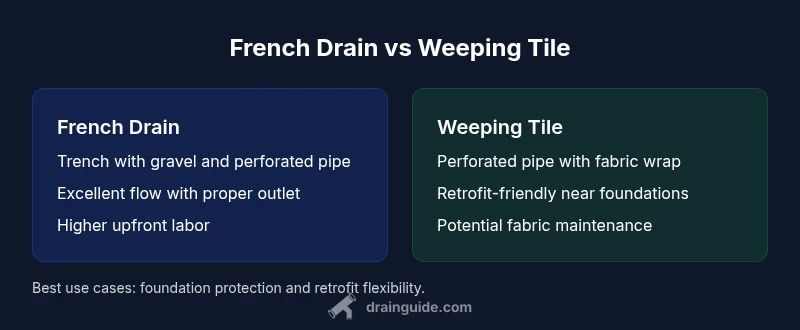
The terms french drain vs weeping tile are frequently confused, yet they describe related drainage solutions with distinct configurations. A french drain is typically a trench filled with gravel around a perforated pipe that carries groundwater away from a foundation or low spot. A weeping tile (or drain tile) is a perforated pipe wrapped in fabric that taps groundwater as it sits along a wall or within a trench, allowing water to seep into the pipe through the fabric and surrounding soils. In practice, many installations blend elements from both concepts, using a gravel or stone bed with a perforated pipe wrapped in geotextile fabric. For homeowners evaluating drainage projects, the exact layout matters for installation effort, maintenance, and performance across soil types. This article uses the french drain vs weeping tile distinction to guide a practical decision for your property with real-world examples from Drain Guide.
How each system handles water in the landscape
Both systems aim to reduce hydrostatic pressure and redirect water, but they behave differently under varying conditions. A French drain is especially effective in loose, well-draining soils where a gravel bed can quickly convey collected water to a safe discharge point. It performs well on slopes and across larger drainage areas because the gravel bed minimizes clogging and promotes gravity-assisted flow. A weeping tile is more about infiltrating groundwater into a perforated pipe wrapped in fabric; it can be advantageous when retrofitting near buildings where digging a deep trench is impractical. However, fabric and surrounding soils can become clogged over time, reducing flow and requiring maintenance. Drain Guide notes that the best outcomes often involve a hybrid approach that leverages a stone-filled trench with a perforated pipe and a fabric wrap, aligning performance with site specifics and maintenance capability.
Key components and material options
The core components are similar, but arrangement matters. A French drain typically includes a perforated pipe, a gravel or stone bed, landscape fabric, and a surface outlet or daylighting location. Materials vary by project goals: PVC or high-density polyethylene (HDPE) perforated pipes, crushed stone or clean gravel, and geotextile fabrics that keep sediment from infiltrating the pipe. Weeping tile configurations emphasize the wrap and surrounding soil, with the emphasis on porous materials along the foundation or trench edge. For homeowners, choosing the right combination—gravel size, pipe diameter, wrap type, and slope—determines initial performance and future maintenance needs. Drain Guide recommends prioritizing filter fabrics that reduce sediment infiltration and ensuring the outlet has a clear, graded path away from the home.
Sizing and planning: how to decide capacity
Sizing a drainage system involves understanding the drainage area, soil type, slope, and water table. A larger roof runoff or a high-water-table site may justify a more robust trench with thicker gravel and a larger pipe diameter. Soil type matters: sandy soils drain quickly but can carry water away faster than clay, which holds water and might clog without proper filtration. For a french drain vs weeping tile discussion, plan for a graded outlet and a trench depth sufficient to stay below the frost line in cold climates, while allowing gravity to carry water away. Drain Guide emphasizes documenting all drainage inputs (roof areas, driveways, sump sources) and selecting a safe discharge location that won’t create new problems downstream.
Cost considerations and time investment
Cost considerations for french drain vs weeping tile hinge on project scope, material choices, and whether you hire a pro. In general, labor-intensive trenching and proper installation lead to higher upfront costs but longer-term reliability. Weeping tile projects may be cheaper upfront, especially for retrofit work close to existing foundations, but can incur ongoing maintenance if fabric clogs or if soil settles and reduces trench effectiveness. Material choices—pipe type, filter fabric, and stone quality—also influence price and long-term performance. Drain Guide suggests obtaining multiple quotes that itemize trench depth, pipe size, filtration, and outlet routing so you can compare value and avoid hidden costs.
Durability, maintenance, and common failure modes
Durability depends on soil conditions, filtration, and how well the trench is maintained. French drains with clean gravel and robust filters tend to resist clogging and require less frequent intervention, provided the outlet remains clear and free of debris. Weeping tile can be highly effective in the short term, but fabric wraps can trap silt or degrade in aggressive soils, increasing maintenance needs. Common failures include crushed or blocked pipes, silt and root intrusion, and poor outlet design. A proactive maintenance plan—periodic inspection, sediment removal, and ensuring the discharge path remains operational—extends life. Drain Guide emphasizes preventative maintenance as a critical factor in achieving long-term drainage success.
Installation approaches: DIY vs professional installation
DIY installations can be feasible for small sites with straightforward grading, shallow trenches, and clear outlets, but deeper or more complex projects benefit from professional expertise. Pros bring knowledge of trench alignment, slope accuracy, and code considerations, reducing the risk of water backing up or failing at the outlet. A well-done installation—whether french drain or weeping tile—requires careful planning, correct trench width, and appropriate backfill. Drain Guide highlights that professional work often includes permits, proper grading, and reliable outlet placement, which can save time and prevent costly mistakes in the long run.
Code, permits, and local considerations
Local codes may regulate drainage discharges, trench depths, and the materials allowed for foundation drainage. In some jurisdictions, permits ensure the drainage plan meets setback requirements, grading rules, and safety standards around utilities. If you’re connecting to municipal stormwater or altering wall drainage, consult local authorities and a qualified plumber before breaking ground. Drain Guide reminds homeowners that even simple projects can trigger compliance steps, so verify requirements early to avoid delays or rework.
Pros and cons in context
General pros of the french drain approach include strong long-term drainage performance and compatibility with landscaping, while weeping tile offers retrofitting advantages and lower upfront labor in some cases. On the downside, french drains may require more digging and site disruption, and improper outlet design can negate benefits. Weeping tile may demand ongoing maintenance if fabric clogs, especially in fine soils. Overall, neither solution is universally superior; the best choice depends on site conditions, the scale of drainage needs, and the homeowner’s willingness to maintain the system over time.
Best-fit scenarios: when to choose one over the other
Choose a French drain when you face high water volumes, challenging soils, or a need for long-term robustness across a larger drainage area. It’s a strong choice for foundations, basements, or yards where water pooling is persistent. Opt for weeping tile when you’re retrofitting near an existing foundation, dealing with a smaller drainage problem, or working within a tight access area where trenching is limited. A hybrid approach can also be effective if site constraints demand a balance of capacity and retrofit practicality. Drain Guide notes that evaluating your site’s specific water profile and future landscape plans will help determine the best path.
Common mistakes to avoid
Avoid common mistakes such as undersizing the trench, skipping proper filtration, neglecting outlet grading, or placing the system where it receives debris from nearby trees. Ensure the trench has a continuous slope toward the discharge point, select durable pipe materials, and confirm that the outlet is directed away from walls and windows. Don’t assume a quick fix; take the time to map drainage inputs and model expected water flow during heavy rain events. With careful design and maintenance, french drain vs weeping tile projects can deliver reliable protection against water intrusion and foundation damage.
Step-by-step planning checklist for homeowners
- Map your drainage area: roof runoff, driveways, patios, and landscaping.
- Assess soil type and water table in the target zone.
- Choose a configuration (french drain, weeping tile, or hybrid) based on scale and retrofit needs.
- Select materials: pipe size, gravel or stone, and filtration.
- Plan outlet routing to a safe discharge area.
- Schedule professional help if necessary and obtain any required permits.
- Create a maintenance plan for sediment removal and inspection.
- Document changes for future renovations or expansions.
Comparison
| Feature | French Drain | Weeping Tile |
|---|---|---|
| Water management approach | Trench-based system with gravel and perforated pipe | Perforated pipe with fabric wrap and soil-based infiltration |
| Typical installation depth | Shallow to moderate depths (baseline 2-4 ft) | Shallow depth aligned with foundation or footing edge |
| Material options | Gravel/stone bed, PVC/HDPE perforated pipe, geotextile fabric | Perforated pipe with fabric wrap, minimal gravel in some setups |
| Maintenance needs | Low to moderate with periodic sediment removal | Higher if fabric clogs or soil settles |
| Best for | New construction or major retrofit; capable of handling larger volumes | Retrofits and smaller sites; easier to install near foundations |
| Cost considerations | Higher upfront labor; long-term value with durability | Lower upfront cost; potential ongoing maintenance |
Positives
- High potential for long-term drainage efficiency with proper trenching and filtration
- Versatile for a range of soil types and slopes
- Can be integrated into landscaping with minimal visible impact
- Flexible to tailor depth, slope, and outlet to site
Cons
- Requires more digging and disruption during installation
- Higher upfront labor costs or need for professional installation
- Performance depends on soil and proper filtration; missteps can reduce effectiveness
- Potential maintenance for fabric clogging in some soils
French drain generally offers stronger long-term performance; weeping tile suits retrofit projects with lower upfront disruption
Choose a French drain for larger areas and challenging soils. Opt for weeping tile when retrofitting near an existing foundation or when minimizing initial disruption is priority; assess site conditions and maintenance capacity."
Got Questions?
Are french drains and weeping tiles the same thing?
Not exactly. A franc drain is a trench-based system with a perforated pipe in a gravel bed, while a weeping tile is a perforated pipe wrapped in fabric. In practice, many installations blend both concepts to optimize performance and retrofitting.
They’re related but not identical; one uses gravel-heavy trenches, the other emphasizes fabric-wrapped pipes. A hybrid approach is common.
Can I install either system myself?
Small projects may be doable for homeowners, but deeper trenches, proper grading, and outlet routing benefit from professional installation. A proper install reduces the risk of water backing up or creating new drainage issues.
You can do a simple, shallow setup, but for best results, especially near foundations, hire a pro.
Which is better for basements or foundations?
For foundations, a French drain or a hybrid with solid grading and a robust outlet generally offers stronger protection against moisture intrusion and hydrostatic pressure. Weeping tile can work for retrofit zones but may require more maintenance.
If foundation protection is the goal, lean toward the French drain approach or a hybrid with careful outlet design.
What soils favor each option?
Sandy soils drain quickly and are forgiving for both options, while clay soils slow drainage and can clog if filtration isn’t ideal. In heavy clays, a well-constructed French drain with proper filtration tends to perform more reliably.
Clay soils like a well-filtrated French drain to keep water moving.
How do costs compare in general?
Costs depend on depth, length, materials, and labor. Generally, French drains involve higher upfront costs due to trenching, while weeping tile may be cheaper initially but could incur maintenance over time.
French drains cost more upfront; weeping tile can be cheaper at first but maintenance adds up.
Do these systems require permits?
Permit requirements vary by location. Some jurisdictions treat foundation drainage as a minor project, while others require permits and inspections for trenching and discharges. Check local codes before digging.
Check your local codes; permits may be needed in some places.
The Essentials
- Assess site soil and water volume before choosing.
- French drains excel in high-flow sites and new builds.
- Weeping tile is retrofit-friendly for tight spaces.
- Prioritize filtration and a well-designed outlet.
- Plan maintenance to sustain long-term performance.